
Eye Surgery
ICL (Implantable Collamer Lens): An Alternative to LASIK
In Medellín from $1,200 USD · 3–5 day stay Get a free quote →
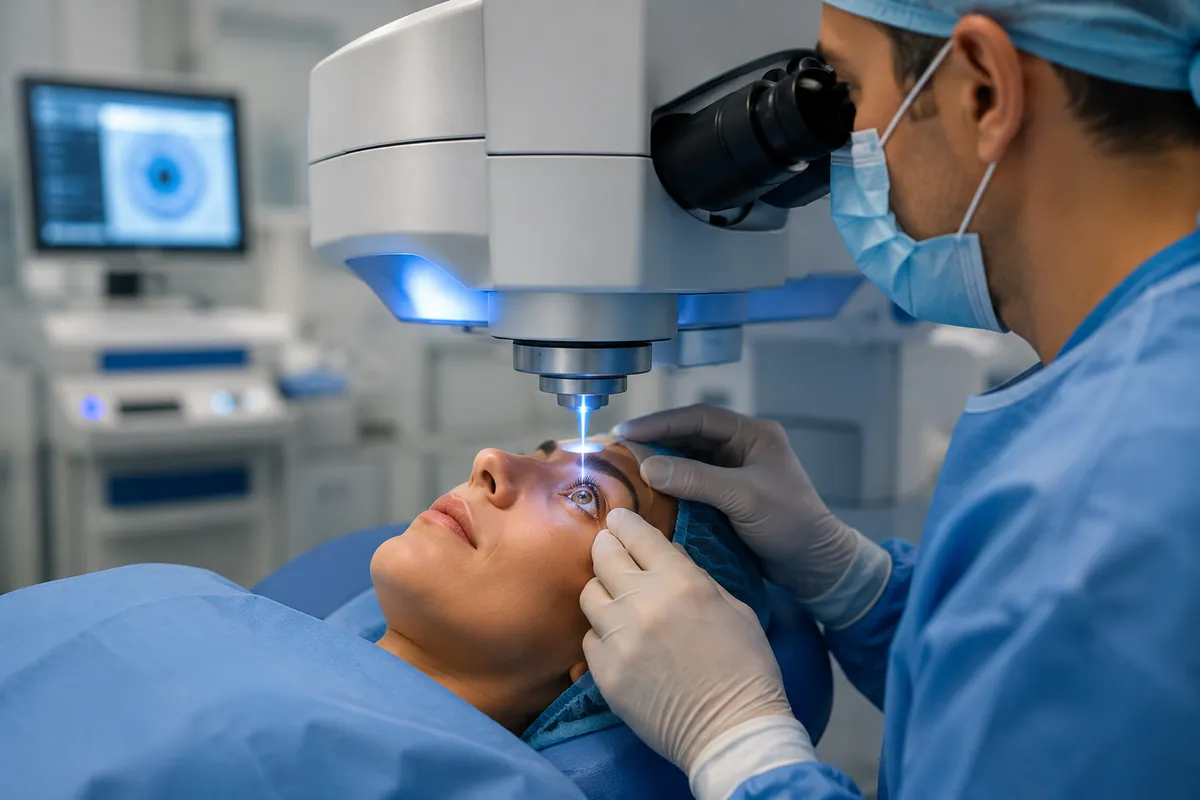
What Is an ICL and How Does It Work?
An ICL, short for Implantable Collamer Lens, is a soft, ultra-thin lens that an ophthalmologist places inside the eye to correct refractive errors such as myopia (nearsightedness) and, in some designs, astigmatism. Rather than reshaping the surface of the eye the way laser procedures do, the ICL works much like a permanent contact lens, except that it sits inside the eye rather than on its surface.
The lens is made of Collamer, a flexible material that contains a small amount of collagen and is highly biocompatible, meaning the body tolerates it well. During the procedure the surgeon positions the lens behind the colored iris and in front of your eye's own natural lens. There it stays, quietly bending light to bring images into sharp focus on the retina. It is not visible to others and you cannot feel it once it is in place.
Crucially, the ICL adds correction without removing any tissue from the cornea. Your natural lens remains untouched and continues to do its job. This is one of the features that makes the ICL fundamentally different from LASIK, and it opens the door to clear vision for people who were previously told they were not candidates for laser surgery. If you are weighing your options, our overview of eye surgery in Colombia explains the wider range of vision procedures available.
Who Is an Ideal Candidate?
The ICL is often described as the solution for patients that LASIK cannot serve, and that is a fair summary. The most common reason people turn to an ICL is high myopia. Laser procedures correct nearsightedness by removing corneal tissue, and the stronger the prescription, the more tissue must be removed. For very high prescriptions there may simply not be enough cornea to treat safely, whereas the ICL can correct a much wider range of myopia because it does not depend on corneal thickness at all.
Thin corneas are another classic reason. Some people have perfectly healthy eyes that are simply too thin for safe laser reshaping. Because the ICL leaves the cornea intact, corneal thickness is not a barrier. Patients with chronic dry eyes also frequently do better with an ICL: LASIK can temporarily worsen dryness by affecting the corneal nerves, while the ICL does not disturb the corneal surface in the same way.
Good candidates are generally adults whose prescription has been stable for about a year, who have healthy eyes free of conditions such as glaucoma or significant cataract, and who have enough internal space in the eye to accommodate the lens, something the surgeon confirms with precise measurements. A thorough evaluation is the only way to know for certain, and that assessment is the foundation of a safe result.
ICL vs. LASIK: A Clear Comparison
Both procedures aim for the same goal, freedom from glasses and contacts, but they take very different paths. LASIK reshapes the cornea with a laser to change how light enters the eye. The ICL leaves the cornea alone and instead inserts a corrective lens inside the eye. Neither is universally better; the right choice depends on your eyes.
The single biggest practical difference is reversibility. LASIK permanently removes corneal tissue and cannot be undone. The ICL, by contrast, can be removed or replaced by a surgeon if your vision needs change or if a different correction becomes appropriate later in life. Many patients find this flexibility reassuring.
Each approach has trade-offs. LASIK is typically faster to perform, slightly less expensive, and has a very long track record for low and moderate prescriptions. The ICL handles higher prescriptions and thin or dry eyes better, preserves the cornea, and many patients report excellent night vision and image quality. On the other side, because the ICL involves entering the eye, it carries the small risks common to any intraocular procedure, and it costs more than LASIK. The table below summarizes the key contrasts.
| Feature | LASIK | ICL |
|---|---|---|
| Method | Reshapes the cornea with a laser | Implants a lens inside the eye |
| Corneal tissue | Tissue is removed | No tissue removed |
| Reversibility | Permanent, not reversible | Removable and reversible |
| Best for | Low to moderate myopia, healthy thick corneas | High myopia, thin corneas, dry eyes |
| Dry eye impact | Can temporarily worsen dryness | Less effect on the corneal surface |
| Relative cost | Lower | Higher |
If you would like a deeper look at the laser side of this comparison, our guide to LASIK vs PRK vs SMILE breaks down the three main laser techniques in detail.
The Procedure and Your Recovery
ICL implantation is a quick outpatient procedure, which surprises many patients who expect something more involved. You are awake but relaxed, and your eye is numbed with drops so you feel no pain. The surgeon makes a tiny opening at the edge of the cornea, gently inserts the folded lens through it, and positions it behind the iris. The opening is so small that it usually seals on its own without stitches. Treating one eye typically takes only about fifteen to thirty minutes.
Recovery is remarkably fast. After a short rest you will go back to your accommodation the same day, ideally with someone to accompany you. Many patients notice their vision becoming clearer within hours, and most see a dramatic improvement by the next morning. You will use prescribed eye drops for a few weeks to prevent infection and control inflammation, and you should avoid rubbing your eyes, swimming and heavy exercise for a short period as advised by your surgeon.
Follow-up matters. Your ophthalmologist will check the eye the day after surgery to confirm the lens is well positioned and the eye pressure is normal, and again before you travel home. These early checks are an important part of a safe outcome, which is why a brief planned stay in Medellín is recommended rather than flying out immediately. Most people return to desk work and normal daily activities within a couple of days.
Candidacy, Evaluation and Cost in Colombia
Everything begins with a comprehensive eye evaluation. The surgeon measures your prescription, maps the cornea, checks the health of the retina and optic nerve, and most importantly measures the internal dimensions of your eye to select the correct lens size and confirm there is adequate space for it. This careful workup is what allows the ICL to deliver such reliable results, and it is never skipped by a responsible surgeon.
On cost, it is honest to say the ICL is more expensive than LASIK. The lens itself is a precision medical device manufactured to your eye's exact measurements, and that is reflected in the price. Even so, having the procedure in Colombia costs a fraction of what U.S. patients commonly pay, with savings that frequently make the difference between postponing the surgery and finally moving forward. For context on the laser side, see our article on LASIK cost in Colombia.
Because the ICL requires a custom lens, the timeline is worth understanding: after your evaluation confirms candidacy and your measurements are taken, the appropriate lens is ordered, and surgery is scheduled once it is ready. HealthBridge coordinates this sequence for you and helps you obtain a clear, itemized quote so you know exactly what is included, from the evaluation and the lens to the surgery and your follow-up visits. We are a facilitator, not a clinic, and our coordinator, Dra. Olga Gonzalez, walks you through the plan in plain language. You can learn more about how we work on the HealthBridge home page.
Safety, Your Stay and Why Medellín
Any procedure that enters the eye deserves respect, and a frank conversation about safety is part of good care. The ICL has been implanted in eyes around the world for many years and is considered a well-established, predictable procedure when performed by an experienced surgeon. The lens is designed to remain in place indefinitely, yet it can be removed if ever needed, which gives the approach a reassuring margin of flexibility. As with any intraocular surgery, there are small risks, and your surgeon will discuss them honestly along with the precise measurements and checks used to minimize them.
The single most important safety factor is the surgeon's training and the quality of the evaluation. This is exactly where a facilitator adds value. HealthBridge connects you only with board-certified ophthalmologists working in accredited facilities, and we verify credentials so you do not have to navigate that alone. We coordinate your consultation, the lens order, logistics and aftercare, leaving you free to focus on your eyes.
Plan for a short stay of roughly three to five days. That window comfortably covers your evaluation, the procedure itself and the essential next-day and pre-departure checks. Medellín makes that stay easy: a mild spring-like climate year round, comfortable recovery accommodations, a time zone close to the United States, and an airport with direct flights from several U.S. cities. Many patients also value the bilingual support and the calm, private setting in which they can rest.
For the right candidate, the ICL offers a path to clear vision that LASIK cannot always provide, with the rare advantage of being reversible. The goal of responsible eye surgery is not to chase the trendiest option but to match the right procedure to your individual eyes, and choosing a qualified team is the most important step toward that result.
Considering eye surgery in Colombia?
See the procedure, pricing and the process for international patients on our Eye Surgery (LASIK & Cataract).
Procedure guides: LASIK in Colombia · Cataract Surgery in Colombia
«LASIK greatly reduces dependence on glasses, but it does not guarantee perfect vision nor remove the presbyopia that will come with age. I say this before surgery, because afterwards it is no longer information: it is disappointment.»

Dra. Olga González, Medical Director, HealthBridge Medical Tourism, Aesthetic Medicine Physician · Longevity & Regenerative Medicine · Health Coach in Nutrition