
Eye Surgery
Presbyopia Correction: Options Beyond Reading Glasses
In Medellín from $1,200 USD · 3–5 day stay Get a free quote →
What Is Presbyopia and Why Does It Happen?
Presbyopia is the gradual, age-related loss of the eye's ability to focus on near objects. It is not a disease and it is not a sign that anything has gone wrong; it is a normal part of aging that eventually affects almost everyone, usually becoming noticeable somewhere in the mid-40s. The first clues are familiar: small print looks blurry in dim light, you find yourself holding your phone or a menu at arm's length, and your eyes tire quickly when you read.
The cause lies inside the eye. To focus on something close, the lens behind your pupil must change shape and become more curved, a process called accommodation. Over the decades the lens slowly stiffens and the tiny muscle that bends it loses some of its flexibility, so the eye can no longer shift focus from far to near as easily as it once did. This is different from nearsightedness or farsightedness, which are about the overall shape of the eye, although presbyopia can occur alongside those conditions.
Because the change is mechanical and progressive, no exercise, diet or eye drop reverses it. Reading glasses are the simplest answer and work well for many people, but they are not the only path. A range of modern options can reduce or even eliminate your reliance on them, and the best starting point is understanding what each one does. If you are exploring treatment abroad, our overview of eye surgery in Colombia explains the wider range of vision procedures available.
Contact Lens Options: Multifocal and EDOF
For many people the first step beyond reading glasses is a contact lens designed for presbyopia, and these have improved considerably. The most common type is the multifocal contact lens, which carries different focusing powers in concentric zones across the lens, much like a multifocal eyeglass. Your brain learns to select the zone it needs, allowing reasonable vision at distance, intermediate and near without switching glasses.
A newer category is the extended depth of focus, or EDOF, lens. Instead of separate rings for near and far, an EDOF design stretches a single elongated focal range so vision transitions more smoothly across distances. Many wearers find EDOF lenses give crisper intermediate vision, useful for a computer screen or a car dashboard, with fewer of the visual rings or halos that some multifocal designs produce.
Contacts are appealing because they are non-surgical, reversible and let you try presbyopia correction before committing to anything permanent. The trade-offs are the usual ones: daily handling and cleaning, the cost of ongoing supplies, and the fact that not every eye tolerates a multifocal design comfortably. Some people accept a small compromise in sharpness in exchange for freedom from glasses, while others prefer crisper vision and decide contacts are not for them. A careful fitting and a trial period reveal which group you fall into.
Monovision LASIK and PRK
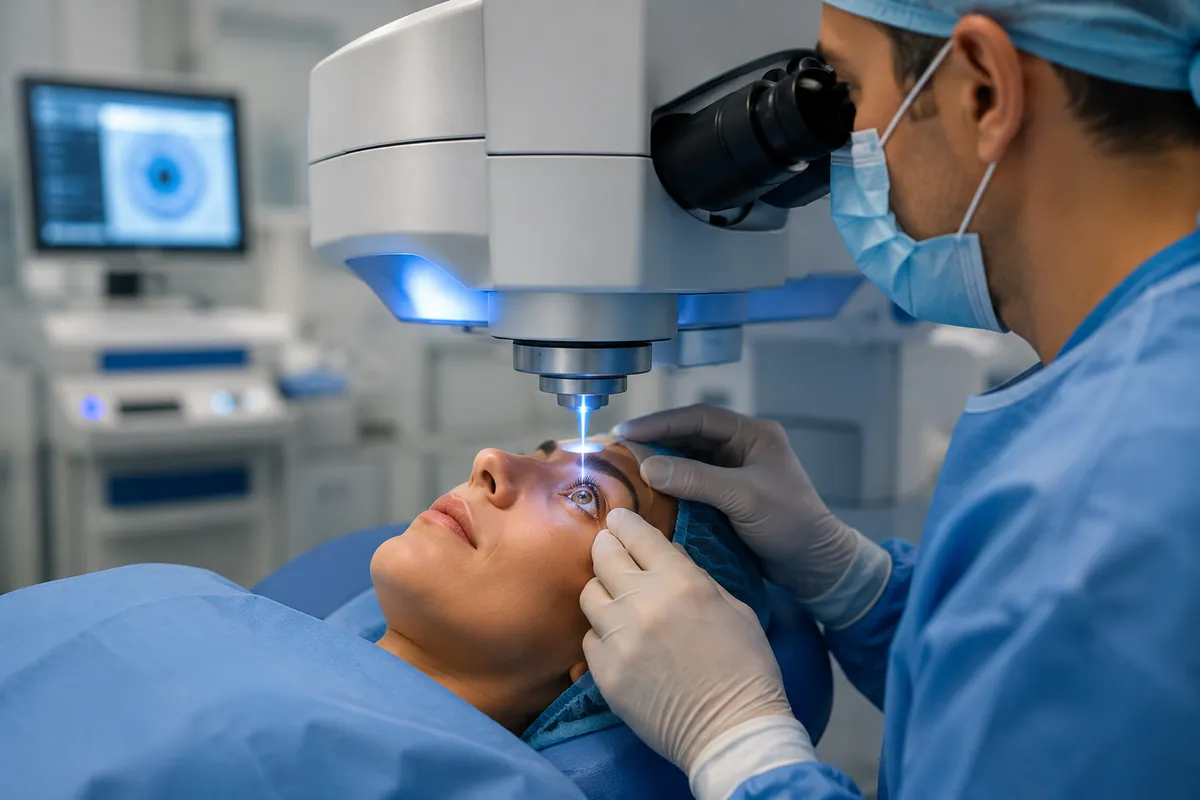
Laser vision correction can also address presbyopia through an approach called monovision. Rather than correcting both eyes for distance, the surgeon sets your dominant eye for clear far vision and your non-dominant eye for near vision. Your brain blends the two images and learns to use whichever eye suits the task, so you read with one eye and see across the room with the other, often without glasses.
This can be done with LASIK or PRK, the same laser techniques used to correct nearsightedness and astigmatism. The advantage is that it is a familiar, well-established procedure with a quick recovery for LASIK, and it leaves the eye's natural lens in place. For people already considering laser vision correction, building in monovision can be an elegant way to handle reading vision at the same time.
Monovision is not for everyone. Because each eye is focused at a different distance, some patients notice a slight reduction in depth perception or find night driving less crisp, and a minority simply cannot adapt to the difference between their eyes. For this reason a good surgeon will often simulate monovision with contact lenses first, letting you live with it for a week or two before any laser is involved. It also does not stop the underlying aging of the lens, so reading needs may continue to shift over the years.
Corneal Inlays and Other Approaches
You may come across corneal inlays in your research, so they are worth a brief mention. An inlay is a tiny device implanted within the cornea of the non-dominant eye to increase depth of focus or create a pinhole effect that sharpens near vision. The appeal is that the procedure is minimally invasive and, in principle, removable.
In practice, corneal inlays have played a smaller role than originally hoped. Some early designs were withdrawn from certain markets, and availability varies considerably by country and clinic. They suit a narrow group of patients and are not a mainstream solution, so most surgeons today reach first for contact lenses, monovision laser or lens-based options. If an inlay is ever proposed to you, it deserves a careful, candid conversation about current evidence and alternatives.
The broader point is that presbyopia correction is a field with several tools, and reputable surgeons match the tool to the patient rather than promoting one fix for everybody. That is exactly why an honest, unhurried evaluation matters more than any single brand or technique you might read about online.
Refractive Lens Exchange and Premium IOLs
The most definitive option for presbyopia is refractive lens exchange, or RLE. The procedure is essentially the same as modern cataract surgery: the eye's natural lens is gently removed and replaced with an artificial intraocular lens (IOL). The difference is the motivation. In cataract surgery the lens is cloudy; in RLE the lens is still clear but is replaced specifically to correct presbyopia and other refractive errors.
What makes RLE powerful for presbyopia is the choice of lens. Premium IOLs come in several designs: multifocal lenses that provide distinct near and far focal points, EDOF lenses that give a continuous range with smoother intermediate vision, and trifocal lenses that add a dedicated middle distance for comfortable computer and arm's-length tasks. Because the natural lens is gone, RLE also means you will never develop a cataract in that eye later. We explain the lens types in detail in our guide to premium IOL options.
RLE makes the most sense for people in their late 40s, 50s and beyond, particularly when an early cataract is already starting to form. In that situation one procedure solves both problems at once, which many patients find compelling. As an intraocular surgery it carries more weight than a laser treatment on the surface of the eye, so candidacy, the health of the retina and realistic goals all need careful discussion. The reward, for the right person, is freedom from both reading glasses and the future certainty of cataract surgery.
Choosing Your Option, Cost and Your Stay in Medellín
There is no universally best treatment for presbyopia; there is only the best treatment for your eyes and your life. Someone who spends all day at a computer values intermediate vision and may lean toward an EDOF or trifocal solution, while a frequent night driver might prioritize the cleanest possible distance vision and approach multifocal designs cautiously. Your age, the health of your eyes, whether a cataract is forming, your tolerance for adaptation and your budget all feed into the decision. This is why a thorough exam with a board-certified ophthalmologist comes before any recommendation.
Cost is a major reason international patients consider Colombia. Procedures here are commonly priced well below what comparable treatment costs in the United States, and the difference reflects lower operating and living costs rather than lower standards. Because the exact figure depends on the technique and the lenses chosen, HealthBridge helps you obtain a clear, itemized quote so you can compare honestly. Many patients find that even with travel and accommodation included, the total remains substantially less than treatment at home.
The stay itself is short. Laser procedures and lens-based surgery are typically done on an outpatient basis, often one eye at a time over a few days, with follow-up checks before you fly home; most patients plan a stay of several days to about two weeks depending on the procedure and whether both eyes are treated. HealthBridge is a facilitator, not a clinic: we connect you only with board-certified ophthalmologists in accredited facilities, and our medical director and coordinator, Dra. Olga Gonzalez, guides you in plain language through every step. You can learn more about how we work on the HealthBridge home page.
Finally, expectations deserve honesty. The goal of presbyopia correction is to reduce your dependence on glasses, not always to eliminate it in every situation. Many patients still keep a light pair for tiny print or dim restaurants, and multifocal solutions can produce halos or glare around lights at night that usually settle as the brain adapts over weeks. For the right candidate with realistic goals, modern presbyopia correction can be genuinely life-changing, and the most important step is choosing an experienced team that tells you the truth.
Considering eye surgery in Colombia?
See the procedure, pricing and the process for international patients on our Eye Surgery (LASIK & Cataract).
Procedure guides: LASIK in Colombia · Cataract Surgery in Colombia
«Not everyone is a LASIK candidate, and that is established with corneal topography and measurements, not with a promotion. A patient the ophthalmologist rules out still has other options, just not that one.»

Dra. Olga González, Medical Director, HealthBridge Medical Tourism, Aesthetic Medicine Physician · Longevity & Regenerative Medicine · Health Coach in Nutrition