
Laser vision correction · Medellín, Colombia
LASIK Eye Surgery in Colombia
Laser vision correction in Medellín performed by board-certified ophthalmologists — LASIK and femto-LASIK from about $1,200 USD for both eyes, versus roughly $4,400 in the U.S., with a short 3-5 day trip. Coordinated end to end by our medical director, Dra. Olga González. Honest about who qualifies — and who doesn't.
- Board-certified ophthalmologists
- From ~$1,200 USD (both eyes)
- 3-5 day trip
- English & Spanish
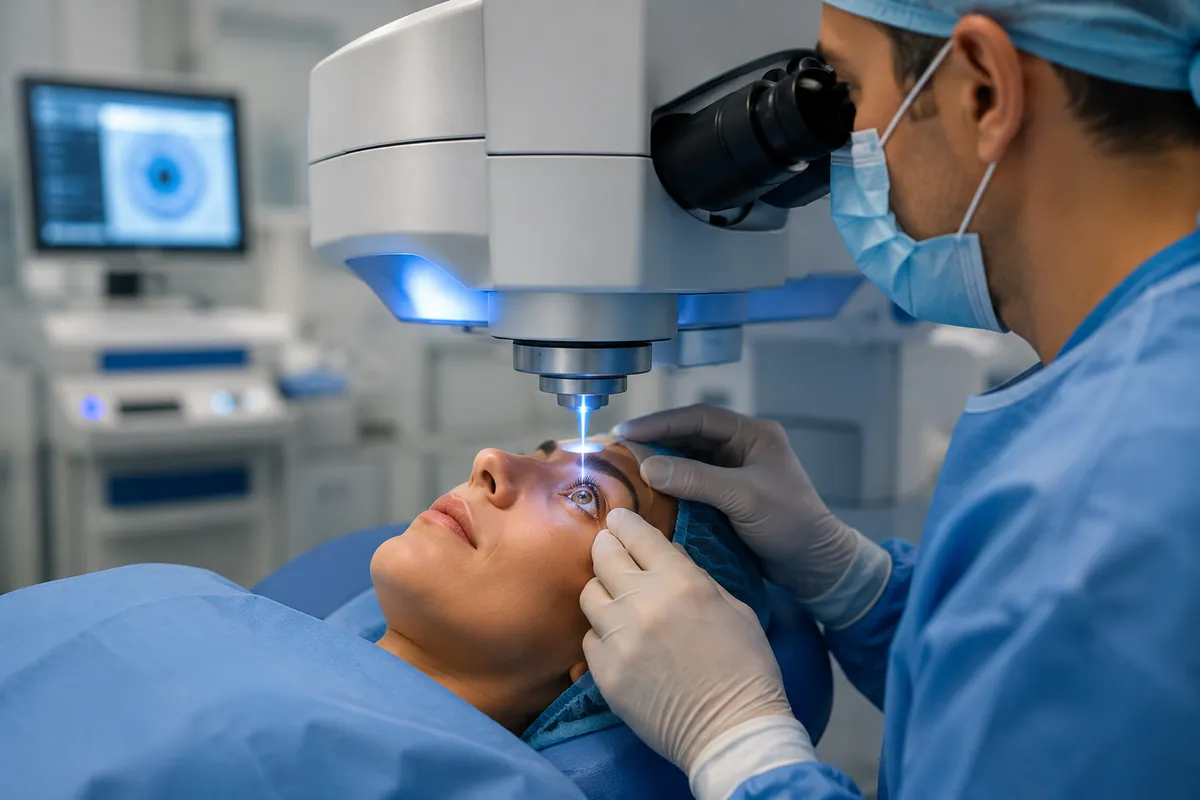
LASIK in Colombia is laser vision correction that reshapes the cornea to treat myopia, hyperopia and astigmatism, reducing or ending reliance on glasses and contacts. In Medellín, both eyes typically start near $1,200 USD, versus about $4,400 in the United States, on a short 3-5 day trip. Surgery is performed by board-certified ophthalmologists and coordinated by medical director Dra. Olga González. It begins with a full eye exam — because not everyone is a candidate, and honest clinics say so.
In Colombia
$1,200
USD from
In the U.S.
$4,400
USD average
Your saving
73%
less
What LASIK actually is — and how it corrects your vision
LASIK — Laser-Assisted In Situ Keratomileusis — is the most widely performed form of laser eye surgery in the world. Its goal is simple to state and precise to execute: gently reshape the front surface of your eye, the cornea, so that light focuses correctly on the retina and your vision becomes sharp without glasses or contact lenses. It corrects the three most common refractive errors — myopia (nearsightedness, where distance is blurry), hyperopia (farsightedness) and astigmatism (an irregular corneal curve that blurs vision at all distances).
The mechanism is worth understanding, because it demystifies the whole procedure. In a normally sighted eye, the cornea and lens bend incoming light to a single focal point on the retina. When the cornea is too steep, too flat or unevenly shaped, that focal point lands in front of or behind the retina, and the image blurs. LASIK uses a cold, computer-guided excimer laser to remove microscopic amounts of corneal tissue — a matter of micrometers — reshaping the curvature to the exact prescription measured in your eye exam. It does not "burn," and it does not touch the internal parts of the eye.
The procedure has two steps. First, the surgeon creates a thin, hinged flap in the outer cornea — either with a precision instrument called a microkeratome or, in femto-LASIK, with a bladeless femtosecond laser. The flap is folded back, the excimer laser reshapes the tissue underneath in seconds, and the flap is laid back into place, where it adheres and heals without stitches. That flap is the defining feature of LASIK, and it is also why recovery is so fast: the surface of the eye is largely preserved.
- It's outpatient. You walk in and walk out the same day; the laser time per eye is measured in seconds.
- It's cornea-only. LASIK reshapes the surface optics of the eye — it does not treat cataracts, glaucoma or retinal disease.
- It's not for everyone. Candidacy depends on corneal thickness, prescription stability and eye health — more on that below.
One honest caveat belongs here at the start: LASIK corrects the refractive error you have today, but it does not stop the eye from aging. Most people over roughly 40 still develop presbyopia — the age-related need for reading glasses — regardless of LASIK, because that is a lens problem, not a corneal one. A good surgeon will explain exactly what LASIK will and will not do for your particular eyes before anything is scheduled. If you want the plain-language primer, our guide on LASIK vs PRK vs SMILE is a useful next read.
Why patients choose Colombia — and Medellín specifically
The economics are straightforward. LASIK for both eyes commonly runs around $4,400 USD in the United States — and premium all-laser packages at big-city centers can run considerably higher. In Medellín, the same laser vision correction, performed by board-certified ophthalmologists on modern equipment, frequently starts near $1,200 USD for both eyes. Even after flights and a few nights in a comfortable hotel, most international patients still save a meaningful amount — and they get it done in a single short trip.
But price is only the entry point. The reason LASIK travels so well is that it is a fast, outpatient procedure with a genuinely quick recovery, which makes it almost ideally suited to a short medical trip. You are not recovering from major surgery in a foreign country; you are having a few-minutes-per-eye procedure and resting your eyes for a couple of days in a pleasant place. Medellín's spring-like climate, walkable El Poblado district and direct flights from the U.S. and Central America make the practical experience easy.
What sets HealthBridge apart is the model. We are a medical-tourism facilitator, not a clinic — which means our job is to match you with the right board-certified ophthalmologist and to manage every logistical detail so you don't have to. Your care is delivered by experienced eye surgeons; your experience is coordinated end to end by our medical director, Dra. Olga González, who reviews your goals, arranges your evaluation, and stays reachable in English or Spanish from your first message to your post-op follow-up.
- Board-certified surgeons — laser vision correction performed by qualified ophthalmologists, not technicians.
- Modern lasers — the same categories of excimer and femtosecond technology used in leading centers.
- One bilingual coordinator — Dra. González's team handles evaluation, scheduling, hotel and transfers.
- Transparent USD pricing — an itemized quote before you commit, with no surprise add-ons.
For a procedure this quick and this well-established, the combination of real savings, modern technology and a single point of accountable, bilingual support is difficult to match at home. You can see how LASIK fits alongside our other treatments on the eye surgery in Colombia hub, or start from the HealthBridge home page.
Why HealthBridge for LASIK
What makes our LASIK program different
A facilitator with a medical conscience: board-certified surgeons, modern lasers, transparent pricing, and honest candidacy — all coordinated in your language by Dra. Olga González.
Board-certified ophthalmologists
Your surgery is performed by qualified eye surgeons who focus on laser vision correction — not technicians or generalists. The exam, the laser and your follow-up are all in specialist hands.
Both eyes from ~$1,200 USD
LASIK for both eyes starts near $1,200 USD versus about $4,400 in the U.S. Even after flights and hotel, most patients save meaningfully — in a single short trip.
Modern excimer & femto lasers
Current-generation, computer-guided lasers with eye-tracking, including femto-LASIK for bladeless flap creation — the same categories used at leading centers.
Honest candidacy screening
A full pre-operative evaluation decides everything. If LASIK isn't right for your eyes, you're told plainly and pointed to better-suited options — never sold the procedure anyway.
One bilingual coordinator
Dra. González's team manages your evaluation, scheduling, hotel and transfers, in English or Spanish, from first message to post-op review.
A 3-5 day trip
LASIK is a few-minutes-per-eye outpatient procedure with fast recovery, so surgery plus at least one post-op check fit comfortably into a short, restful stay in Medellín.
Are you a candidate? The pre-operative evaluation, honestly
This is the most important section on the page, and the one bad clinics rush through. Not everyone is a candidate for LASIK — and the surgeons we work with will tell you plainly if you are not, even though it means you won't book the procedure. That honesty is not a weakness; it is the single most important safety feature in refractive surgery, because a poorly-selected LASIK patient is where complications come from.
Candidacy is determined by a comprehensive pre-operative eye evaluation, not by a price quote. That exam measures several things that decide whether LASIK is safe and sensible for you:
- Corneal thickness and shape. LASIK removes corneal tissue, so you need enough of it to start with. Corneal topography maps the surface to rule out thinning or irregular curvature (such as keratoconus), which would make LASIK unsafe.
- A stable prescription. Your refraction should have been steady for roughly a year. Correcting an eye that is still changing can leave you under- or over-corrected before long.
- Dry-eye status. LASIK can temporarily worsen dryness, so significant pre-existing dry eye is screened for and addressed first — sometimes changing the recommendation.
- Prescription range. Very high degrees of myopia, hyperopia or astigmatism may exceed what LASIK can safely correct, pointing toward an alternative.
- Age and eye health. Generally 18+ with a mature prescription, no active eye disease, and specific caution around pregnancy, certain autoimmune conditions and uncontrolled diabetes.
Because so much rides on that evaluation, HealthBridge coordinates it carefully. Where possible, Dra. González's team will review your recent prescription and eye records before you travel, so you arrive with realistic expectations — and the definitive on-site exam by the ophthalmologist confirms the plan before any laser is used. If the exam shows LASIK isn't right for you, you are told, and better-suited options are discussed rather than pushed.
The honest bottom line: a large share of people who want LASIK are excellent candidates and do beautifully. A minority are not, and for them the responsible answer is PRK, SMILE, ICL, or simply "wait" — never LASIK anyway. We would rather you fly home with the right recommendation than the one that was easiest to sell. Our guide to LASIK vs PRK vs SMILE explains where each alternative fits.
The procedure and same-week recovery — why the short trip works
LASIK is remarkable for how quick it is. On surgery day, numbing eye drops are applied — no needles, no general anesthesia — and you remain awake and comfortable throughout. A device gently holds the eyelids open so you don't have to worry about blinking. The surgeon creates the corneal flap, the excimer laser reshapes the cornea while you focus on a target light, and the flap is repositioned. Laser time is typically well under a minute per eye, and the whole visit usually lasts under an hour, both eyes included.
Recovery is what makes LASIK so well-suited to a 3-5 day trip. Many patients notice clearer vision within hours, and functional vision often returns by the next morning. There is usually some initial haze, light sensitivity, watering or a gritty, foreign-body sensation for the first day — normal and expected as the eye settles. You'll rest, use lubricating and medicated drops on schedule, avoid rubbing your eyes, and wear protective shields at night.
Here is how a typical eye-surgery trip is structured:
- Day 1 — arrival & evaluation. The on-site pre-operative exam confirms candidacy and finalizes the surgical plan with your ophthalmologist.
- Day 2 — surgery. The procedure itself, then rest for the remainder of the day with your eyes closed as much as possible.
- Day 3 — first post-op check. The surgeon confirms the flap is well positioned and vision is improving as expected.
- Days 4-5 — buffer & departure. A margin for a second review if advised, and comfortable travel home once cleared.
Vision continues to sharpen and stabilize over the following weeks. Most people return to desk work within a couple of days and to exercise, driving and screens on the surgeon's timeline. You'll leave with clear written aftercare instructions — drop schedule, activity restrictions, warning signs to watch for — that you and your home eye doctor can follow, and HealthBridge stays reachable after you return. For a detailed timeline, see LASIK recovery: what to expect.
Laser & lens options
LASIK and its alternatives
- LASIK
- The standard flap-based procedure for myopia, hyperopia and astigmatism, with famously fast recovery. Best for suitable corneas and stable prescriptions. See our LASIK cost guide for details.
- Femto-LASIK (bladeless)
- All-laser LASIK where the corneal flap is created with a femtosecond laser instead of a blade, allowing highly precise flap geometry — often preferred for thinner corneas.
- PRK
- A flapless surface procedure, often the better choice for thinner corneas or certain active lifestyles. Slower recovery than LASIK but excellent final results. More in LASIK vs PRK vs SMILE.
- SMILE
- A newer, flapless, small-incision laser option for suitable myopia and astigmatism. Your surgeon will confirm whether your eyes qualify during the evaluation.
Realistic expectations, results and alternatives
LASIK has an excellent track record, and for well-selected candidates the results are genuinely life-changing — the overwhelming majority achieve driving-standard vision or better and reduce or eliminate their dependence on glasses and contacts. But responsible expectation-setting still matters, and we would rather tell you the honest picture than the brochure one.
A few things every prospective patient should understand:
- "20/20" is likely, not guaranteed. Most patients reach excellent uncorrected vision; a small number need a fine-tuning enhancement, and a few still use light glasses for specific tasks like night driving.
- Presbyopia still comes. LASIK doesn't prevent the age-related need for reading glasses after roughly 40 — that's a separate, lens-based change. Monovision LASIK is one option your surgeon may discuss.
- Temporary dryness and night glare are common. Dry eye, halos or starbursts around lights can occur early on and usually improve over weeks to months; a small minority notice lingering effects.
- Serious complications are uncommon when candidacy is done properly — which is exactly why the evaluation is non-negotiable.
When LASIK isn't the right fit, that is not the end of the conversation — it's the start of a better one. PRK (surface ablation, no flap) is often the answer for thinner corneas or certain lifestyles, with a slower recovery but excellent final results. SMILE is a newer, flapless, small-incision laser option for suitable myopia and astigmatism. ICL (an implantable collamer lens) suits very high prescriptions or corneas too thin for laser reshaping, without removing corneal tissue at all. The right choice is a medical decision made with your surgeon.
This is where a facilitator that says "no" earns its keep. HealthBridge and the ophthalmologists we work with will steer you to the procedure that fits your eyes — even when that means recommending against the LASIK you asked for. Our comparison of LASIK vs PRK vs SMILE lays out the trade-offs so you arrive informed.
Safety, technology and choosing a surgeon well
LASIK is one of the most studied elective procedures in modern medicine, and when it is performed on a properly selected eye by a qualified surgeon on well-maintained equipment, it is considered very safe. The variables that actually determine safety are candidate selection, surgeon experience and technology — not the country on the map. That is precisely what HealthBridge is built to get right.
On who performs it: your surgery is carried out by board-certified ophthalmologists — physicians who specialize in the eye — not by technicians or generalists. LASIK is their focused work, and the pre-operative exam, the laser, and your follow-up are all in specialist hands.
On technology: modern LASIK relies on computer-guided excimer lasers with eye-tracking that follows tiny eye movements, and femto-LASIK adds a femtosecond laser for bladeless flap creation. The clinics we work with use current-generation equipment in these same categories — the technology gap that patients sometimes worry about is far smaller than the price gap.
On risk, we are direct. Like any procedure, LASIK carries risks — dry eye, glare or halos (usually temporary), under- or over-correction that may need enhancement, flap-related issues, and, rarely, more serious complications. These are uncommon with careful patient selection, and your surgeon will discuss them with you as part of genuine informed consent, in plain English or Spanish, before you decide anything.
Finally, some sensible questions to ask any refractive clinic — and that we welcome you asking us: Who is the surgeon, and are they a board-certified ophthalmologist? What does the full pre-op evaluation include, and who reads it? Which laser is used, and is femto-LASIK available? What is the enhancement policy if fine-tuning is needed? And crucially — what happens if the exam shows I'm not a candidate? A clinic that answers that last one honestly is a clinic worth trusting. HealthBridge and Dra. González will answer every one of them plainly.
Pricing
How much it costs in Colombia
| Option | In Colombia | In the U.S. |
|---|---|---|
| LASIK — both eyes | from ~$1,200 USD | ~$4,400 USD |
| Femto-LASIK (all-laser) — both eyes | individualized quote | $4,000-$6,000+ USD |
| PRK — both eyes | individualized quote | $4,000-$5,000+ USD |
| SMILE — both eyes | individualized quote | $4,000-$6,000+ USD |
| Pre-operative eye evaluation | included in program | $100-$300+ USD |
Reference 'from' prices in USD, subject to medical assessment.
Full breakdown, by area and by technique, in our guide to LASIK cost in Colombia.
At a glance
LASIK: Colombia vs the United States
| Colombia (HealthBridge) | United States | |
|---|---|---|
| LASIK, both eyes (from) | ~$1,200 USD | ~$4,400 USD |
| Performed by | Board-certified ophthalmologists | Board-certified ophthalmologists |
| Technology | Modern excimer & femto lasers | Comparable, at premium pricing |
| Pre-op evaluation | Included; coordinated by Dra. González | Included; separate consult fees common |
| Trip / wait | 3-5 day trip, quick scheduling | Local, but higher out-of-pocket cost |
| Recovery setting | Spring-like Medellín, concierge support | At home |
What it costs, what's included, and how to plan your trip
Pricing depends on the technology used (standard versus all-laser femto-LASIK), your prescription and the specifics of your eyes, but as a clear reference point LASIK at HealthBridge starts near $1,200 USD for both eyes. The comparable U.S. figure is around $4,400 USD for both eyes, and premium packages there run higher — so even with travel factored in, the savings are real and the whole thing is done in one short trip. Your quote is itemized and in USD, so you know exactly what you are paying for.
A typical LASIK program includes the pre-operative evaluation, the surgery itself, the surgeon's fee and use of the laser facility, and at least one post-operative review before you fly home, plus written aftercare guidance. We are equally clear about what is not included — flights, hotel and optional upgrades — so there are no surprises. Because the plan follows your eye exam, the final figure is confirmed after evaluation rather than sold sight-unseen.
Planning is simple because one team handles the details:
- Free assessment. Share your goals and your most recent eye prescription or records by WhatsApp; Dra. González's team responds with honest guidance and an all-inclusive quote in USD.
- Schedule & travel. Medellín's MDE airport receives direct flights from Miami, Fort Lauderdale, New York, Houston and Panama City — typically a 3-5 hour hop. We help arrange a hotel in El Poblado and airport transfers.
- Evaluation & surgery. Your on-site exam confirms candidacy, then surgery and post-op review fit inside a relaxed 3-5 day stay. A companion is welcome and helpful for the day of surgery.
- Follow-up. You leave with written instructions for you and your home eye doctor, and we stay reachable afterward.
You can compare our specialties on the HealthBridge home page, explore related procedures on the eye surgery in Colombia hub, or dig into the numbers in our LASIK cost in Colombia guide before you reach out.
Meet your coordinator — Dra. Olga González
A medical trip is only as good as the person coordinating it, which is why HealthBridge is built around a single, named medical director rather than an anonymous booking desk. Dra. Olga González is our medical director and coordinator — she reviews your goals, arranges your evaluation with a board-certified ophthalmologist, and stays with you as your single point of contact from first message to post-op follow-up.
It's worth being precise about roles, because honesty is the point. Your LASIK is performed by board-certified ophthalmologists — eye surgeons who do this work every day. Dra. González's role is to make sure the right specialist, the right evaluation and the right plan come together, and that you understand every step in your own language. She treats HealthBridge as a facilitator with a medical conscience: the goal is the correct outcome for your eyes, not simply a booked procedure.
That posture matters most in the moments that don't generate a sale. If the pre-operative exam shows LASIK isn't right for you, you'll hear it clearly, along with the alternatives that are — PRK, SMILE, ICL, or waiting until your prescription stabilizes. A facilitator willing to say "not you, not yet, or not this procedure" is exactly the kind you want handling your vision.
When you travel to Medellín with HealthBridge, you correspond with one bilingual team, you're cared for by qualified eye surgeons, and you leave with written follow-up guidance you can share with your own optometrist or ophthalmologist at home. For a decision as consequential as your eyesight, that direct, accountable relationship is the whole point. To go deeper before you decide, start with our LASIK cost guide and reach out for a free, no-obligation assessment.
How it works
Your medical journey, step by step
Part of our Eye Surgery (LASIK & Cataract) program.
Free assessment & quote
Message us on WhatsApp with your case, records or photos. We review it and send a plan and quote in USD before you book a flight — at no cost.
Travel plan
We coordinate a board-certified specialist, accredited hospital, dates, accommodation and airport transfers in Medellín.
Procedure
You're treated by board-certified specialists in accredited facilities, with bilingual support at every step.
Recovery & follow-up
You recover in Medellín with included check-ups and WhatsApp follow-up once you're home.

Your trusted physician
Dra. Olga González
Medical Director
Aesthetic Medicine Physician · Longevity & Regenerative Medicine · Health Coach in Nutrition · Universidad de San Martín
Dra. Olga González is the medical director of HealthBridge Medical Tourism. A physician trained at Universidad de San Martín and certified in aesthetic medicine, she has built her practice in El Poblado, Medellín, around longevity, regenerative medicine and biohacking. She personally coordinates each international patient's care — vetting surgeons, accredited hospitals and recovery plans — so that every traveler is treated by board-certified specialists and supported in their own language from the first message to the final follow-up.
- Aesthetic Medicine
- Regenerative & Longevity Medicine
- Biohacking
- Clinical Nutrition
Frequently asked questions
How much does LASIK cost in Colombia?
Is LASIK in Colombia safe?
Am I a candidate for LASIK?
What conditions does LASIK correct?
How long is the trip for LASIK?
Does LASIK hurt?
How quickly will I see after LASIK?
What's the difference between LASIK and femto-LASIK?
What if I'm not a LASIK candidate?
What are the risks and side effects?
Will I still need glasses after LASIK?
Who performs the surgery and who coordinates my trip?
You may also consider
Other procedures in this specialty
Many patients combine procedures in a single trip. These are the ones we coordinate within the same specialty.
Sources
Where to verify this information
We're not asking you to take our word for it. These are independent medical bodies whose guidance you can read directly before making any decision.
- American Academy of Ophthalmology — eye health information
- CDC Yellow Book — Medical Tourism: risks, planning and post-travel care
- MedlinePlus (U.S. National Library of Medicine) — patient health information
HealthBridge is not affiliated with or endorsed by these organizations. They are cited as independent reference.
Other specialties
Explore more treatments in Colombia


Ready to take the first step?
Send us your case on WhatsApp and get a personalized plan and quote — free, with no obligation.
El Poblado, Medellín · Mon–Fri 8:00 AM – 6:00 PM · Sat 9:00 AM – 1:00 PM (COT)