
Eye surgery · Medellín, Colombia
Cataract Surgery in Colombia — Phacoemulsification in Medellín
Modern phacoemulsification cataract surgery in Medellín with board-certified ophthalmologists, from about $1,500 USD per eye including the lens — a quick, stitch-free outpatient procedure with a short 3–5 day trip. Monofocal and premium multifocal, EDOF and toric IOLs available. Coordinated end to end by our medical director, Dra. Olga González.
- Board-certified ophthalmologists
- From ~$1,500 USD per eye
- Stitch-free phacoemulsification
- Monofocal & premium IOLs
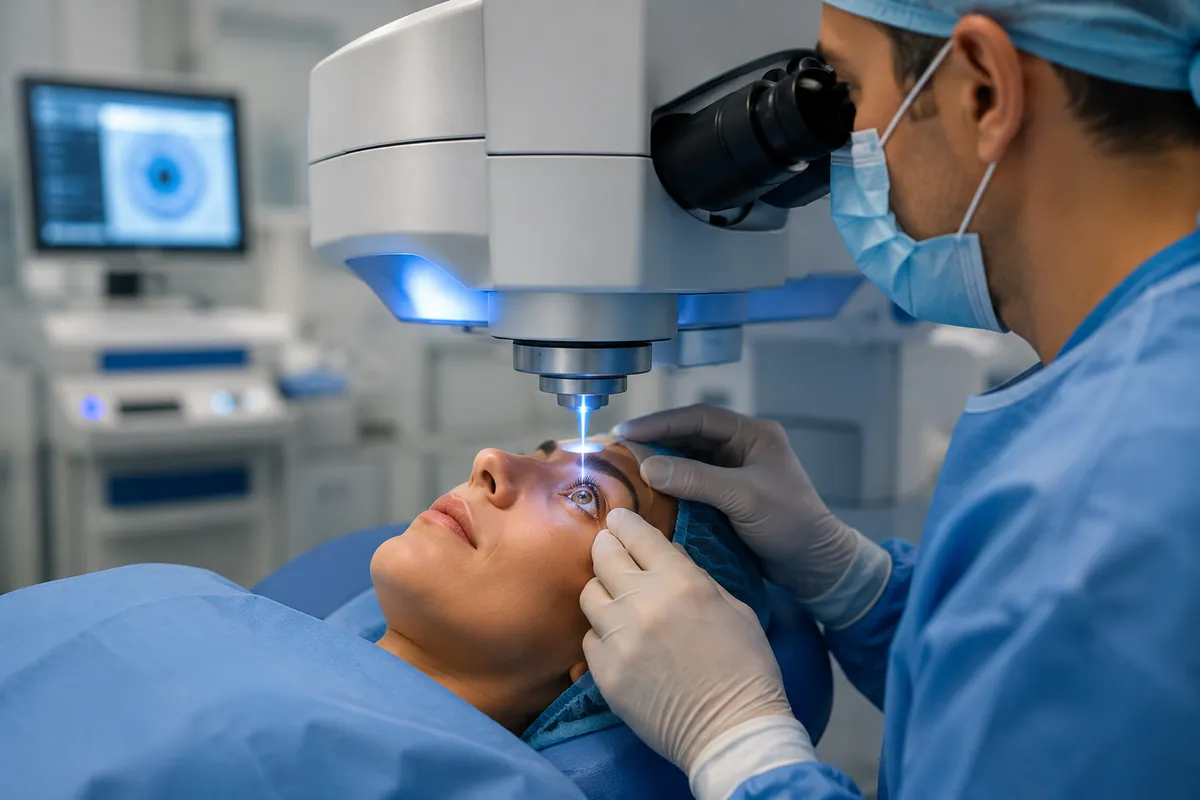
Cataract surgery in Colombia removes the eye's clouded natural lens by phacoemulsification — ultrasound breaks up the lens through a tiny, usually stitch-free incision — and replaces it with a clear intraocular lens (IOL) to restore vision. In Medellín, it starts near $1,500 USD per eye including a standard lens, versus roughly $5,000 in the U.S. It is a 15–30 minute outpatient procedure under numbing drops, performed by a board-certified ophthalmologist, with each eye usually done on a separate day. Because recovery is fast, a short 3–5 day trip is enough. Premium lenses can reduce dependence on glasses, with honest tradeoffs.
In Colombia
$1,500
USD from
In the U.S.
$5,000
USD average
Your saving
70%
less
What a cataract is — and what the surgery actually does
A cataract is a clouding of the eye's natural lens, the clear disc that sits behind the pupil and focuses light onto the retina. With age the proteins in that lens gradually clump and yellow, so vision turns hazy, colors look faded, glare and halos appear around lights, and glasses stop helping. Cataracts are the leading cause of treatable vision loss in the world, and the only effective treatment is surgery — there are no drops or exercises that reverse a cataract once it has formed.
The operation is elegantly simple in concept: the clouded natural lens is removed and replaced with a clear artificial one. A board-certified ophthalmologist performs it using phacoemulsification — the modern global standard. Through a micro-incision of just two to three millimeters at the edge of the cornea, an ultrasonic probe gently breaks the cloudy lens into tiny fragments and suctions them away, leaving the thin natural capsule in place. A folded intraocular lens (IOL) is then slipped through the same tiny opening and unfolds inside that capsule, where it stays permanently. The incision is usually self-sealing, so most patients need no stitches at all.
What surprises many patients is how quick and gentle it is. Each eye typically takes only 15 to 30 minutes, the eye is numbed with anesthetic drops rather than injections in most cases, and you are awake but relaxed with light sedation offered for comfort. It is an outpatient procedure — you walk in and go home the same day. For a fuller picture of what the eye program covers, see our eye surgery in Colombia overview.
- It replaces a clouded lens — the natural lens comes out, a clear IOL goes in permanently.
- Phacoemulsification is the standard — ultrasound and a tiny, usually stitch-free incision.
- It is quick and outpatient — about 15–30 minutes per eye, under numbing drops.
- The IOL is permanent — it does not wear out and never needs routine replacement.
Choosing your lens (IOL) — the decision that shapes your result
Removing the cataract is largely standardized; the choice that most shapes your everyday vision is which intraocular lens you receive. This is the single most important conversation to have with your ophthalmologist, and it is worth understanding the options before you travel. There is no universally "best" lens — only the best lens for your eyes, your habits and your budget.
A monofocal IOL is the standard, time-tested option included in the base price. It gives excellent, crisp vision at one fixed distance — most people choose sharp distance vision — and is superbly reliable, with the fewest visual side effects. The tradeoff is honest and simple: you will still need reading glasses for close work such as books and phones. Many patients are perfectly happy with this, especially those who don't mind readers.
Premium IOLs aim to reduce or remove that dependence on glasses. Multifocal and trifocal lenses provide focus at multiple distances (far, intermediate and near). Extended-depth-of-focus (EDOF) lenses give a continuous stretch of vision from distance through intermediate with generally fewer night-time visual disturbances than multifocals. Toric lenses correct significant astigmatism and come in monofocal or premium versions. These lenses can be genuinely life-changing for the right patient — but they cost more and carry real tradeoffs we describe frankly in the expectations section below and in our premium IOL lens options guide.
- Monofocal — one sharp focal distance, fewest side effects, reading glasses still needed. Included in the base price.
- Multifocal / trifocal — near, intermediate and far vision; greatest freedom from glasses; more risk of halos and glare.
- EDOF — a smooth range from far to intermediate; often fewer night-vision issues than multifocals; readers may still help for fine print.
- Toric — corrects astigmatism; can be combined with monofocal or premium designs.
Why choose HealthBridge
What's included and why it matters
Cataract surgery is only as good as the ophthalmologist, the measurements and the lens behind it. Here is what a HealthBridge eye-surgery program is built around — and why each part matters.
Board-certified ophthalmologists
Your procedure is performed by an experienced eye surgeon who specializes in cataract and refractive surgery — credentialed and high-volume. We match you to the right surgeon rather than the cheapest slot.
Modern phacoemulsification
Surgery uses the current global standard — ultrasound removal through a tiny, usually stitch-free incision, with precise biometry to calculate your lens power. The same platforms used in the U.S. and Europe.
Standard lens included, premium available
A quality monofocal IOL is included in the base price, with multifocal, trifocal, EDOF and toric lenses available as clearly quoted upgrades — recommended only when they genuinely suit your eyes.
Honest lens counseling
We explain the real tradeoffs — glasses independence versus possible night-time halos and adaptation — so you choose the lens that fits your eyes and life, not the one with the biggest markup.
Bilingual, end-to-end coordination
One accountable coordinator, in English or Spanish, from your first message through your follow-up — led by medical director Dra. Olga González, with airport transfers and the next-day check handled.
Honest, itemized USD pricing
You receive a clear, itemized quote in USD, with the lens, facility and follow-up spelled out and premium upgrades priced transparently — no bait pricing and no surprises after you land.
Why patients choose Colombia — and Medellín specifically
The cost difference is striking and real. Cataract surgery that commonly runs $3,500 to $5,000 or more per eye at a U.S. private practice — and considerably more with a premium lens — frequently starts near $1,500 USD per eye in Medellín, with a quality monofocal lens included. For patients paying out of pocket, needing both eyes, or wanting a premium lens their insurance won't cover, the savings are substantial even after flights and a hotel. Crucially, that gap reflects the lower cost of delivering care in Colombia, not a cheaper standard of surgery.
Colombia has a strong, established tradition in ophthalmology. Its board-certified eye surgeons are experienced and high-volume, and modern Colombian eye centers use the same phacoemulsification platforms, biometry and premium IOLs found in the U.S. and Europe. Cataract surgery is one of the most performed and most refined operations in all of medicine, and the technology and lens brands are largely international. You are not trading quality for price.
Medellín itself makes the trip easy. Its spring-like climate, the walkable and hotel-rich El Poblado district, and direct flights from Miami, Fort Lauderdale, New York, Houston and Panama City put it a short hop from the U.S. and Central America — and because eye-surgery recovery is so quick and comfortable, it suits a brief visit unusually well. What sets HealthBridge apart is that we treat this as medical care, not a shopping trip: our medical director Dra. Olga González personally coordinates your care, vets the ophthalmologist match, confirms the facility, and stays reachable in English or Spanish from your first message through your follow-up.
- Meaningful, honest savings — often from ~$1,500 per eye with a lens included.
- Board-certified ophthalmologists — experienced, high-volume cataract and refractive specialists.
- Modern technology and lenses — the same phaco platforms and international IOL brands.
- One accountable coordinator — Dra. Olga González, bilingual, end to end.
A quick procedure and a fast recovery — why a short trip works
One of the best things about cataract surgery is that recovery is genuinely fast, which is exactly why it suits medical travel so well. The procedure itself is brief and painless: your eye is numbed with drops, you are awake but relaxed, and you feel pressure and see light rather than any pain. After a short rest you go home the same day with a clear protective shield over the eye and a set of medicated drops to prevent infection and inflammation.
Vision typically starts to clear within a day or two, and many patients notice brighter, sharper images almost immediately, continuing to improve over the following week. There is no long convalescence — most people resume gentle daily activities the next day. You simply avoid rubbing the eye, heavy lifting, swimming and dusty or dirty environments for a couple of weeks, and use your drops on schedule. A next-day check-up confirms the eye is healing well before you carry on.
This fast, comfortable recovery is why a short 3–5 day trip is enough for cataract surgery, in contrast to the longer stays some other procedures require. It gives time for the pre-operative work-up and measurements, the surgery itself, and the important next-day review — with a little margin. Eyes handle air travel well once the surgeon has cleared you; there is no prolonged grounding as with some body surgeries.
When both eyes have cataracts, they are almost always treated one at a time on separate days — a standard safety practice worldwide. This lets the first eye begin healing and confirms the result before the second is done, and it is easily accommodated within a short stay. Your surgeon will advise the ideal spacing for your eyes.
Options
Intraocular lens (IOL) options
- Monofocal IOL (standard)
- Sharp, reliable vision at one fixed distance — usually set for distance — with the fewest visual side effects. Reading glasses are still needed for close work. Included in the base price and an excellent choice for many patients.
- Multifocal / trifocal IOL
- Provides focus at near, intermediate and far distances for the greatest freedom from glasses. The tradeoff, explained honestly, is a higher chance of halos or glare around lights at night and a brief adaptation period.
- EDOF (extended depth of focus) IOL
- Gives a continuous range of vision from distance through intermediate, typically with fewer night-time visual disturbances than multifocals. You may still prefer readers for very fine print. A balanced premium option.
- Toric IOL
- Corrects significant astigmatism for a sharper result, available in monofocal or premium designs. Chosen when the cornea has meaningful astigmatism that would otherwise blur vision even after a standard lens.
Am I a good candidate for cataract surgery?
The clearest sign that it is time is simple: a cataract is interfering with the things you want to do — reading, driving (especially at night), recognizing faces, working or hobbies — and stronger glasses no longer fix it. You do not have to wait until a cataract is "ripe"; modern surgery is easier and safer when done before the lens becomes very dense, so the modern approach is to operate when your vision meaningfully affects daily life.
Most people with cataracts are good candidates, because the surgery is well tolerated even at older ages and under topical anesthesia. That said, a proper pre-operative eye examination matters. The ophthalmologist checks the health of the rest of the eye — the retina, macula, optic nerve and cornea — because other conditions such as macular degeneration, advanced glaucoma or diabetic eye disease can limit how much vision surgery will restore. Being honest about this beforehand is part of setting the right expectations.
Candidacy for a premium lens is a separate, more selective question. Multifocal and EDOF lenses work best in eyes with a healthy retina and cornea and a personality suited to a brief adaptation; significant astigmatism, dry eye or certain retinal conditions may make a premium lens a poor choice, and a monofocal (or toric monofocal) is then the wiser, honest recommendation. A good surgeon will sometimes tell you that a premium lens is not right for your eyes — that is careful medicine, not a lost sale.
The honest bottom line: candidacy — both for surgery and for a specific lens — is decided by the operating ophthalmologist after a full examination and measurements, based on your eye health, your daily needs and your expectations, not on a one-size-fits-all rule.
Realistic expectations — the honest truth about premium lenses
Cataract surgery is one of the most successful operations in medicine, and the vast majority of patients see a dramatic improvement. But being honest about the nuances — especially with premium lenses — is what separates a satisfied patient from a disappointed one, and we would rather you decide fully informed.
With any lens there is a brief neuroadaptation period: the brain has to get used to seeing through a new optic, and vision can fluctuate for days to a few weeks before it settles. That is normal. The bigger, honest conversation is about multifocal and trifocal lenses specifically. In exchange for freedom from glasses, some patients notice halos, glare or starbursts around lights at night, and contrast in dim light can be slightly reduced. For most, the brain adapts and these effects fade or become easy to ignore over weeks to months — but for a minority they remain noticeable, and rarely a lens exchange is considered. This is a genuine tradeoff, not fine print.
EDOF lenses were designed to soften these night-time effects and generally cause fewer halos than full multifocals, at the cost of slightly less near vision — you may still want readers for tiny print. A monofocal lens has the fewest visual side effects of all, which is exactly why it remains an excellent, honest choice; the "price" is simply keeping reading glasses. There is no lens that gives everyone perfect vision at every distance with zero compromise, and any provider who promises that should be treated with skepticism.
It is also honest to say that even after a perfect operation, you may still want thin glasses for some tasks, that a very small number of eyes need a fine-tuning touch-up, and that months or years later some patients develop a harmless clouding of the lens capsule (a "secondary cataract") corrected in minutes with a quick, painless laser. Our cataract surgery guide walks through these realities in more depth — we would rather set expectations properly than oversell a result.
Pricing
How much it costs in Colombia
| Option | In Colombia | In the U.S. |
|---|---|---|
| Cataract surgery per eye (monofocal IOL) | from ~$1,500 USD | ~$5,000+ USD |
| Cataract surgery per eye (toric IOL) | individualized quote | $6,000–$8,000+ USD |
| Cataract surgery per eye (EDOF IOL) | individualized quote | $6,500–$9,000+ USD |
| Cataract surgery per eye (multifocal/trifocal IOL) | individualized quote | $7,000–$9,000+ USD |
| Refractive Lens Exchange per eye (premium IOL) | quoted after assessment | $4,000–$8,000+ USD |
Reference 'from' prices in USD, subject to medical assessment.
Full breakdown, by area and by technique, in our guide to cataract surgery cost in Colombia.
At a glance
Cataract surgery: Colombia vs the United States
| Colombia (HealthBridge) | United States | |
|---|---|---|
| Cataract surgery per eye (from) | ~$1,500 USD | ~$5,000+ USD |
| Premium lens upgrade | transparent add-on | $2,000–$4,000+ USD extra per eye |
| Surgeon | Board-certified ophthalmologist, high-volume | Board-certified, at premium pricing |
| Technique & lenses | Phaco + international IOL brands | Phaco + international IOL brands |
| Wait time | Days–weeks | Weeks–months |
| Recovery & trip | Spring-like Medellín, 3–5 days | At home |
Refractive Lens Exchange — for patients before a cataract forms
Not everyone who wants to reduce their dependence on glasses has a cataract yet. For patients typically over about 45 to 50 who are strongly long-sighted, short-sighted, or increasingly reliant on reading glasses, Refractive Lens Exchange (RLE) — also called clear lens extraction — offers a permanent option using the very same technique as cataract surgery. The still-clear natural lens is replaced with a premium IOL chosen to match your vision goals.
RLE appeals to people who are beyond the ideal age for LASIK, or whose prescription is too strong for laser vision correction, and who want a lasting solution to presbyopia (the age-related loss of near focus). Because it uses a multifocal, EDOF or toric lens, it can dramatically reduce the need for glasses — and, as a lasting side benefit, once your natural lens is removed you can never develop a cataract in that eye. For the right patient it solves two problems at once.
Honesty matters here even more, because RLE is elective surgery on a healthy, clear lens rather than treatment of a disease. That raises the bar: the same premium-lens tradeoffs — night-time halos, an adaptation period, and the small risks of any intraocular surgery — apply fully, and must be weighed carefully against the benefit. A responsible ophthalmologist will screen candidacy strictly and will sometimes recommend LASIK, an implantable contact lens, or simply waiting, rather than RLE. It is not the right answer for everyone, and we will tell you so.
If you are exploring your options across laser and lens-based correction, our LASIK in Colombia page and our premium IOL lens options guide are good next reads before you decide.
Planning your trip and what's included
Planning eye surgery abroad is easier than most patients expect, because the recovery is short and one team handles the logistics. It starts with a free, no-obligation assessment: you send your goals, a brief medical and eye history, and any recent prescriptions or reports by WhatsApp, and Dra. González's team reviews your case, matches you with an appropriate board-certified ophthalmologist, and returns guidance and an itemized quote in USD. Your final lens recommendation and price follow the surgeon's examination and measurements once you arrive.
A typical cataract program with HealthBridge includes the surgeon's fee, the outpatient surgical facility, the standard monofocal intraocular lens, your pre-operative biometry and eye examination, post-operative medicated drops, and the next-day follow-up check — plus airport transfers and bilingual coordination throughout. Premium lenses (multifocal, trifocal, EDOF, toric) are an add-on quoted transparently after your assessment. We are equally clear about what is not included — international flights, your hotel, and optional extras — so there are no surprises after you land.
- Free assessment. Share your history, prescriptions and goals by WhatsApp; receive honest guidance and an itemized USD quote.
- Schedule & travel. Fly into Medellín's MDE airport — direct from Miami, Fort Lauderdale, New York, Houston and Panama City. We arrange transfers and help with a nearby hotel.
- Exam, surgery & check. Plan for a short 3–5 day trip covering measurements, the outpatient procedure, and the important next-day review.
- Follow-up. You leave with drops, a clear post-op plan and guidance to share with your eye doctor at home, and we stay reachable afterward.
Throughout, our promise is straightforward: a board-certified procedure, an honest lens recommendation with its tradeoffs explained, and a named coordinator who stays with you. To go deeper before you decide, start with our eye surgery in Colombia overview and our cataract surgery guide, then reach out from our medical tourism home page for a free assessment.
Meet your coordinator — Dra. Olga González
When your eyesight is at stake, it matters that a named, accountable physician oversees your journey rather than an anonymous booking desk. Dra. Olga González is HealthBridge's medical director and the person who personally coordinates your cataract or lens surgery — reviewing your case, matching you to a suitable board-certified ophthalmologist, confirming the facility, and staying reachable in English or Spanish from your first message through your follow-up.
To be clear about roles: Dra. González does not perform your surgery. The operation is carried out by an experienced, board-certified ophthalmologist who specializes in cataract and refractive procedures. Her job as medical director is to make sure you are matched to the right surgeon, that the setting meets real standards, and that you understand honestly what surgery — and each lens option — can and cannot do before anything is scheduled.
That posture — care over sales — is the whole point of using a facilitator like HealthBridge. You are not funneled toward the most expensive lens or the cheapest clinic; you are guided by someone whose interest is a safe, well-matched outcome, and who will tell you plainly if a premium lens is not right for your eyes or if you should wait. It is the standard we hold across our eye-surgery program.
When you travel to Medellín with us, you correspond with one bilingual team, you know who your surgeon is before you fly, and you leave with follow-up guidance you can share with your eye doctor at home. To begin, reach out from our home page for a free, no-obligation assessment, and read the cataract surgery guide first so you arrive genuinely informed.
How it works
Your medical journey, step by step
Part of our Eye Surgery (LASIK & Cataract) program.
Free assessment & quote
Message us on WhatsApp with your case, records or photos. We review it and send a plan and quote in USD before you book a flight — at no cost.
Travel plan
We coordinate a board-certified specialist, accredited hospital, dates, accommodation and airport transfers in Medellín.
Procedure
You're treated by board-certified specialists in accredited facilities, with bilingual support at every step.
Recovery & follow-up
You recover in Medellín with included check-ups and WhatsApp follow-up once you're home.

Your trusted physician
Dra. Olga González
Medical Director
Aesthetic Medicine Physician · Longevity & Regenerative Medicine · Health Coach in Nutrition · Universidad de San Martín
Dra. Olga González is the medical director of HealthBridge Medical Tourism. A physician trained at Universidad de San Martín and certified in aesthetic medicine, she has built her practice in El Poblado, Medellín, around longevity, regenerative medicine and biohacking. She personally coordinates each international patient's care — vetting surgeons, accredited hospitals and recovery plans — so that every traveler is treated by board-certified specialists and supported in their own language from the first message to the final follow-up.
- Aesthetic Medicine
- Regenerative & Longevity Medicine
- Biohacking
- Clinical Nutrition
Frequently asked questions
How much does cataract surgery cost in Colombia?
Is cataract surgery in Colombia safe?
How long does cataract surgery take, and does it hurt?
How long do I need to stay in Medellín?
Which lens (IOL) should I choose?
Will I still need glasses after cataract surgery?
Are the premium multifocal lenses worth it?
Can both eyes be done on the same trip?
What is recovery like?
Does a cataract come back after surgery?
What is Refractive Lens Exchange (RLE)?
Does HealthBridge perform the surgery?
You may also consider
Other procedures in this specialty
Many patients combine procedures in a single trip. These are the ones we coordinate within the same specialty.
Sources
Where to verify this information
We're not asking you to take our word for it. These are independent medical bodies whose guidance you can read directly before making any decision.
- American Academy of Ophthalmology — eye health information
- CDC Yellow Book — Medical Tourism: risks, planning and post-travel care
- MedlinePlus (U.S. National Library of Medicine) — patient health information
HealthBridge is not affiliated with or endorsed by these organizations. They are cited as independent reference.
Other specialties
Explore more treatments in Colombia




Ready to take the first step?
Send us your case on WhatsApp and get a personalized plan and quote — free, with no obligation.
El Poblado, Medellín · Mon–Fri 8:00 AM – 6:00 PM · Sat 9:00 AM – 1:00 PM (COT)