
Restorative & implant dentistry · Medellín, Colombia
Dental Implants in Colombia
Board-certified dental implants and full-arch All-on-4 / All-on-6 restorations in Medellín — from about $700 USD per implant versus roughly $3,500 in the United States, with a typical stay of 5–7 days per visit. Coordinated by HealthBridge and our medical director Dra. Olga González, with honest timelines and no rushed promises.
- Board-certified implantologists
- From ~$700 USD per implant
- All-on-4 & All-on-6
- English & Spanish
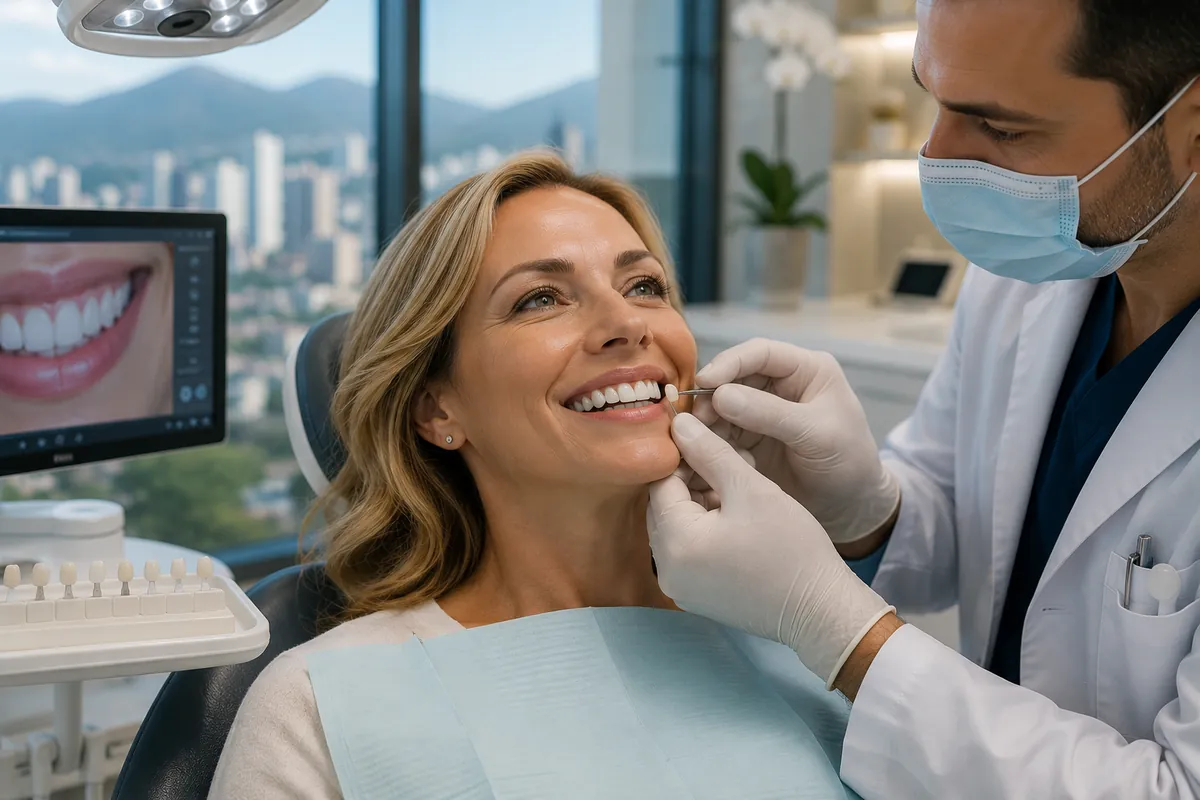
Dental implants in Colombia replace missing teeth with a titanium (or zirconia) post placed in the jawbone, an abutment, and a custom crown. In Medellín, a single implant starts near $700 USD versus about $3,500 in the U.S., and full-arch All-on-4 / All-on-6 is available. Care is delivered by board-certified implantologists and coordinated by Dra. Olga González. Because implants must fuse to bone (osseointegration, ~3–6 months), treatment is honest about timing — often two trips, though immediate-load All-on-4 can be done in one.
In Colombia
$700
USD from
In the U.S.
$3,500
USD average
Your saving
80%
less
What a dental implant actually is
A dental implant is not a single object but a small system of three parts that together replace a missing tooth from the root up. The first part is the implant post — a screw-shaped fixture, almost always made of medical-grade titanium (or, increasingly, zirconia) — that is placed surgically into the jawbone to act as an artificial tooth root. The second is the abutment, a connector that sits on top of the post and links it to the visible restoration. The third is the crown (for a single tooth), or a bridge or full-arch prosthesis when more teeth are involved, custom-made in ceramic to match your natural teeth.
What makes an implant fundamentally different from a bridge or a denture is osseointegration: over roughly three to six months, living bone grows against and bonds to the titanium surface, anchoring the implant the way a natural root is anchored. This is why implants feel and function like real teeth, preserve the jawbone that otherwise shrinks after tooth loss, and — with good care — can last decades. It is also why implant treatment cannot honestly be rushed: the biology of bone healing sets the timeline, not the clinic's schedule.
It also helps to understand what an implant is not. It is not a denture — dentures rest on the gums, can slip, and do nothing to stop bone loss. It is not a conventional bridge, which relies on cutting down the healthy teeth on either side of a gap to serve as anchors. An implant stands on its own root in the bone, independent of the neighboring teeth, which is why dentists increasingly regard it as the gold standard for replacing a missing tooth when a patient is a suitable candidate. The trade-off is time and an upfront surgical step, and that is precisely the honest conversation worth having before you travel.
At HealthBridge medical tourism, our role is to coordinate that care with board-certified implantologists and prosthodontists in Medellín, while our medical director Dra. Olga González oversees your journey end to end. Implants are a well-established, evidence-based standard of care worldwide — the honesty here is not about whether they work, but about setting realistic expectations for timing, candidacy and the occasional need for a second trip. If you are also considering cosmetic work, our dental veneers in Colombia page covers the front-of-mouth aesthetic side.
Why patients choose Colombia — and Medellín specifically
The economics of implant dentistry are hard to ignore. A single implant that commonly runs $3,000 to $5,000 or more at a U.S. practice frequently starts near $700 USD in Medellín, with the crown added on top — and full-arch All-on-4 that can approach $25,000–$30,000 per arch in the U.S. is available here at a fraction of that. The difference is driven by the lower cost of operating a practice in Colombia, not by cutting corners on the implant systems, imaging or the surgeon's training.
Just as important, the leading implantologists in Medellín routinely place premium, globally recognized implant systems — such as Straumann and Nobel Biocare, among other established brands — the same fixtures used in top clinics in the United States and Europe. Modern practices use CBCT 3D imaging and guided digital planning, so the medicine and technology are genuinely comparable; what changes is the price and, often, the waiting time.
Medellín itself makes the practical experience easier than most people expect. Its spring-like climate, the walkable El Poblado district, and direct flights from Miami, Fort Lauderdale, New York, Houston and Panama City make a short dental trip comfortable rather than daunting. What sets HealthBridge apart is coordination: we are a facilitator, so we are honest that the dentistry is performed by independent board-certified specialists — and Dra. Olga González personally coordinates your assessment, your treatment plan and your follow-up, in English or Spanish, so you are never navigating a foreign healthcare system alone.
- Meaningful savings — a single implant from ~$700 USD vs ~$3,500 in the U.S.
- Premium implant brands — Straumann, Nobel Biocare and other established systems.
- Board-certified specialists — implantologists and prosthodontists, not general practice as an afterthought.
- One bilingual coordinator — Dra. González from first message to final crown.
Why HealthBridge for implants
Board-certified care, coordinated end to end
We are a facilitator: the dentistry is performed by independent, board-certified implantologists and prosthodontists in Medellín, while Dra. Olga González coordinates your journey and keeps everything bilingual and honest.
Board-certified implantologists
Your surgery is placed by specialists in implant dentistry and prosthodontics — not treated as a general-practice sideline — using CBCT-guided digital planning.
Premium implant systems
Globally recognized brands such as Straumann and Nobel Biocare, the same fixtures used in leading U.S. and European clinics, with long documented track records.
Meaningful, transparent savings
A single implant from ~$700 USD versus ~$3,500 in the U.S., and full-arch at a fraction of U.S. pricing — quoted itemized and in USD after assessment.
Honest timelines
We tell you upfront whether your case needs one trip or two, because osseointegration takes 3–6 months and cannot be rushed. No false promises of instant permanent teeth.
One bilingual coordinator
Dra. Olga González coordinates your assessment, treatment plan and follow-up in English or Spanish, so you never navigate a foreign system alone.
Continuity of care
You leave with written aftercare for your home dentist, and we help coordinate any return visit for the final crown or bridge.
Single, multiple and full-arch: which option fits you
The right implant solution depends on how many teeth are missing and where. Understanding the options up front helps you have a realistic conversation about cost and timeline before you travel.
A single implant with a crown replaces one missing tooth without touching the neighbors — unlike a traditional bridge, which grinds down adjacent healthy teeth for support. It is the most conservative, longest-lasting way to replace an individual tooth. When several adjacent teeth are missing, an implant-supported bridge uses two or more implants to carry a span of teeth, which is more economical than one implant per tooth while still avoiding a removable appliance.
When an entire arch is failing or already lost, full-arch restoration becomes the goal, and this is where All-on-4 and All-on-6 come in. Rather than placing an implant for every tooth, a full set of fixed teeth is supported on four or six implants — the posterior ones often angled to anchor into denser bone and frequently avoid the need for grafting. All-on-6 adds two implants for extra support and load distribution, which some cases benefit from. Many full-arch cases can use immediate-load protocols, where a fixed temporary bridge is fitted the same day as surgery, so you never leave without teeth.
Which of these is appropriate is a clinical decision made after imaging, not a menu choice — and it directly shapes how many trips you will need. To go deeper on the full-mouth options, see our guides to All-on-4 implants in Colombia and full-mouth reconstruction in Colombia.
The two-stage timeline — and how dental tourism handles it honestly
This is the section most implant marketing skips, and it is the most important. A conventional dental implant is a two-stage treatment. In stage one, the implant post is surgically placed in the jaw. Then comes the part that cannot be shortcut: osseointegration, the roughly three-to-six-month period during which bone fuses to the implant. Only once the implant is stable is stage two performed — attaching the abutment and fitting the permanent crown. Trying to rush a permanent restoration onto an implant that has not integrated risks failure, and a responsible clinic will not do it.
For a patient flying in from abroad, that biology creates a real logistical question, and we answer it plainly rather than pretending it away. There are two honest approaches:
- Two trips (the conservative standard for single/multiple implants). On the first trip, the implants are placed and you heal at home. After 3–6 months of osseointegration, you return for a short second trip to receive the final crowns or bridge. Impressions and planning can often be coordinated remotely to keep the second visit brief.
- One trip with immediate load (common for All-on-4 / All-on-6). In many full-arch cases, a fixed temporary bridge is placed the same day as surgery, so you leave with functional teeth on the first trip. The definitive prosthesis is fitted later — sometimes on a brief return, sometimes coordinated with your home dentist — after the implants have integrated.
Some single-implant situations also allow immediate temporaries, and in select cases a local dentist at home can place the final crown once integration is confirmed. The point is that we are honest about which path your case requires. Dra. González maps out the exact number of visits and the timeline for your specific plan before you book anything, so there are no surprises. If you want the full walkthrough, our dental implants guide details how each timeline works in practice.
Implant options
From one tooth to a full arch
- Single implant + crown
- Replaces one missing tooth with a titanium post and custom ceramic crown, without grinding down healthy neighbors. The most conservative, longest-lasting single-tooth solution.
- Implant-supported bridge
- Two or more implants carry a span of several adjacent missing teeth — more economical than one implant per tooth, and fixed in place rather than removable.
- All-on-4 full arch
- A complete fixed set of upper or lower teeth supported on four implants, with posterior implants angled to use denser bone and often avoid grafting. Frequently immediate-load.
- All-on-6 full arch
- Adds two implants over All-on-4 for extra support and load distribution — useful in cases with adequate bone or heavier bite forces, restored with a fixed acrylic-titanium or zirconia bridge.
Candidacy, bone grafting and sinus lifts
Not everyone is an immediate candidate for an implant, and the honest first step is always imaging. A CBCT 3D scan shows the volume and quality of bone available, the position of the sinus in the upper jaw and the nerve in the lower jaw, and whether the neighboring teeth and gums are healthy. Because an implant relies on bone to anchor it, adequate bone is essential — and where it is lacking, it can very often be rebuilt.
When a tooth has been missing for a long time, the bone that once supported it tends to resorb. Two common preparatory procedures address this. A bone graft adds volume to a deficient ridge so an implant has something solid to integrate into; grafts may heal for a few months before the implant is placed, or in some cases be done at the same time. A sinus lift gently raises the sinus membrane in the upper back jaw and adds bone beneath it, creating room for implants where the sinus would otherwise be too low. These are routine, well-established procedures — but they add time to the overall plan, which is exactly why an accurate assessment matters before you travel.
Certain factors also affect suitability and are reviewed candidly: uncontrolled diabetes, heavy smoking, active gum disease, some medications (including certain bone drugs and blood thinners) and untreated infection can all impair healing or integration. None of these is automatically disqualifying, but each is discussed openly. If a case is not a good fit for implants, or would benefit from treating gum disease first, Dra. González and the treating specialists will say so rather than proceed for the sake of a booking.
Materials, brands and how implants are made
The quality of an implant restoration comes down to two things: the implant system in the bone and the prosthetic materials you see and chew with. On the first, the implantologists we coordinate with use globally recognized, well-documented systems — brands such as Straumann and Nobel Biocare among other established manufacturers — whose long-term clinical track records are precisely why they are trusted in the U.S. and Europe. These are the fixtures that make decades-long survival realistic; discount, unbranded implants are a false economy, and we do not treat them as equivalent.
Most posts are titanium, biocompatible and the most studied material in implant dentistry, with a decades-long history of osseointegration. Zirconia implants are a metal-free alternative some patients prefer for biological or aesthetic reasons, and can be discussed where appropriate. For the visible restoration, single crowns and bridges are typically made in high-strength ceramic (porcelain) or zirconia, custom-shaded to match your natural teeth. Full-arch prostheses are usually built in acrylic over a titanium bar or in solid monolithic zirconia for maximum durability.
The workflow itself is digital in modern Medellín practices: CBCT imaging and guided planning position each implant precisely, and intraoral scanning feeds a dental laboratory that fabricates the final restoration to a custom fit and shade. The result is designed to look and function like natural teeth — not obviously "false" — which for front teeth in particular is what makes the difference between a functional replacement and a genuinely invisible one.
Pricing
How much it costs in Colombia
| Option | In Colombia | In the U.S. |
|---|---|---|
| Single dental implant (post only) | from ~$700 USD | ~$3,500+ USD |
| Single implant + crown | individualized quote | $4,000–$6,000+ USD |
| All-on-4 (per arch) | a fraction of U.S. cost | $20,000–$30,000+ USD |
| All-on-6 (per arch) | quoted after assessment | $24,000–$35,000+ USD |
| Full-mouth (both arches) | quoted after assessment | $40,000–$60,000+ USD |
Reference 'from' prices in USD, subject to medical assessment.
Full breakdown, by area and by technique, in our guide to dental implants cost in Colombia.
At a glance
Dental implants: Colombia vs the United States
| Colombia (HealthBridge) | United States | |
|---|---|---|
| Single implant (from) | ~$700 USD (+ crown) | ~$3,500 USD |
| Implant systems | Straumann, Nobel Biocare & other premium brands | Comparable brands, premium pricing |
| Full-arch All-on-4 | A fraction of U.S. cost | $20,000–$30,000+ per arch |
| Wait time | Days to a few weeks | Weeks to months |
| Coordination | Bilingual, coordinated by Dra. Olga González | Self-navigated, insurance-dependent |
| Recovery setting | Spring-like Medellín, 5–7 days per visit | At home / local practice |
Durability, aftercare and what to expect long term
Well-placed, well-maintained implants are among the most durable restorations in dentistry. The implant post itself can last decades — often a lifetime — because titanium integrated into healthy bone is remarkably stable. The crown or bridge on top is subject to normal wear and, like any restoration, may eventually need replacement after many years, but the foundation typically endures. This longevity is a large part of why implants, despite a higher upfront cost than a bridge or denture, are frequently the more economical choice over a lifetime.
Long-term success, though, depends heavily on care. Implants do not decay, but the gum and bone around them can become inflamed — a condition called peri-implantitis — if plaque is allowed to build up, and that is the main threat to their survival. The maintenance is not complicated: daily brushing, careful cleaning around and (for bridges) under the restoration, and regular professional cleanings. Smoking meaningfully raises the risk of problems, and we say so plainly.
It is worth knowing what recovery actually feels like, since implant placement is done under local anesthesia and is generally far less dramatic than patients fear. Most people compare the first few days to a tooth extraction — mild soreness, some swelling or bruising, all readily managed with standard medication and a soft diet. Full-arch All-on-4 or All-on-6 surgery is more involved and the recovery a little longer, but even then patients are typically comfortable within days rather than weeks. Your written instructions spell out exactly what to expect day by day, what is normal, and when to reach out.
Because you will return home after treatment, we make continuity part of the plan. You leave with clear written aftercare instructions you can share with your local dentist, who can handle routine cleanings and monitoring close to home. Dra. González and the team remain reachable for questions afterward. Honest expectation-setting applies here too: implants are excellent, but they are not maintenance-free, and their decades-long performance is a partnership between the surgeon, the prosthesis and your own oral hygiene.
Planning your trip, costs and how to start
Pricing depends on how many implants you need, whether grafting or a sinus lift is required, the implant brand, and the type of final restoration. As clear reference points, a single implant starts near $700 USD (with the crown added), and full-arch All-on-4 / All-on-6 is a fraction of the U.S. price — where a single implant commonly runs about $3,500 and a full arch can reach $25,000–$30,000. Your quote is itemized and in USD, and follows a proper assessment rather than a fixed wall price, because implant plans are genuinely individual.
A typical program includes the specialist consultation and CBCT-based planning, the implant surgery, the implants and restorations agreed in your plan, and written follow-up guidance. We are equally clear about what is not included — flights, hotel, and any add-ons such as grafting only if it turns out to be needed — so there are no surprises after you arrive. Because most cases are non-surgical to recover from, a stay of 5–7 days per visit is typical.
- Free assessment. Send recent dental X-rays or a CBCT if you have one, plus a short history, by WhatsApp. Dra. González coordinates a review with the implantologist and returns honest guidance and an all-inclusive quote in USD.
- Plan & travel. We confirm how many trips your case realistically needs, help with a hotel in El Poblado and airport transfers, and schedule around Medellín's direct flights (a 3–5 hour hop from much of the U.S. and Central America).
- Treatment. Surgery and, where applicable, an immediate-load temporary are completed over a relaxed 5–7 day stay. A companion is welcome.
- Follow-up. You leave with written aftercare for you and your home dentist, and we coordinate any second visit for the final restoration.
You can compare every specialty on our medical tourism home page, or explore the cosmetic side on our dental veneers page. When you are ready, a free, no-obligation assessment is the honest place to start — implants reward good planning, and that is exactly what we coordinate.
How it works
Your medical journey, step by step
Part of our Cosmetic Dentistry & Veneers program.
Free assessment & quote
Message us on WhatsApp with your case, records or photos. We review it and send a plan and quote in USD before you book a flight — at no cost.
Travel plan
We coordinate a board-certified specialist, accredited hospital, dates, accommodation and airport transfers in Medellín.
Procedure
You're treated by board-certified specialists in accredited facilities, with bilingual support at every step.
Recovery & follow-up
You recover in Medellín with included check-ups and WhatsApp follow-up once you're home.
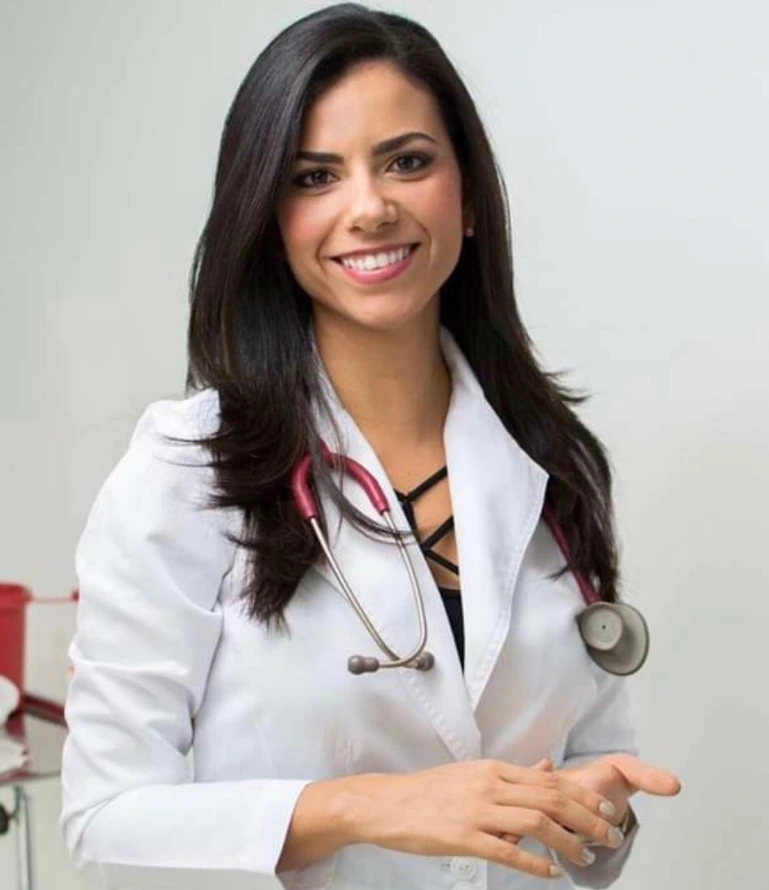
Your trusted physician
Dra. Olga González
Medical Director
Aesthetic Medicine Physician · Longevity & Regenerative Medicine · Health Coach in Nutrition · Universidad de San Martín
Dra. Olga González is the medical director of HealthBridge Medical Tourism. A physician trained at Universidad de San Martín and certified in aesthetic medicine, she has built her practice in El Poblado, Medellín, around longevity, regenerative medicine and biohacking. She personally coordinates each international patient's care — vetting surgeons, accredited hospitals and recovery plans — so that every traveler is treated by board-certified specialists and supported in their own language from the first message to the final follow-up.
- Aesthetic Medicine
- Regenerative & Longevity Medicine
- Biohacking
- Clinical Nutrition
Frequently asked questions
How much do dental implants cost in Colombia?
Are dental implants in Colombia safe and good quality?
How long does the whole process take?
Will I need to make two trips to Colombia?
How long do dental implants last?
What is All-on-4 and All-on-6?
Am I a candidate for dental implants?
What is a bone graft or sinus lift, and will I need one?
What brands of implants do you use?
Titanium or zirconia implants?
Why choose Colombia over the U.S. for implants?
How do I get started?
You may also consider
Other procedures in this specialty
Many patients combine procedures in a single trip. These are the ones we coordinate within the same specialty.
Sources
Where to verify this information
We're not asking you to take our word for it. These are independent medical bodies whose guidance you can read directly before making any decision.
- American Dental Association — oral health topics
- CDC Yellow Book — Medical Tourism: risks, planning and post-travel care
- MedlinePlus (U.S. National Library of Medicine) — patient health information
HealthBridge is not affiliated with or endorsed by these organizations. They are cited as independent reference.
Other specialties
Explore more treatments in Colombia

Ready to take the first step?
Send us your case on WhatsApp and get a personalized plan and quote — free, with no obligation.
El Poblado, Medellín · Mon–Fri 8:00 AM – 6:00 PM · Sat 9:00 AM – 1:00 PM (COT)