Dental & Veneers
Full-Mouth Reconstruction in Colombia: Restoring Function and Aesthetics
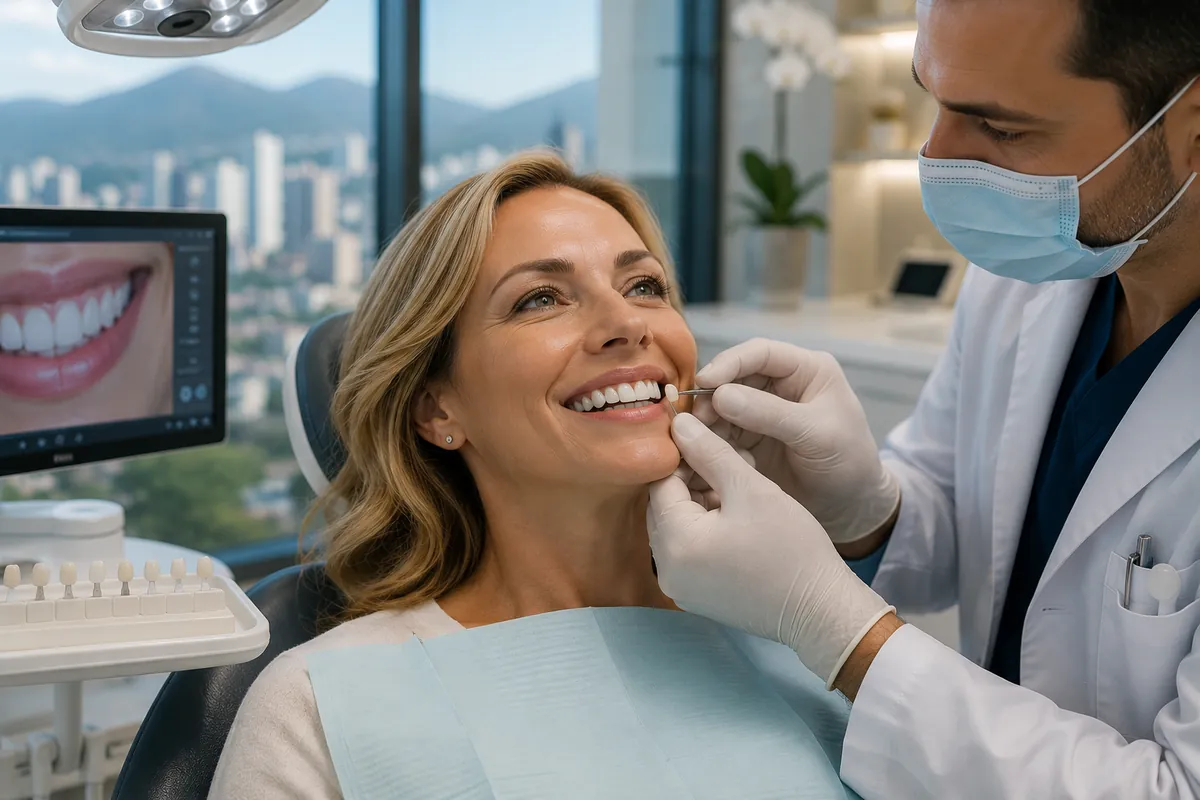
What Is Full-Mouth Reconstruction?
Full-mouth reconstruction, also called full-mouth rehabilitation, is not a single procedure but a comprehensive treatment plan that rebuilds or replaces most or all of the teeth in both the upper and lower jaws. Rather than fixing one tooth at a time, the dentist evaluates the entire mouth as a system and designs a coordinated sequence of treatments that restore the teeth, the bite and the supporting structures together.
A reconstruction can draw on many different procedures depending on what each patient needs. It often combines crowns to rebuild broken or heavily worn teeth, bridges to span gaps, dental implants to replace teeth that are missing entirely, and veneers or onlays to restore shape and surface. Just as important, it includes correcting the way the upper and lower teeth meet, known as the bite or occlusion, so that the new restorations function comfortably and last.
Because so many elements work together, full-mouth reconstruction is typically led by a restorative dentist or a prosthodontist, a specialist trained in rebuilding and replacing teeth. The goal is a mouth that not only looks natural but also chews, speaks and feels the way healthy teeth should. If you are exploring your options, our overview of cosmetic & restorative dentistry in Colombia describes the wider range of treatments available.
Who Needs a Full-Mouth Reconstruction?
Full-mouth reconstruction is reserved for people whose dental problems are widespread rather than isolated. One of the most common reasons is extensive tooth wear. Years of grinding and clenching, acid erosion or simply aging can wear teeth down until they are short, sensitive and no longer meet properly, changing both the smile and the way the jaw closes.
Another frequent reason is multiple missing teeth. When several teeth are lost to decay, gum disease or extraction, the remaining teeth drift, the bite collapses and chewing becomes difficult. Reconstruction replaces what is missing and re-establishes a stable, even bite. Trauma is a third path: a serious accident or fall can fracture or knock out several teeth at once, requiring a coordinated rebuild rather than a series of separate repairs.
Bite and jaw-joint problems also bring patients to reconstruction. A misaligned bite can cause headaches, jaw pain, clicking and uneven wear, and correcting it requires planning the entire mouth together. Finally, many candidates simply have a mouth full of aging dental work, old crowns, fillings and bridges placed decades ago, that is now failing and is best replaced as a whole. A thorough examination is the only way to know whether a comprehensive plan or a more limited treatment is right for you.
The Phased Process and Digital Planning
A reconstruction this comprehensive is never rushed. It begins with detailed diagnostics: a full clinical examination, digital X-rays, 3D cone-beam scans when implants are involved, intraoral scans or impressions, and photographs. With this information the dentist studies how your teeth, gums, muscles and jaw joints work together before proposing any treatment.
Modern reconstructions rely heavily on digital planning. Your mouth is mapped in software so the specialist can design the final bite, tooth shape and proportions in advance, and even produce a preview or trial restoration. This careful planning is what allows the many separate procedures to fit together precisely. The plan is then carried out in deliberate phases: any necessary extractions or gum treatment first to create a healthy foundation, then implant placement where teeth are missing, followed by the restorative work, crowns, bridges and veneers, and finally fine-tuning of the bite.
For international patients, the schedule is organized around travel. Straightforward cases can sometimes be completed in a single extended stay, but complex reconstructions, particularly those involving implants that must heal before final teeth are attached, are usually staged across two trips with a healing period in between. HealthBridge coordinates the timing so your visits are efficient and you always know what to expect. You can read more about how we work on the HealthBridge home page.
Materials and How They Are Chosen
The materials used in a full-mouth reconstruction are chosen for both strength and a natural appearance, because they must withstand the heavy forces of chewing for many years. Modern dentistry offers excellent options, and your specialist selects them based on which teeth are being restored and how much force those areas absorb.
Crowns and bridges are commonly made from zirconia or layered ceramic, materials prized for their durability and lifelike translucency. Porcelain veneers may be used on front teeth where appearance matters most, while stronger full-coverage crowns are often preferred on back teeth that do the heaviest work. When teeth are missing, dental implants made of biocompatible titanium serve as artificial roots, supporting individual crowns, bridges or full arches. If you are considering tooth replacement specifically, our guides to dental implants and full-arch All-on-4 implants explain those options in detail.
Color, shape and proportion are planned so the finished result blends naturally with your face and any remaining teeth. A good reconstruction should be invisible as dental work; people should simply see a healthy, natural smile. Your dentist will explain the trade-offs of each material in plain terms so you can make an informed choice together.
How It Differs From a Cosmetic Smile Makeover
It is easy to confuse full-mouth reconstruction with a cosmetic smile makeover, but they are fundamentally different in purpose. A smile makeover is an elective, appearance-driven treatment for someone whose teeth are basically healthy; it improves color, shape and alignment, often with veneers or whitening, to create a more attractive smile. The motivation is aesthetic choice.
Full-mouth reconstruction, by contrast, is driven by function and oral health. It is usually necessary, not optional, because the teeth are worn, broken, missing or no longer biting correctly, and these problems affect chewing, comfort and long-term dental health. The plan must restore a stable bite, protect the jaw joints and rebuild structure that has been lost, all while also looking good. In other words, a makeover starts from a healthy mouth and refines it, whereas a reconstruction starts from a damaged mouth and rebuilds it.
The two can overlap, since a well-executed reconstruction also produces a beautiful smile, and cosmetic techniques are part of the toolkit. The key distinction is that reconstruction treats the entire system, teeth, bite and supporting tissues, to restore health and function first, with aesthetics achieved as part of the same comprehensive plan. Understanding this difference helps you ask the right questions and choose the appropriate level of care.
Cost, Timeline and How HealthBridge Coordinates
Cost is one of the strongest reasons patients consider Colombia for extensive dental work. A full-mouth reconstruction involves many procedures, so in the United States the total can climb very high, often into the tens of thousands of dollars depending on how many implants, crowns and other treatments are required. In Colombia, the same comprehensive work performed by board-certified dentists and prosthodontists costs a fraction of that, which is why the savings on large cases are so significant. Because every reconstruction is individual, an accurate price comes only from a personalized plan, and HealthBridge helps you obtain a clear, itemized quote so you understand exactly what is included.
The timeline depends on the complexity of your case. Many reconstructions are organized as two trips to Medellín: a first visit for diagnostics, preparation, any extractions and implant placement, then a healing period of a few months at home, and a second visit to fit the final restorations. Simpler cases may be completed in fewer visits, while the most complex may take longer. Your specialist sets a realistic schedule during planning so you can arrange travel and time away from work.
HealthBridge is a facilitator, not a clinic. We connect you only with board-certified dentists and prosthodontists working in modern, accredited facilities, and we coordinate your consultations, treatment plan, scheduling, logistics and follow-up between trips. Dra. Olga Gonzalez serves as our medical director and coordinator, guiding you in plain language so a complex, multi-stage treatment feels organized and clear from your first question to your final visit.
Considering dental & veneers in Colombia?
See the procedure, pricing and the process for international patients on our Cosmetic Dentistry & Veneers.
Procedure guides: Dental Implants Colombia · All-on-4 in Colombia: Cost from $5,500 per Arch