
Aesthetic medicine
Dermal Fillers in Colombia
Hyaluronic acid fillers for cheeks, lips, tear troughs, chin and jawline — placed by a licensed physician using INVIMA-registered products, reversible with hyaluronidase, and priced at a fraction of what the same brands cost in the United States.
- From ~$320 USD per syringe
- INVIMA-registered products
- Reversible with hyaluronidase
- Lasts 6–18 months
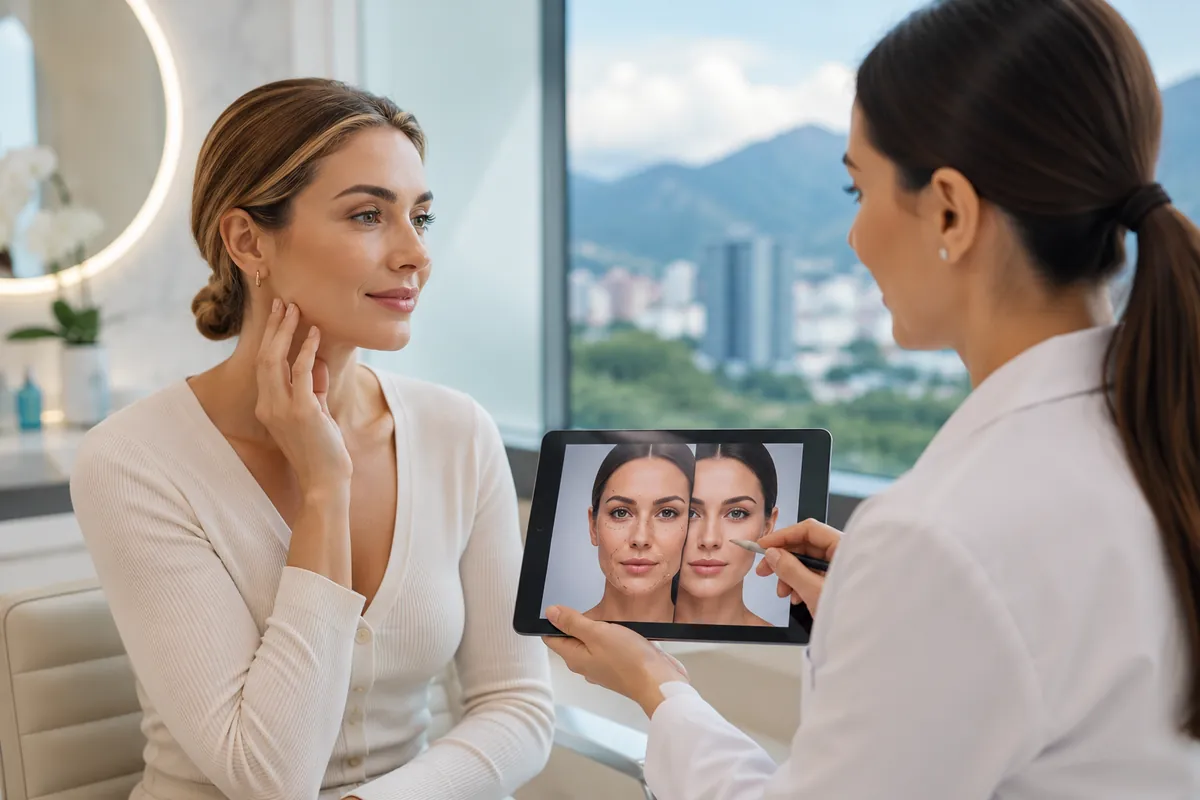
Dermal fillers in Colombia use cross-linked hyaluronic acid gel to restore volume and define contour — cheeks, lips, tear troughs, chin and jawline. In Medellín treatment starts near $320 USD per syringe, against roughly $700 to $1,200 in the United States for the same brands. Products are INVIMA-registered and injected by a licensed physician. Two things worth knowing before anything else: hyaluronic acid filler is reversible — it can be dissolved with hyaluronidase if you dislike the result — and it is temporary, reabsorbing over roughly 6 to 18 months depending on product and area.
In Colombia
$320
USD from
In the U.S.
$800
USD average
Your saving
60%
less
What fillers do — and how they differ from Botox
A dermal filler is a gel injected beneath the skin to add volume. That single sentence separates it from botulinum toxin, which adds nothing and instead relaxes the muscles that fold the skin. The two treat opposite problems, which is why so many patients end up using both: most faces show both muscle-driven lines and volume loss at once.
Facial aging is not only about wrinkles. Over time the face loses fat compartments, bone resorbs subtly, and ligaments loosen, so the midface flattens, the tear trough hollows, the jawline softens and folds deepen because the tissue above them has descended. Filler addresses that structural change. Placed well, it does not simply plump a line — it restores support so the overlying tissue sits where it used to.
Most fillers used today are hyaluronic acid, a sugar molecule your body already produces and which binds water. Its great advantage is that it is reabsorbed naturally and can be actively dissolved. If your goal is stimulating your own collagen rather than placing gel, that is a different category covered in our biostimulators guide, and if your lines come from movement rather than volume loss, see our Botox guide.
Where fillers are used
Cheeks and midface are where structural filling has the most impact, because restoring support there often improves the folds below without injecting them directly. Nasolabial folds and marionette lines can be treated directly, though a good injector frequently treats the cheek first and reassesses.
Lips are the most requested and the most easily overdone. Softer, more flexible products are used here, and the honest advice is to start conservatively: lips swell dramatically for the first 48 hours and the true result appears at two weeks. Tear troughs — the hollow between lower lid and cheek — are among the most technically demanding areas, unforgiving of too much product or too superficial placement, and not every patient is a candidate.
Chin and jawline have become some of the most transformative uses, defining the lower face and improving profile balance, often with a smaller total volume than people expect. Temples address the hollowing that makes the upper face look gaunt. Filler is also used in the nose as a non-surgical rhinoplasty to camouflage a bump or lift a drooping tip — an area demanding particular caution, since it carries a higher vascular risk than any other and is not a substitute for surgical rhinoplasty when structure needs changing.
Why choose HealthBridge
What is included and why it matters
With fillers, the product on the shelf matters far less than who injects it, how much, and what safety net is in the room. Here is what our program is built around.
INVIMA-registered products only
You can ask which product will be used and see the box and lot number opened in front of you. Unregistered or unsourced filler is the single biggest avoidable risk in this field.
Hyaluronidase on site, always
The emergency treatment for vascular occlusion is physically present in the clinic. Any provider injecting hyaluronic acid without it available should not be injecting.
Injected by a licensed physician
Facial vascular anatomy is what keeps this treatment safe. Cannula technique in higher-risk areas, conservative volumes and medical training are the protections that matter.
Product matched to the area
A gel engineered to support a cheekbone is deliberately firmer than one made for lips. Using one product for everything is not a choice — it is the absence of one.
Conservative first, review at two weeks
Swelling peaks at 48 hours and the true result appears at two weeks. We would rather add a little then than dissolve a lot later.
No permanent fillers
We do not use permanent or semi-permanent products. They cannot be dissolved, and complications from them are extremely difficult to correct.
Brands, INVIMA registration and what actually differs
Patients often ask which brand is best, and the more useful answer is that the recognized manufacturers all make good products with different properties. The families you will encounter include Juvederm (Voluma, Volbella, Volift), Restylane (Lyft, Kysse, Defyne), Teosyal (RHA range, Kiss), Belotero and Stylage.
A specific one worth naming, because patients ask about it constantly: Teosyal Kiss is the lip-specific product in the Teosyal range — a softer, more flexible gel formulated for a mobile area rather than for lifting a cheekbone. It is one of several legitimate options for lips, alongside Restylane Kysse and Juvederm Volbella, and none of them is inherently the "best": the right one depends on your anatomy and on how much projection you actually want.
What you should verify is not the brand's reputation but its INVIMA registration for the exact product going into your face. Every filler legally sold in Colombia carries a health registration, and it is specific to the product and presentation — not to the brand family as a whole. Ask to see the box before it is opened, check that the name on it matches what you agreed to, and ask for the batch number and the registration to be written into your record. A clinic that cannot show you an unopened box, or that decants product from an unlabelled syringe, has failed the only test that matters here. We keep a full brand-by-brand comparison in our guide to filler brands and INVIMA registration.
What genuinely differs is the physical behaviour of the gel — how firm it is, how much it lifts, how it moves with expression. A product engineered to support a cheekbone is deliberately firmer than one designed for lips, which needs to stay soft and flexible when you speak and smile. Matching product to area is a large part of what an experienced injector is actually doing, and a clinic that uses one product for everything is not choosing.
In Colombia the question worth asking is about INVIMA registration. INVIMA is the national health regulator, and registration means the product has been through its authorization process for use here. Ask which specific product will be used, ask to see the box and lot number opened in front of you, and treat vagueness as a warning sign — this is the single most useful consumer protection in injectable aesthetics anywhere, and it costs you nothing to ask.
How long fillers last, honestly
Duration depends on the product, the area and you. As a general guide, lips last 6 to 12 months, because the mouth is constantly moving and mobile areas metabolize filler faster. Cheeks and chin last 12 to 18 months or occasionally longer, since firmer products in less mobile areas placed deep on bone are broken down more slowly. Tear troughs are variable and can persist longer than expected.
Your own metabolism matters: people who are very physically active or have fast metabolisms tend to reabsorb filler faster, sometimes noticeably so. This is normal biology rather than a defective product.
Two honest notes. First, nobody can tell you exactly how long yours will last, and a clinic that promises a precise figure is overselling. Second, filler does not fall off a cliff — it fades gradually, so the change is usually gentle rather than sudden. Some patients also find that after several rounds in the same area they need less product to maintain the result, which is a real and welcome effect. And when you stop, you do not look worse than before: you return to your natural baseline, plus whatever aging happened meanwhile.
Treatment areas
Where dermal fillers are used
- Cheeks and midface
- Where structural filling has the most impact. Restoring support here often improves the folds below without injecting them directly. Typically two or more syringes for a visible result.
- Lips
- The most requested and most easily overdone area. Softer, flexible products, and a conservative first session — lips swell dramatically for 48 hours and the real result appears at two weeks.
- Tear troughs
- The hollow between lower lid and cheek. Technically demanding, unforgiving of excess or superficial placement, and not every patient is a candidate — we will say so if you are not.
- Chin and jawline
- Among the most transformative uses, defining the lower face and improving profile balance. Commonly two to four syringes, often with less total volume than patients expect.
- Non-surgical rhinoplasty
- Camouflaging a bump or lifting a drooping tip with filler. Higher vascular risk than any other area, so it demands particular caution — and it is not a substitute for surgery when structure must change.
Safety, risks and the one complication that matters most
Most side effects are minor and expected: swelling, bruising, tenderness and small lumps that settle within days to two weeks. Lips bruise and swell more than anywhere else. None of this is a complication — it is the normal course.
The complication that genuinely matters is vascular occlusion: filler entering or compressing a blood vessel and blocking blood supply to the tissue it feeds. It is rare, but it is the reason this treatment belongs with a medically trained injector rather than anyone with a needle. Untreated it can cause skin necrosis, and in the very rare worst case involving vessels around the eye, vision loss. The warning signs are immediate — severe disproportionate pain, blanching or a white patch, or mottled purple discoloration — and they require urgent treatment with hyaluronidase, not a wait-and-see appointment tomorrow.
Your protections are concrete: an injector who understands facial vascular anatomy, cannula technique in higher-risk areas, aspiration where appropriate, conservative volumes, and hyaluronidase physically present in the clinic. Ask that last question directly — do you have hyaluronidase here today? Any clinic injecting hyaluronic acid without it on the premises should not be injecting. Other risks include infection, nodules, the Tyndall effect (a bluish tint from superficial placement), and product migration over years, particularly in lips.
Reversibility: the safety net that makes fillers different
Hyaluronic acid filler has a property almost no other aesthetic procedure offers: it can be undone. Hyaluronidase is an enzyme that breaks the gel down, with visible effect usually within 24 to 48 hours.
That changes the risk calculation entirely. If you dislike the result, if one side looks different, if a lip is fuller than you wanted, or if product has migrated over the years, it can be dissolved rather than lived with until it reabsorbs. It is also the emergency treatment for vascular occlusion, which is why its availability is non-negotiable.
Two caveats keep this honest. Dissolution is not surgically precise — it may remove more than intended, and the area can initially look flatter than before any filler was placed. And elective dissolution of product built up over several years often needs more than one session. But the principle holds and it is genuinely reassuring: with hyaluronic acid you are not stuck with a result you dislike. This is also the reason we do not offer permanent or semi-permanent fillers such as polymethylmethacrylate or injectable silicone: they cannot be dissolved, and complications from them can be extremely difficult to correct. If a clinic offers you a filler described as permanent, understand exactly what that word commits you to.
Pricing
How much it costs in Colombia
| Option | In Colombia | In the U.S. |
|---|---|---|
| Hyaluronic acid filler, per syringe | from ~$320 USD | $700–$1,200 USD |
| Lips (0.5–1 syringe) | ~$250–$380 USD | $600–$1,000 USD |
| Cheeks / midface (2 syringes) | ~$700–$900 USD | $1,600–$2,400 USD |
| Chin and jawline (2–4 syringes) | ~$700–$1,400 USD | $1,800–$4,000 USD |
| Hyaluronidase dissolution | quoted per session | $300–$800 USD |
Reference 'from' prices in USD, subject to medical assessment.
Full breakdown, by area and by technique, in our guide to dermal filler cost in Colombia.
At a glance
Dermal fillers: Colombia vs the United States
| Colombia (HealthBridge) | United States | |
|---|---|---|
| Per syringe (1 ml) | from ~$320 USD | $700–$1,200 USD |
| Lips (0.5–1 syringe) | ~$250–$380 USD | $600–$1,000 USD |
| Cheeks (2 syringes) | ~$700–$900 USD | $1,600–$2,400 USD |
| Products | INVIMA-registered brands | FDA-approved brands |
| Hyaluronidase available | On site | Varies by provider |
| Wait time | Days | Days–weeks |
Getting a result that looks like you
The overfilled look people fear is not caused by filler. It is caused by too much filler, placed too superficially, in too many areas, too often. It develops gradually: each session adds a little, the face slowly changes proportion, and because the change is incremental the person receiving it often does not notice.
The principles that prevent it are unglamorous. Less is more, and a conservative first session with a review at two weeks beats an ambitious one you have to dissolve. Treat the cause, not the symptom — filling a deep fold directly often looks heavy, while restoring the cheek support above it looks natural. Respect proportion: the goal is balance, not maximum volume in every compartment. And space your sessions, since accumulating product faster than it reabsorbs is precisely how the overfilled look happens.
Some goals are simply not filler goals. Significant skin laxity needs tightening or surgery, not volume. Very deep static creases may need resurfacing alongside. If your face needs a facelift, adding filler until it looks lifted will not work and will look heavy on the way. Our aesthetic medicine and plastic surgery page covers the alternatives honestly, including when the right answer is surgery.
Cost in Colombia versus the United States
In Medellín, hyaluronic acid filler starts near $320 USD per syringe, with premium structural products for cheeks and chin sitting higher. In the United States the same branded syringes commonly run $700 to $1,200, and in major cities more. The product is the same globally registered brand; what differs is the cost of delivering care.
How to read a quote: filler is priced per syringe (usually 1 ml), and how many you need depends on your anatomy and goal. Lips typically take half to one syringe. Cheeks often take two or more for a visible structural result. Chin and jawline commonly need two to four. A clinic quoting a total without saying how many syringes it includes is not giving you a comparable number, so ask.
Be wary of prices far below market. Genuine INVIMA-registered product from a recognized manufacturer has a floor cost, and unusually cheap filler usually means an unregistered product, an unknown source, or a non-medical injector — occasionally all three. This is one area where the cheapest option carries real risk rather than merely disappointment.
Your visit and how our program works
A filler visit is short: 1 to 3 days is enough, and the treatment itself takes 30 to 60 minutes. There is no true downtime, though you should plan around swelling — you will look swollen for 24 to 48 hours and slightly uneven for a few days, so leave a week before an important event rather than treating the day before.
Because there is no recovery, most international patients combine fillers with other treatments — toxin, biostimulators, or a surgical consultation — in a single trip. Our guide for patients traveling from the United States covers flights and logistics. If you want an in-person two-week review, plan the timing accordingly or arrange it remotely.
At HealthBridge every treatment is performed by a licensed physician under Colombian regulations after an individualized assessment, using INVIMA-registered products, with hyaluronidase on site. Our medical director Dra. Olga González leads the aesthetic medicine program. We will tell you when less product is the better plan, when a different treatment fits your goal better, and when the honest answer is that what you want needs surgery — and you are welcome to ask us which product, which lot, and what we would do if you were unhappy.
How it works
Your medical journey, step by step
Part of our Plastic Surgery & Aesthetic Medicine program.
Free assessment & quote
Message us on WhatsApp with your case, records or photos. We review it and send a plan and quote in USD before you book a flight — at no cost.
Travel plan
We coordinate a board-certified specialist, accredited hospital, dates, accommodation and airport transfers in Medellín.
Procedure
You're treated by board-certified specialists in accredited facilities, with bilingual support at every step.
Recovery & follow-up
You recover in Medellín with included check-ups and WhatsApp follow-up once you're home.

Your trusted physician
Dra. Olga González
Medical Director
Aesthetic Medicine Physician · Longevity & Regenerative Medicine · Health Coach in Nutrition · Universidad de San Martín
Dra. Olga González is the medical director of HealthBridge Medical Tourism. A physician trained at Universidad de San Martín and certified in aesthetic medicine, she has built her practice in El Poblado, Medellín, around longevity, regenerative medicine and biohacking. She personally coordinates each international patient's care — vetting surgeons, accredited hospitals and recovery plans — so that every traveler is treated by board-certified specialists and supported in their own language from the first message to the final follow-up.
- Aesthetic Medicine
- Regenerative & Longevity Medicine
- Biohacking
- Clinical Nutrition
Frequently asked questions
How much do dermal fillers cost in Colombia?
Hyaluronic acid filler in Medellín starts near $320 USD per syringe, against roughly $700 to $1,200 in the United States for the same branded product. How many syringes you need depends on your anatomy and goal: lips typically take half to one, cheeks often two or more, chin and jawline commonly two to four. Ask any clinic how many syringes a quoted total includes, or the number is not comparable.
How long do fillers last?
Roughly 6 to 12 months in lips, since constant movement metabolizes filler faster, and 12 to 18 months or occasionally longer in cheeks and chin where firmer products sit deep on bone in less mobile areas. Your own metabolism matters — very active people often reabsorb filler faster. Nobody can predict your exact duration, and a clinic promising a precise figure is overselling.
Can fillers be removed if I do not like them?
Yes, and this is the property that makes hyaluronic acid different from almost every other aesthetic procedure. Hyaluronidase is an enzyme that dissolves the gel, usually with visible effect within 24 to 48 hours. It works for a result you dislike, asymmetry, or product that has migrated over years. Note that dissolution is not surgically precise and may remove more than intended.
What is INVIMA registration and why does it matter?
INVIMA is Colombia's national health regulator, and registration means a product went through its authorization process for use here. It is your simplest consumer protection: ask which specific product will be used and to see the box and lot number opened in front of you. Vagueness about product or source is a warning sign, and asking costs you nothing.
Does it hurt?
Less than most people expect. Topical anesthetic is applied, most fillers contain lidocaine, and local anesthetic can be injected for sensitive areas — lips in particular are usually numbed properly. Most patients describe pressure rather than sharp pain. A blunt cannula, often used in higher-risk areas for safety, also tends to be more comfortable than a needle.
What is the most serious risk?
Vascular occlusion — filler entering or compressing a blood vessel and cutting blood supply to tissue. It is rare but it is why a medically trained injector matters. Warning signs are immediate and require urgent hyaluronidase: severe disproportionate pain, blanching or a white patch, or mottled purple discoloration. Ask any clinic directly whether they have hyaluronidase on site.
Will I look overfilled?
Not if the plan is conservative. The overfilled look comes from too much product, placed too superficially, in too many areas, too often — and it develops gradually enough that the person receiving it often does not notice. Our approach is a conservative first session with a review at two weeks, because adding a little then is far better than dissolving a lot later.
What is the difference between fillers and Botox?
They solve opposite problems. Filler adds volume, so it treats hollowing, deep static folds and contour — cheeks, lips, chin, tear troughs. Botulinum toxin adds nothing and relaxes the muscles that fold skin, so it treats lines created by movement. Most faces show both kinds of change, which is why many patients use both together.
Can fillers replace a facelift?
No. Filler restores volume; it does not remove or reposition loose skin. Used well it can delay the point at which surgery becomes the right answer, and for many people that is genuinely valuable. But if significant skin laxity is your main concern, adding filler until the face looks lifted does not work and tends to look heavy. We will tell you when surgery is the honest answer.
How soon can I go to an event?
Leave at least a week, and two is safer. You will look swollen for 24 to 48 hours and can look slightly uneven for a few days, with bruising possible especially in lips. The true result appears at about two weeks. Treating the day before a wedding or a shoot is the most common scheduling mistake patients make.
Do you use permanent fillers?
No, deliberately. Permanent and semi-permanent products such as polymethylmethacrylate or injectable silicone cannot be dissolved, and complications from them can be extremely difficult to correct, sometimes requiring surgery. We use hyaluronic acid precisely because it is reversible. If a clinic offers you a permanent filler, be certain you understand what that commits you to.
How many days do I need in Medellín?
One to three days is enough, with the treatment itself taking 30 to 60 minutes and no true downtime. Because there is no recovery, most international patients combine fillers with toxin, biostimulators or a surgical consultation in a single trip. If you want the two-week review in person, plan the timing accordingly or arrange it remotely.
You may also consider
Other procedures in this specialty
Many patients combine procedures in a single trip. These are the ones we coordinate within the same specialty.
BBL in Colombia
from $3,800 USD · stay 7–12 days
Mommy Makeover in Colombia
from $6,500 USD · stay 10–14 days
Liposuction in Colombia
from $3,500 USD · stay 7–10 days
Rhinoplasty in Colombia
from $4,000 USD · stay 7–10 days
Tummy Tuck in Colombia
from $4,000 USD · stay 7–10 days
Breast Augmentation in Colombia
from $3,500 USD · stay 5–7 days
Botox in Colombia
from $180 USD · stay 1–3 days
Biostimulators in Colombia: Cost from $450 per Vial
from $450 USD · stay 1–3 days
Sources
Where to verify this information
We're not asking you to take our word for it. These are independent medical bodies whose guidance you can read directly before making any decision.
- American Society of Plastic Surgeons — patient safety resources
- CDC Yellow Book — Medical Tourism: risks, planning and post-travel care
- MedlinePlus (U.S. National Library of Medicine) — patient health information
HealthBridge is not affiliated with or endorsed by these organizations. They are cited as independent reference.
Other specialties
Explore more treatments in Colombia



Ready to take the first step?
Send us your case on WhatsApp and get a personalized plan and quote — free, with no obligation.
El Poblado, Medellín · Mon–Fri 8:00 AM – 6:00 PM · Sat 9:00 AM – 1:00 PM (COT)