
Joint replacement · Medellín, Colombia
Knee Replacement in Colombia
Total and partial knee replacement in Medellín performed by board-certified orthopedic surgeons in accredited hospitals — from about $12,000 USD all-inclusive (implant, hospital and physical therapy) versus roughly $35,000 in the United States. Coordinated end-to-end by our medical director, Dra. Olga González, with an honest 10–16 day stay for safe rehab and travel.
- Board-certified orthopedic surgeons
- From ~$12,000 USD all-inclusive
- Coordinated by Dra. Olga González
- English & Spanish
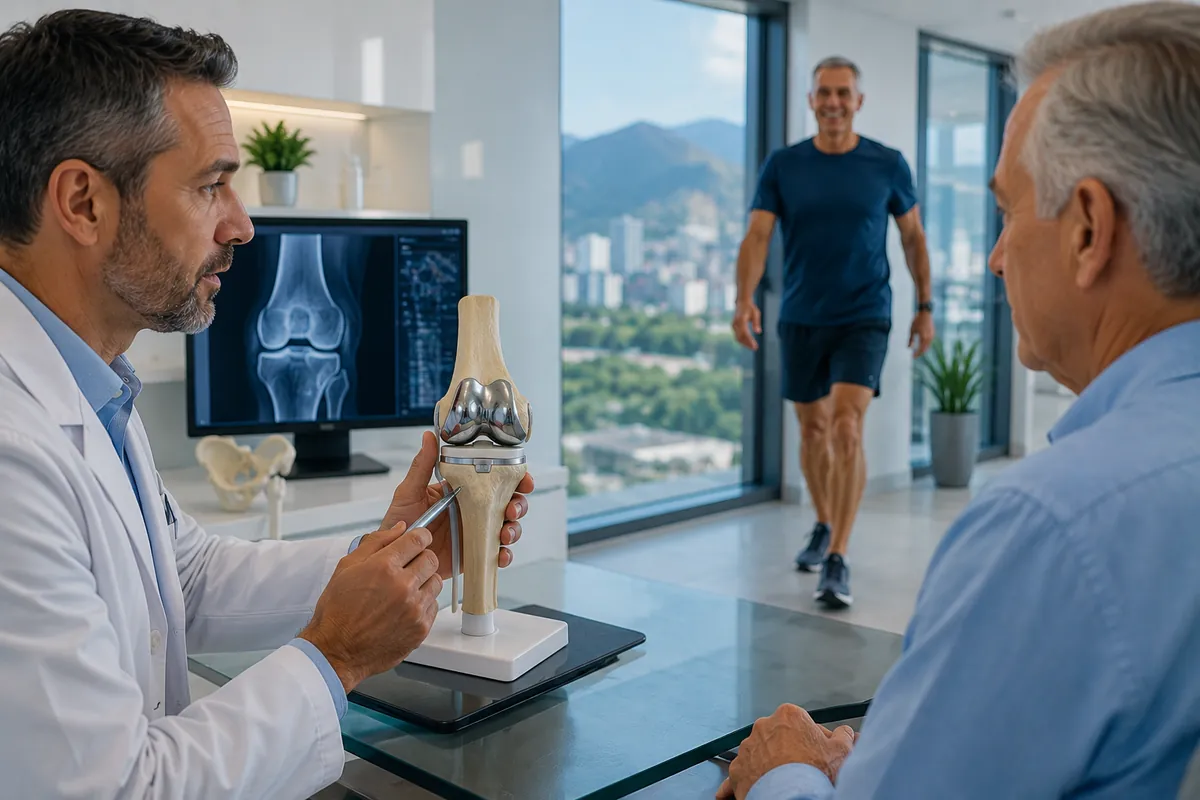
Knee replacement in Colombia is major orthopedic surgery in which worn, arthritic knee surfaces are replaced with metal and medical-grade plastic implants to relieve pain and restore movement. In Medellín, an all-inclusive total knee replacement starts near $12,000 USD — implant, accredited hospital and physical therapy included — versus roughly $35,000+ in the United States. Surgery is performed by board-certified orthopedic surgeons and coordinated by medical director Dra. Olga González. Plan a realistic 10–16 day stay for rehabilitation and safe travel home.
In Colombia
$12,000
USD from
In the U.S.
$35,000
USD average
Your saving
66%
less
What knee replacement really is — and when it makes sense
Knee replacement, known medically as knee arthroplasty, is a well-established orthopedic operation in which a surgeon removes the worn, arthritic surfaces of the knee and replaces them with precisely fitted implant components made of metal and durable medical-grade plastic. It is one of the most studied and reliably successful surgeries in modern medicine — but it is still major surgery, and it is worth understanding honestly rather than romantically before you fly anywhere for it.
The knee is essentially a hinge where the thigh bone (femur) meets the shin bone (tibia), cushioned by cartilage and stabilized by ligaments, with the kneecap (patella) gliding in front. In osteoarthritis — the most common reason for replacement — that cartilage gradually wears away until bone rubs on bone, producing the deep, activity-limiting pain, stiffness and swelling that eventually make walking, stairs and sleep difficult. A knee replacement resurfaces those damaged surfaces so the joint can move smoothly and bear weight without that grinding pain.
It is important to be clear about what the surgery does and does not do. A well-done knee replacement is excellent at relieving arthritis pain and restoring function — most patients walk far more comfortably and return to everyday activities. It does not turn back the clock to a 20-year-old knee, it will not make you a competitive athlete, and it carries the real risks of any major operation. Honest surgeons frame it as a reliable way to reclaim comfortable daily life, not as a miracle.
- It is major surgery. It involves anesthesia, an incision, bone work and a genuine recovery — not a quick fix.
- It is highly effective for the right patient. For advanced arthritis that has failed conservative care, satisfaction is generally high.
- It requires you to do your part. Physical therapy and follow-through largely determine your final result.
As a medical tourism facilitator, HealthBridge does not perform surgery — we connect you with board-certified orthopedic surgeons in accredited Medellín hospitals and coordinate the entire journey. Our medical director, Dra. Olga González, reviews your case, arranges honest surgical opinions, and makes sure you understand the operation, the realistic recovery and the risks before anything is booked. For deeper reading, see our joint replacement overview and our knee replacement cost guide.
Total vs partial knee replacement — and which fits you
Not every arthritic knee needs the same operation, and one of the most important conversations you will have is whether a total or a partial replacement fits your specific joint. This is a surgical decision made from your imaging and exam — not a preference you pick from a menu — but understanding the difference helps you ask better questions.
The knee has three compartments: the inner (medial), the outer (lateral), and the front where the kneecap sits. In a total knee replacement (total knee arthroplasty), the surgeon resurfaces the ends of the femur and tibia across all compartments and usually the back of the kneecap, fitting metal components with a plastic spacer between them to act as new cartilage. It is the right choice when arthritis is widespread across the joint, and it is the most common and most predictable version of the surgery.
A partial, or unicompartmental, knee replacement is a bone-sparing alternative for patients whose arthritis is confined to just one compartment — usually the inner side — with intact ligaments and healthy cartilage elsewhere. Because only the damaged section is resurfaced through a smaller incision, patients often report a more natural-feeling knee and a somewhat quicker early recovery. The trade-off is that it only suits carefully selected candidates, and if arthritis later spreads to other compartments it may need to be revised to a total replacement down the line.
- Total replacement: best for widespread, multi-compartment arthritis; the most common and predictable option.
- Partial replacement: for localized single-compartment arthritis with good ligaments; more bone-sparing, but candidate selection is strict.
Your surgeon confirms which is appropriate using weight-bearing X-rays and a clinical exam, sometimes an MRI. Where the picture is unclear, Dra. González can arrange a second surgical opinion so you travel with confidence. Our partial vs total knee replacement guide breaks the decision down in plain language.
Why HealthBridge
What makes knee replacement in Medellín different
As a facilitator, HealthBridge coordinates board-certified orthopedic surgeons and accredited hospitals — and builds the whole trip around a safe, unhurried recovery.
Board-certified orthopedic surgeons
Your surgery is performed by experienced, board-certified orthopedic specialists operating in accredited Medellín hospitals — never anonymous or unvetted providers.
All-inclusive from ~$12,000 USD
One transparent USD quote covers the surgeon, the accredited hospital, the implant and physical therapy — versus roughly $35,000+ for the same total knee replacement in the U.S.
Same major implant brands
Accredited hospitals use the same major international implant brands found in leading U.S. and European operating rooms. You can confirm the brand and model before you commit.
Coordinated by Dra. Olga González
Our medical director reviews your case, arranges the surgical opinion, and manages the journey end to end in English or Spanish — one accountable point of contact throughout.
A safe, realistic 10–16 day stay
The trip is built around genuine rehabilitation and a DVT-safe flying-clearance window — not a rushed few days. Honest recovery is a feature, not a delay.
No long waitlists
Suitable candidates schedule surgery in weeks rather than the months or years common in some public systems — with the pre-operative work-up done properly, not skipped.
Implants and materials — the same major international brands
A common and reasonable worry is whether the implant used in Colombia is somehow inferior to what you would receive at home. It is not. Accredited Medellín hospitals routinely use the same major international implant brands found in leading U.S. and European operating rooms — the global orthopedic implant market is dominated by a handful of large manufacturers, and their products are distributed and used worldwide.
A modern knee implant is a carefully engineered system of components. The femoral (thigh-bone) component is typically a cobalt-chromium or similar metal alloy shaped to the natural contour of the bone. The tibial (shin-bone) side pairs a metal baseplate with a durable high-grade polyethylene (medical plastic) insert that acts as the new gliding cartilage. The kneecap, when resurfaced, receives a small polyethylene button. These materials are chosen for strength, low friction and long-term durability, and are the same categories of materials used globally.
Components are secured either with bone cement or, in some designs, press-fit so bone grows into a porous surface. Modern implants are designed for durability, and while no implant is guaranteed for life, contemporary knee replacements commonly last many years, with a proportion of patients never needing revision. Your surgeon selects the specific implant and fixation method based on your anatomy, bone quality, age and activity level.
What we will not do is dress this up. The implant is only part of the equation; surgical technique, hospital sterility and rehabilitation matter just as much. That is precisely why HealthBridge works with board-certified orthopedic surgeons in accredited hospitals rather than chasing the lowest price. You can always ask, before you commit, exactly which implant brand and model your surgeon plans to use — a fair question we are happy to answer in writing.
Why patients choose Colombia — and Medellín specifically
The economics are the headline, and they are genuinely dramatic. A total knee replacement in the United States commonly totals around $35,000 or more once the surgeon, anesthesia, implant, hospital stay and therapy are added up — and that is before considering high deductibles or the uninsured price. In Medellín, an all-inclusive total knee replacement starts near $12,000 USD, with the implant, the accredited hospital stay and physical therapy already included. Even after flights and lodging for you and a companion, most international patients save a substantial sum.
That gap is not explained by lower-quality medicine. It reflects the far lower cost of operating a hospital in Colombia — labor, facilities and administrative overhead — not any compromise in the surgeon's training or the implant used. Medellín has become a serious hub for orthopedic and joint-replacement travel because it pairs board-certified orthopedic surgeons and accredited hospitals with a comfortable, walkable base for the extended recovery this surgery requires.
The city's spring-like climate, the well-served El Poblado district, and easy direct flights from the U.S., Canada and Central America make an extended stay far more pleasant than most people expect. For patients from countries with long public waitlists, the ability to schedule surgery in weeks rather than months or years is often just as valuable as the savings.
- All-inclusive from ~$12,000 USD — surgeon, accredited hospital, implant and physical therapy in one transparent USD quote.
- Board-certified orthopedic surgeons — experienced specialists operating in accredited hospitals.
- No long waitlists — scheduling in weeks, not the months or years common in some public systems.
- One bilingual coordinator — Dra. González's team manages everything from first message to travel-home clearance.
Explore how knee surgery fits within our broader joint replacement program, or start with the detailed cost breakdown.
Procedure options
Types of knee replacement
- Total knee replacement
- Resurfaces the entire joint — femur, tibia and usually the kneecap — with metal and plastic components. The most common and predictable option, best for widespread, multi-compartment arthritis.
- Partial (unicompartmental) replacement
- Replaces only the single damaged compartment through a smaller incision, sparing healthy bone and ligaments. Suits carefully selected patients with localized arthritis; often a more natural-feeling knee and quicker early recovery.
- Robotic-assisted replacement
- Where available, robotic or computer-assisted systems help the surgeon plan and align the implant with high precision. It is a tool that supports the surgeon's skill — not a replacement for experience — and suitability is decided case by case.
- Bilateral knee replacement
- Both knees replaced, either in one session (simultaneous) or staged over two operations. It is only considered for suitable, fit patients, as it involves a longer, more demanding recovery that must be planned honestly.
Are you a candidate? Honest candidacy and conservative care first
Knee replacement is a superb operation for the right patient at the right time — and the wrong choice when tried too early. A responsible program will tell you both, and Dra. González's first job is to make sure surgery is actually the appropriate next step rather than simply booking a paying patient.
The clearest candidates are adults with advanced knee osteoarthritis (or rheumatoid or post-traumatic arthritis) whose pain is severe, persistent and genuinely limiting — pain that disturbs sleep, makes stairs and walking difficult, and no longer responds to conservative treatment. Imaging typically shows significant joint-space narrowing or bone-on-bone changes that match the symptoms.
Just as important is that reasonable non-surgical options have been tried first. Before recommending replacement, sensible care usually includes weight management, activity modification, physical therapy to strengthen the surrounding muscles, anti-inflammatory or pain medication as advised, and sometimes injections. Knee replacement is best viewed as the step you take after these have been given a fair trial and failed to keep you comfortable, not instead of them.
- Severe, activity-limiting arthritis pain confirmed on weight-bearing imaging.
- Failed conservative care — therapy, weight management, medication and sometimes injections no longer control the pain.
- Fit enough for surgery — general health suitable for anesthesia, with any heart, diabetic or clotting risks assessed beforehand.
- Realistic expectations — you understand it relieves pain and restores function, not that it creates a perfect young knee.
Certain conditions — active infection, some heart or clotting disorders, uncontrolled diabetes, or a body weight that raises surgical risk — may mean surgery should be optimized or reconsidered first. That is exactly what the pre-operative assessment is for. If your case is borderline, we would rather tell you honestly than sell you a flight.
Avoiding long waitlists without cutting corners
For many patients — particularly from Canada, the U.K. and parts of Central America — the deciding factor is not only cost but time. Public health systems that fund knee replacement often carry waitlists measured in many months or even years, during which arthritis pain, immobility and loss of muscle strength quietly worsen. Living in that holding pattern has a real cost to work, sleep and quality of life.
Medical travel to Medellín lets suitable candidates schedule surgery in a matter of weeks rather than waiting out a queue. That speed, however, should never come at the expense of proper work-up. A responsible facilitator does not simply move you to the front of a line — it makes sure the operation is genuinely indicated and that you are medically prepared for it.
Our approach keeps the timeline short and the safety intact. Dra. González's team reviews your imaging and history up front, arranges the surgical opinion, confirms you are a suitable candidate, and coordinates the pre-operative clearances (labs, cardiac assessment where needed, medication review) before you travel — so your time in Medellín is spent on surgery and rehabilitation, not on discovering avoidable problems on arrival.
The honest promise here is speed with diligence: no invented urgency, no skipping the assessment, and a clear recommendation to optimize or reconsider if the work-up turns up something that should be addressed first. Fast access should mean well-organized access — not corners cut.
Pricing
How much it costs in Colombia
| Option | In Colombia | In the U.S. |
|---|---|---|
| Total knee replacement (all-inclusive) | from ~$12,000 USD | ~$35,000+ USD |
| Partial (unicompartmental) replacement | quoted after assessment | $20,000–$30,000+ USD |
| Robotic-assisted knee replacement | quoted after assessment | $40,000+ USD |
| Bilateral (both knees) | quoted after assessment | $60,000+ USD |
| Physical therapy (during stay) | included in package | billed separately |
Reference 'from' prices in USD, subject to medical assessment.
Full breakdown, by area and by technique, in our guide to knee replacement cost in Colombia.
At a glance
Knee replacement: Colombia vs the United States
| Colombia (HealthBridge) | United States | |
|---|---|---|
| Total knee replacement (all-inclusive) | from ~$12,000 USD | ~$35,000+ USD |
| What's included | Surgeon, accredited hospital, implant & physical therapy | Often billed separately; high deductibles |
| Implant brands | Same major international brands | Same major international brands |
| Wait time | Weeks | Weeks–months (or long public waitlists) |
| Surgeons | Board-certified orthopedic specialists | Board-certified orthopedic specialists |
| Recovery setting | Spring-like Medellín, coordinated 10–16 day stay | At home, therapy arranged separately |
Why the stay is 10–16 days — and why it should be
This is the part where honesty matters most, because it is where corner-cutting is most tempting. Knee replacement is major orthopedic surgery, and a responsible program plans a 10 to 16 day stay in Medellín — not a rushed few days. There are two concrete medical reasons for that length, and both protect you.
The first is rehabilitation. The final result of a knee replacement is built in the days and weeks after surgery, not on the operating table. Physical therapy begins within a day of surgery to restore range of motion, control swelling and get you walking safely with aids, progressing steadily over the stay. Beginning supervised rehab on-site, under your surgical team, sets the trajectory for the rest of your recovery — and lets any early issue be caught immediately.
The second reason is safe travel and clot prevention. Major lower-limb surgery temporarily raises the risk of deep vein thrombosis (DVT) — a blood clot in the leg that, in the worst case, can travel to the lungs. Long-haul flying too soon after surgery compounds that risk. For that reason, careful practice is to avoid long flights for roughly the first 10–14 days and to use clot-prevention measures (blood-thinning medication as prescribed, early movement, compression) during recovery. The stay length is built around this window, letting your team monitor you through the highest-risk period before clearing you to fly home.
- On-site supervised rehab from day one, under the surgical team.
- Early wound and recovery monitoring so any complication is caught quickly.
- DVT prophylaxis and a flying-clearance window before a long-haul flight home.
Anyone offering a knee replacement and a next-day flight home is not doing you a favor. The 10–16 days are a feature of doing this safely, and we build the trip — hotel, transfers, a welcome companion — around a genuine, unhurried recovery. Our recovery timeline guide walks through what to expect week by week.
Recovery timeline, safety and planning your trip
Recovery from a knee replacement is a gradual, months-long project, and setting honest expectations is the kindest thing we can do. In the hospital and during your Medellín stay, the focus is early mobilization: standing and walking with aids within a day or two, physical therapy to rebuild range of motion and reduce swelling, wound care, and clot prevention. By the time you fly home you should be walking with support and have a clear home-therapy plan.
The bigger arc unfolds afterward. Most patients continue physical therapy for weeks, gradually trade a walker for a cane and then walk unaided, and see steady gains in comfort and mobility over the first 6 to 12 weeks. Meaningful improvement in everyday activities is common within a few months, while the last increments of strength and full comfort can continue improving for up to a year. This is normal — a knee replacement rewards patience and consistent rehab, and pushing too hard too soon is counterproductive.
On safety, we are transparent: like any major surgery, knee replacement carries real risks — infection, blood clots (DVT), bleeding, stiffness, anesthesia risks, and the small possibility of implant problems over time. These are uncommon with board-certified surgeons in accredited hospitals and proper aftercare, but they are never zero, and your surgeon will discuss them with you as part of informed consent. Keeping your home physician in the loop, and arranging continued therapy at home before you travel, is part of doing this responsibly.
Planning the trip is straightforward because one bilingual team handles the details:
- Free assessment. Share your goals, medical history and recent knee imaging by WhatsApp; Dra. González's team reviews your case and responds with honest guidance and an all-inclusive USD quote.
- Surgical opinion & clearance. A board-certified orthopedic surgeon confirms the plan (total vs partial) and the pre-operative work-up is arranged before you fly.
- Surgery & rehab. Direct flights land at Medellín's MDE airport; surgery and supervised physical therapy are spread across a realistic 10–16 day stay, with a companion welcome.
- Fly home & follow-up. You travel home only after a flying-clearance window, with written rehab guidance for you and your home physician, and we stay reachable afterward.
Compare every specialty on our medical tourism home page, or read the recovery timeline for a week-by-week picture.
How it works
Your medical journey, step by step
Part of our Joint Replacement Surgery program.
Free assessment & quote
Message us on WhatsApp with your case, records or photos. We review it and send a plan and quote in USD before you book a flight — at no cost.
Travel plan
We coordinate a board-certified specialist, accredited hospital, dates, accommodation and airport transfers in Medellín.
Procedure
You're treated by board-certified specialists in accredited facilities, with bilingual support at every step.
Recovery & follow-up
You recover in Medellín with included check-ups and WhatsApp follow-up once you're home.

Your trusted physician
Dra. Olga González
Medical Director
Aesthetic Medicine Physician · Longevity & Regenerative Medicine · Health Coach in Nutrition · Universidad de San Martín
Dra. Olga González is the medical director of HealthBridge Medical Tourism. A physician trained at Universidad de San Martín and certified in aesthetic medicine, she has built her practice in El Poblado, Medellín, around longevity, regenerative medicine and biohacking. She personally coordinates each international patient's care — vetting surgeons, accredited hospitals and recovery plans — so that every traveler is treated by board-certified specialists and supported in their own language from the first message to the final follow-up.
- Aesthetic Medicine
- Regenerative & Longevity Medicine
- Biohacking
- Clinical Nutrition
Frequently asked questions
How much does knee replacement cost in Colombia?
Are the surgeons and hospitals qualified?
Is the implant the same quality as in the U.S.?
What's the difference between total and partial knee replacement?
Why is the stay 10 to 16 days?
Is knee replacement in Colombia safe?
Who is a good candidate for knee replacement?
How long is recovery after knee replacement?
When can I fly home after surgery?
How long does a knee implant last?
What's included in the price?
How do I get started?
You may also consider
Other procedures in this specialty
Many patients combine procedures in a single trip. These are the ones we coordinate within the same specialty.
Sources
Where to verify this information
We're not asking you to take our word for it. These are independent medical bodies whose guidance you can read directly before making any decision.
- OrthoInfo (American Academy of Orthopaedic Surgeons) — joint and bone conditions
- CDC Yellow Book — Medical Tourism: risks, planning and post-travel care
- MedlinePlus (U.S. National Library of Medicine) — patient health information
HealthBridge is not affiliated with or endorsed by these organizations. They are cited as independent reference.
Other specialties
Explore more treatments in Colombia



Ready to take the first step?
Send us your case on WhatsApp and get a personalized plan and quote — free, with no obligation.
El Poblado, Medellín · Mon–Fri 8:00 AM – 6:00 PM · Sat 9:00 AM – 1:00 PM (COT)