
Joint replacement · Medellín, Colombia
Hip Replacement in Colombia — Total Hip Arthroplasty in Medellín
An all-inclusive total hip replacement in Medellín with board-certified orthopedic surgeons, accredited hospitals, and the same major international implant brands — from about $12,000 USD, with a typical stay of 10–16 days for in-person rehabilitation. Coordinated end to end by our medical director, Dra. Olga González.
- Board-certified orthopedic surgeons
- Accredited hospitals
- From ~$12,000 all-inclusive
- No surgical waitlists
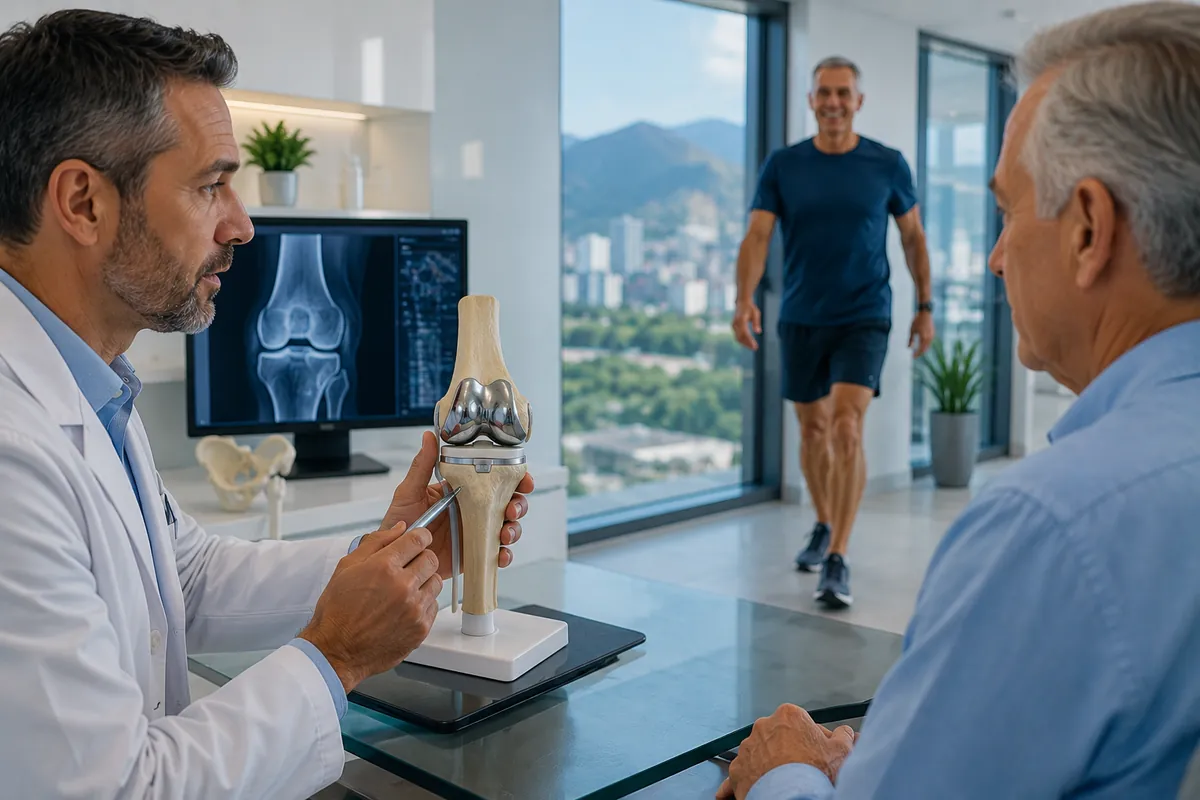
A total hip replacement in Colombia replaces your worn hip joint with an artificial ball-and-socket implant to relieve end-stage arthritis pain and restore mobility. In Medellín, an all-inclusive hip replacement starts near $12,000 USD — including the implant, hospital, surgeon and physical therapy — versus roughly $32,000+ in the U.S. It is performed by board-certified orthopedic surgeons in accredited hospitals, using the same major international implant brands. Plan a 10–16 day stay for rehabilitation and to avoid long-haul flying too early, which lowers blood-clot risk.
In Colombia
$12,000
USD from
In the U.S.
$32,000
USD average
Your saving
63%
less
What a total hip replacement actually is
A total hip replacement — known medically as total hip arthroplasty — replaces a hip joint that has worn out with a durable artificial one. The hip is a ball-and-socket joint: the ball is the top of your thigh bone (the femoral head) and the socket is a cup in your pelvis (the acetabulum). When the smooth cartilage that lets these surfaces glide is destroyed by arthritis or disease, bone grinds on bone, and the result is deep, mechanical pain and stiffness that no amount of rest fully relieves. Surgery removes the damaged surfaces and rebuilds the joint with implant components.
In practice, the surgeon removes the worn femoral head and inserts a stem down into the hollow of the femur, tops it with a new ball, reshapes the socket and fixes an acetabular cup with a smooth liner into the pelvis. Together these recreate a clean, low-friction joint. This is a mature, highly refined operation — one of the most successful in all of modern surgery — and for the right patient it reliably converts constant pain into comfortable, dependable walking.
It is important to be realistic about what a hip replacement does and does not do. It is outstanding at relieving pain and restoring day-to-day mobility — walking, stairs, sleeping, putting on shoes. It is not a license for high-impact abuse: implants are mechanical and wear over time, and while modern joints commonly last 15–20 years or more, they can eventually loosen or wear and need revision. Understanding this up front helps you make a sound decision about timing and activity.
- It replaces both surfaces — a new ball on a stem, and a new socket cup.
- It targets pain and stiffness — the goal is comfortable, reliable walking.
- It is real major surgery — done under anesthesia in a hospital, with genuine rehabilitation.
- Implants are durable, not eternal — commonly 15–20+ years, with revision possible later.
Anterior vs posterior approach — how the surgeon reaches the joint
One of the most common questions patients ask is about the surgical approach — the path the surgeon uses to reach the hip. The two most widely used are the anterior approach (from the front) and the posterior approach (from the back or side). Both implant the same components and both, in experienced hands, produce excellent long-term results. The right choice depends on your anatomy, the surgeon's expertise, and the specifics of your case — not on marketing.
The anterior approach reaches the joint by working between muscles rather than cutting through the major muscles at the back of the hip. Its potential advantages are a possibly quicker early recovery and fewer traditional movement restrictions, because the muscles that stabilize the hip against dislocation are less disturbed. It can be more technically demanding and is not ideal for every body type or hip shape, which is exactly why surgeon experience with the technique matters.
The posterior approach is the most established and versatile route, giving the surgeon excellent visualization and working well across a wide range of anatomies and complex cases. Its trade-off is that patients traditionally follow hip precautions for several weeks — avoiding certain positions (deep bending, crossing the legs, turning the foot inward) while the tissues at the back of the hip heal, to protect against dislocation. Modern technique has made this approach very reliable and safe.
The honest takeaway: there is no single "best" approach for everyone, and a good surgeon selects the one that fits you and that they perform most safely. Our role is to match you with a board-certified orthopedic surgeon whose experience suits your case, and to make sure you understand the precautions your specific approach requires before you travel.
Why choose HealthBridge
What's included and why it matters
A hip replacement is only as good as the surgeon, the hospital and the rehabilitation behind it. Here is what a HealthBridge hip-replacement program is built around — and why each part matters.
Board-certified orthopedic surgeons
Your procedure is performed by an experienced, board-certified orthopedic surgeon — credentialed, high-volume, and held to real standards. We do not book uncredentialed operators to shave the price.
Accredited hospitals, full surgical team
Surgery is done in a properly accredited hospital with an anesthesiologist and complete team — not an outpatient shortcut. When a price sits far below the Colombian range, this is usually the corner that was cut.
Same major international implant brands
Your implant is from the same leading global manufacturers used in top U.S. and European hospitals — ceramic, metal and advanced polyethylene bearings — not off-brand hardware.
All-inclusive price with therapy
One clear USD number bundles the implant, hospital, surgeon and anesthesiologist fees, and post-operative physical therapy — instead of fragmented, unpredictable billing.
In-person rehabilitation, no early flying
Guided physical therapy during your 10–16 day stay, plus clot-prevention and a fly-home clearance from your surgeon — so you recover safely, not on a premature long-haul flight.
Bilingual, end-to-end coordination
One accountable coordinator, in English or Spanish, from your first message through recovery — led by medical director Dra. Olga González, with airport transfers and post-op checks handled.
Implant materials and brands — the same joints used worldwide
A frequent and reasonable worry is whether an implant abroad is somehow inferior. It is not. Reputable Colombian orthopedic surgeons implant the same major international brands used in top U.S. and European hospitals — the leading global orthopedic manufacturers supply these markets alike. The implant in your hip in Medellín is, in the typical case, identical in make and model to what you would receive at home; the difference is the cost of the surgery around it, not the hardware inside you.
Modern hip implants are built from a small number of proven material combinations, chosen for your age, activity and anatomy. The bearing surface — the ball and the liner it glides against — is what determines wear over the years. The most common pairings are a ceramic ball on a highly cross-linked polyethylene (plastic) liner, or a ceramic-on-ceramic bearing; both are prized for very low wear. Older metal-on-polyethylene combinations are also durable and widely used. The stem and cup are typically titanium alloy that bone grows into.
These material choices carry real trade-offs your surgeon will explain. Ceramic bearings are extremely hard and wear-resistant, favored for younger, active patients; advanced cross-linked polyethylene has dramatically improved the longevity of plastic liners. Fixation can be cementless (press-fit), relying on bone to grow into a roughened surface, or cemented, which can suit softer or osteoporotic bone. There is no universally "best" combination — only the best one for your bone quality, age and goals.
- Same global brands — the leading international manufacturers, not off-brand hardware.
- Ceramic-on-poly or ceramic-on-ceramic — low-wear bearings favored for active patients.
- Metal-on-poly — a durable, long-established option.
- Cementless or cemented fixation — matched to your bone quality.
Why patients choose Colombia — and Medellín specifically
The cost difference is the headline, and it is substantial. A total hip replacement that commonly runs $32,000 or more in the U.S. — often far higher once every line item is counted — frequently starts near $12,000 USD, all-inclusive, in Medellín. Crucially, "all-inclusive" here means the price bundles the implant, the hospital stay, the surgeon's and anesthesiologist's fees, and post-operative physical therapy into one clear number, rather than the fragmented, unpredictable billing patients face at home. The savings come from lower healthcare costs in Colombia, not from cutting corners on the implant or the surgeon.
For many international patients, cost is not even the deciding factor — waiting time is. In several countries a hip replacement can mean months, sometimes more than a year, of waitlisted pain and shrinking mobility. In Medellín, once you are cleared, surgery is typically scheduled in a matter of weeks. For someone whose life has narrowed to managing pain, avoiding that wait is worth as much as the money saved.
Medellín itself is well suited to this recovery. Colombia has an established orthopedic tradition, accredited hospitals with modern operating theaters, and experienced, high-volume surgeons. The city's spring-like climate year-round, the walkable and hotel-rich El Poblado district, and direct flights from Miami, Fort Lauderdale, New York, Houston and Panama City make the practical logistics of a longer joint-replacement stay genuinely manageable for U.S. and Central American patients.
What sets HealthBridge apart is that we treat this as medical care, not a shopping trip. Our medical director Dra. Olga González personally coordinates your care — vetting the surgeon match, confirming the hospital is accredited, and staying reachable in English or Spanish from your first message through your recovery. If you are also weighing knee surgery, our knee replacement in Colombia guide follows the same honest standard.
Options
Hip replacement options
- Total hip replacement
- The standard operation: the worn ball and socket are both replaced with implant components. The most reliable, versatile solution for end-stage hip arthritis and the right choice for most patients.
- Anterior approach
- The surgeon reaches the joint from the front, working between muscles. May allow a quicker early recovery and fewer position restrictions for suitable patients; more technically demanding and not ideal for every anatomy.
- Hip resurfacing
- A bone-preserving alternative that caps the femoral head instead of removing it, considered for select younger, active patients with strong bone. Technically demanding and highly selection-dependent; decided by the surgeon.
- Bilateral hip replacement
- For patients with severe arthritis in both hips, both may be addressed — either in one staged plan or sequentially — depending on the surgeon's judgment, your health and recovery capacity. Discussed case by case.
Am I a candidate? Who a hip replacement is for
A total hip replacement is major surgery, so candidacy is a medical decision made by the orthopedic surgeon after reviewing your imaging, history and goals — not a box everyone can tick. The clearest candidates are patients with severe hip osteoarthritis: X-rays showing bone-on-bone joint destruction, paired with pain that limits walking, sleep and daily life. When the joint surface is truly worn out, no amount of physical therapy or injection rebuilds it, and replacement is what reliably restores comfort.
Beyond wear-and-tear arthritis, common reasons for hip replacement include avascular necrosis (osteonecrosis — where the femoral head loses its blood supply and collapses, often in younger patients), rheumatoid and other inflammatory arthritis, hip dysplasia, and painful arthritis following an old fracture or injury. What these share is a joint whose cartilage or bone is irreversibly damaged and painful.
Just as important is that surgery is usually reserved for patients who have failed reasonable conservative care. Before recommending replacement, a responsible surgeon expects that appropriate non-surgical measures — activity modification, weight management, physical therapy, anti-inflammatory medication, walking aids, and sometimes injections — have been tried and no longer control the pain. Surgery is the right answer when the joint is genuinely worn out and quality of life has meaningfully declined, not at the first twinge.
Certain factors need to be managed or may make surgery inadvisable, and an ethical surgeon will say so: active infection, uncontrolled diabetes or heart disease, significant clotting disorders, or a body weight that raises surgical risk. Many of these are modifiable with preparation. The honest bottom line is that candidacy is decided after a proper review — and sometimes the responsible answer is "optimize these things first," which is a feature of good care, not a rejection.
Avoiding the waitlist — timing your surgery
For a large share of the patients we help, the deciding issue is not price at all — it is time. Advanced hip arthritis is progressive and disabling: as the joint deteriorates, walking distance shrinks, sleep is broken by pain, and the muscles around the hip weaken from disuse. Being told the surgery that would fix this is months or more than a year away on a public waitlist means enduring all of that decline in the meantime.
There is also a medical cost to waiting too long. Prolonged pain leads to reduced activity, muscle wasting, weight gain, reliance on pain medication, and stiffness that can make the eventual surgery and rehabilitation harder. Getting the joint replaced while you are still relatively strong and mobile tends to make recovery smoother — deconditioning is a real disadvantage to bring into an operation.
In Medellín, once your work-up is complete and you are cleared, a hip replacement is typically scheduled within weeks, not months. That responsiveness lets you plan your surgery and recovery around your own life and support at home, rather than waiting for a slot to open. It is one of the most concrete, and often most valued, advantages of treating your hip as medical tourism — the ability to act while acting still helps most.
Pricing
How much it costs in Colombia
| Option | In Colombia | In the U.S. |
|---|---|---|
| Total hip replacement (all-inclusive) | from ~$12,000 USD | ~$32,000+ USD |
| Hip resurfacing | individualized quote | $30,000–$45,000+ USD |
| Anterior approach total hip | individualized quote | $32,000–$45,000+ USD |
| Bilateral hip replacement | quoted after assessment | $55,000–$80,000+ USD |
| Revision hip replacement | quoted after assessment | $40,000–$70,000+ USD |
Reference 'from' prices in USD, subject to medical assessment.
Full breakdown, by area and by technique, in our guide to hip replacement cost in Colombia.
At a glance
Hip replacement: Colombia vs the United States
| Colombia (HealthBridge) | United States | |
|---|---|---|
| Total hip replacement (from) | ~$12,000 USD all-inclusive | ~$32,000+ USD |
| Implant brand | Same major international brands | Same major international brands |
| What's included | Implant, hospital, surgeon, therapy | Often billed separately |
| Surgeon | Board-certified orthopedic, high-volume | Board-certified, at premium pricing |
| Wait time | Days–weeks | Weeks–many months |
| Recovery setting | Spring-like Medellín, in-person rehab, 10–16 days | At home |
Why the stay is longer — 10 to 16 days and the reason
Compared with a purely cosmetic trip, a joint-replacement stay is deliberately longer, and understanding why makes the plan reassuring rather than daunting. We recommend 10 to 16 days in Medellín, and the length is driven by two genuine medical priorities: guided early rehabilitation, and safely getting past the window when long-haul flying is risky.
The first days after a hip replacement are when rehabilitation begins and matters most. You are helped to stand and walk within a day, and physical therapists guide you through progressively getting up, walking with a walker and then a cane, managing stairs, and learning the movements to favor and avoid. Doing this supervised, in person, during your stay — rather than being discharged to a long flight and figuring it out alone — protects your result and catches any early issue while your surgeon is right there. Post-operative checks and, if needed, suture or wound review happen in this same window.
The second reason is blood-clot safety. Major hip and leg surgery temporarily raises the risk of deep vein thrombosis (DVT) — clots forming in the leg veins — which can, in the worst case, travel to the lungs (pulmonary embolism). A long-haul flight, with hours of immobility in a cramped seat, compounds that risk at exactly the wrong time. For this reason, patients follow clot-prevention measures (early walking, sometimes blood-thinning medication and compression) and do not take a long flight until the surgeon clears them — usually around 10 to 14 days. Staying put through this period is not padding the trip; it is the standard, cautious way to keep you safe.
Put simply, the extra days buy you supervised recovery and a safer journey home. It is the difference between rehabilitating properly under expert eyes and gambling on a premature flight — and it is why we build the timeline around your safety, not around getting you out the door.
Recovery timeline and precautions — what to expect
Recovery from a hip replacement is steady and, for most patients, remarkably encouraging — the deep arthritic pain is often gone almost immediately, replaced by the ordinary soreness of surgery that fades week by week. The key is understanding the phases so your expectations match reality, and so you protect the new joint while it heals.
The first days (in Medellín). You stand and walk with assistance within about a day, use a walker and then a cane, and work daily with physical therapists. You follow the precautions specific to your surgical approach — a posterior approach traditionally means avoiding deep bending, crossing your legs, and rotating the foot inward for several weeks to prevent dislocation, while an anterior approach often has fewer position restrictions. You will learn safe ways to sit, sleep, dress and get in and out of bed.
Weeks 2–6. You transition off the walker to a cane, keep up prescribed exercises, and gradually resume light daily activities. Swelling and bruising settle, and walking distance grows. Many patients are noticeably more comfortable and mobile by the end of this stretch, though it is still early and precautions and pacing remain important.
Weeks 6–12 and beyond. Most people are walking well, often without a cane, and returning to normal daily life; those with desk jobs frequently return to work within this window, while physically demanding work takes longer. Strength and endurance keep improving for several months, with full recovery and maximal benefit unfolding over roughly six months to a year. Low-impact activity — walking, swimming, cycling — is encouraged long-term; high-impact pounding is generally discouraged to protect the implant. Our hip replacement in Colombia guide walks through the timeline in more detail, and the parallel knee replacement recovery timeline is a useful comparison if you are weighing both joints.
Hip resurfacing — an option for some younger, active patients
Not every hip needs a full replacement. For a select group of younger, active patients with strong bone, a surgeon may discuss hip resurfacing as a bone-preserving alternative. Instead of removing the femoral head and inserting a stem, resurfacing trims and caps the head with a smooth metal cover that glides against a matching metal socket. Because more of your own bone is kept, the idea is to preserve options for the future.
The potential appeal of resurfacing is a more natural feel for high-demand activity and, because bone is conserved, a possibly more straightforward future revision if one is ever needed. It is, however, technically demanding and highly dependent on both surgeon experience and correct patient selection — it is not a better choice for everyone, and it is used far more selectively than total replacement.
Resurfacing is generally reserved for younger, active patients with good bone quality and normal hip anatomy, and is usually not advised for those with weaker or osteoporotic bone, certain metal sensitivities, or smaller femoral heads. Whether it is appropriate for you — versus a standard total hip replacement — is a decision only the operating surgeon can make after reviewing your imaging, age, activity and anatomy. We will make sure that conversation happens honestly, with a surgeon experienced in the technique, rather than pushing any one option.
Safety and standards — how we protect you
Hip replacement is one of the most successful operations in modern medicine, but it is still major surgery, and safety comes from the people and place behind it. Every case we coordinate is performed by a board-certified orthopedic surgeon in an accredited hospital with a full surgical team and an anesthesiologist — not an outpatient shortcut. That setting matters: it means proper pre-operative clearance, sterile modern theaters, and the resources to handle anything unexpected.
The specific risks of hip replacement are well understood and actively managed: blood clots (DVT) are prevented with early walking, compression and, when appropriate, medication; infection is guarded against with sterile technique, antibiotics and pre-operative screening (including dental review); and dislocation is minimized by sound surgical technique and the approach-specific precautions you follow during healing. None of these risks are unique to Colombia — they are the standard risks of the operation anywhere, mitigated the same proven ways.
Our role as a facilitator is to make sure those standards are actually met. HealthBridge does not perform surgery. We connect you with vetted, board-certified orthopedic surgeons operating in accredited facilities, and we will not book anyone into an under-resourced setting to hit a lower price. When a quote sits far below the realistic Colombian range, that is a warning sign, not a bargain — and we would rather explain that plainly than let you chase it.
Planning your trip and what's included
Planning a surgical trip abroad sounds daunting, but the point of a facilitator is that one team handles the logistics so you can focus on healing. It starts with a free, no-obligation assessment: you send your goals, a short medical history, and recent hip X-rays or reports by WhatsApp, and Dra. González's team reviews your case, matches you with an appropriate board-certified orthopedic surgeon, and returns an itemized quote in USD. Because every hip is different, the final price and plan follow the surgeon's review — not a fixed wall price.
A typical hip-replacement program with HealthBridge is genuinely all-inclusive: it bundles the surgeon's and anesthesiologist's fees, the accredited hospital stay, the implant itself, standard pre-operative labs and imaging review, and post-operative physical therapy during your stay, along with airport transfers and bilingual coordination throughout. We are equally clear about what is not included — international flights, your hotel or recovery accommodation, and any optional add-ons — so there are no surprises after you land.
- Free assessment. Share your goals, history and hip imaging by WhatsApp; receive honest guidance and an itemized USD quote.
- Schedule & travel. Fly into Medellín's MDE airport — direct from Miami, Fort Lauderdale, New York, Houston and Panama City. We arrange transfers and help with a suitable, accessible hotel.
- Surgery & rehab. Your operation is performed in an accredited hospital; plan for 10–16 days in Medellín for guided physical therapy and post-op checks.
- Fly-home clearance. No long-haul flying until your surgeon clears you (about 10–14 days), with clot-prevention measures throughout — and we stay reachable afterward.
Throughout, our promise is a safe, board-certified operation, an honest plan, and a named coordinator who stays with you. To go deeper before you decide, start with our joint replacement in Colombia overview, then reach out from our medical tourism home page for a free assessment.
Meet your coordinator — Dra. Olga González
For a major operation abroad, it matters that a named, accountable physician oversees your journey rather than an anonymous booking desk. Dra. Olga González is HealthBridge's medical director and the person who personally coordinates your hip replacement — reviewing your case and imaging, matching you to a suitable board-certified orthopedic surgeon, confirming the hospital is accredited, and staying reachable in English or Spanish from your first message through your recovery.
To be clear about roles: Dra. González does not perform your surgery. The operation is carried out by an experienced, board-certified orthopedic surgeon, with an anesthesiologist and full surgical team, in an accredited hospital. Her job as medical director is to make sure you are matched to the right surgeon for your anatomy and goals, that the setting meets real safety standards, and that you understand honestly what a hip replacement can and cannot do — and what recovery genuinely requires — before anything is scheduled.
That posture — care over sales — is the whole point of using a facilitator like HealthBridge. You are not funneled to whoever is cheapest; you are guided by someone whose interest is a safe, well-matched outcome, and who will tell you plainly if you should optimize your health first or reconsider timing. When you travel to Medellín with us, you correspond with one bilingual team, you know who your surgeon is before you fly, and you leave with follow-up guidance you can share with your doctor at home.
To begin, reach out from our home page for a free, no-obligation assessment, and read our hip replacement in Colombia guide first so you arrive genuinely informed.
How it works
Your medical journey, step by step
Part of our Joint Replacement Surgery program.
Free assessment & quote
Message us on WhatsApp with your case, records or photos. We review it and send a plan and quote in USD before you book a flight — at no cost.
Travel plan
We coordinate a board-certified specialist, accredited hospital, dates, accommodation and airport transfers in Medellín.
Procedure
You're treated by board-certified specialists in accredited facilities, with bilingual support at every step.
Recovery & follow-up
You recover in Medellín with included check-ups and WhatsApp follow-up once you're home.

Your trusted physician
Dra. Olga González
Medical Director
Aesthetic Medicine Physician · Longevity & Regenerative Medicine · Health Coach in Nutrition · Universidad de San Martín
Dra. Olga González is the medical director of HealthBridge Medical Tourism. A physician trained at Universidad de San Martín and certified in aesthetic medicine, she has built her practice in El Poblado, Medellín, around longevity, regenerative medicine and biohacking. She personally coordinates each international patient's care — vetting surgeons, accredited hospitals and recovery plans — so that every traveler is treated by board-certified specialists and supported in their own language from the first message to the final follow-up.
- Aesthetic Medicine
- Regenerative & Longevity Medicine
- Biohacking
- Clinical Nutrition
Frequently asked questions
How much does a hip replacement cost in Colombia?
Are the implants the same as in the U.S.?
What is the difference between the anterior and posterior approach?
How long do I need to stay in Medellín?
Why is the stay longer than for other procedures?
Am I a candidate for a hip replacement?
How long does a hip replacement last?
What is hip resurfacing, and is it better?
What is recovery like after a hip replacement?
Is it safe to have surgery in Colombia?
Can both hips be replaced?
Does HealthBridge perform the surgery?
You may also consider
Other procedures in this specialty
Many patients combine procedures in a single trip. These are the ones we coordinate within the same specialty.
Sources
Where to verify this information
We're not asking you to take our word for it. These are independent medical bodies whose guidance you can read directly before making any decision.
- OrthoInfo (American Academy of Orthopaedic Surgeons) — joint and bone conditions
- CDC Yellow Book — Medical Tourism: risks, planning and post-travel care
- MedlinePlus (U.S. National Library of Medicine) — patient health information
HealthBridge is not affiliated with or endorsed by these organizations. They are cited as independent reference.
Other specialties
Explore more treatments in Colombia



Ready to take the first step?
Send us your case on WhatsApp and get a personalized plan and quote — free, with no obligation.
El Poblado, Medellín · Mon–Fri 8:00 AM – 6:00 PM · Sat 9:00 AM – 1:00 PM (COT)