
Joint replacement · Medellín, Colombia
Shoulder Replacement in Colombia — Anatomic & Reverse Total Shoulder in Medellín
A board-certified shoulder replacement in Medellín with experienced orthopedic shoulder surgeons, accredited hospitals, and an all-inclusive price that covers the implant, hospital stay and early physical therapy — from about $13,000 USD, with a typical stay of 10–16 days. Coordinated end to end by our medical director, Dra. Olga González.
- Board-certified orthopedic surgeons
- Anatomic & reverse options
- From ~$13,000 USD
- Implant + hospital + PT included
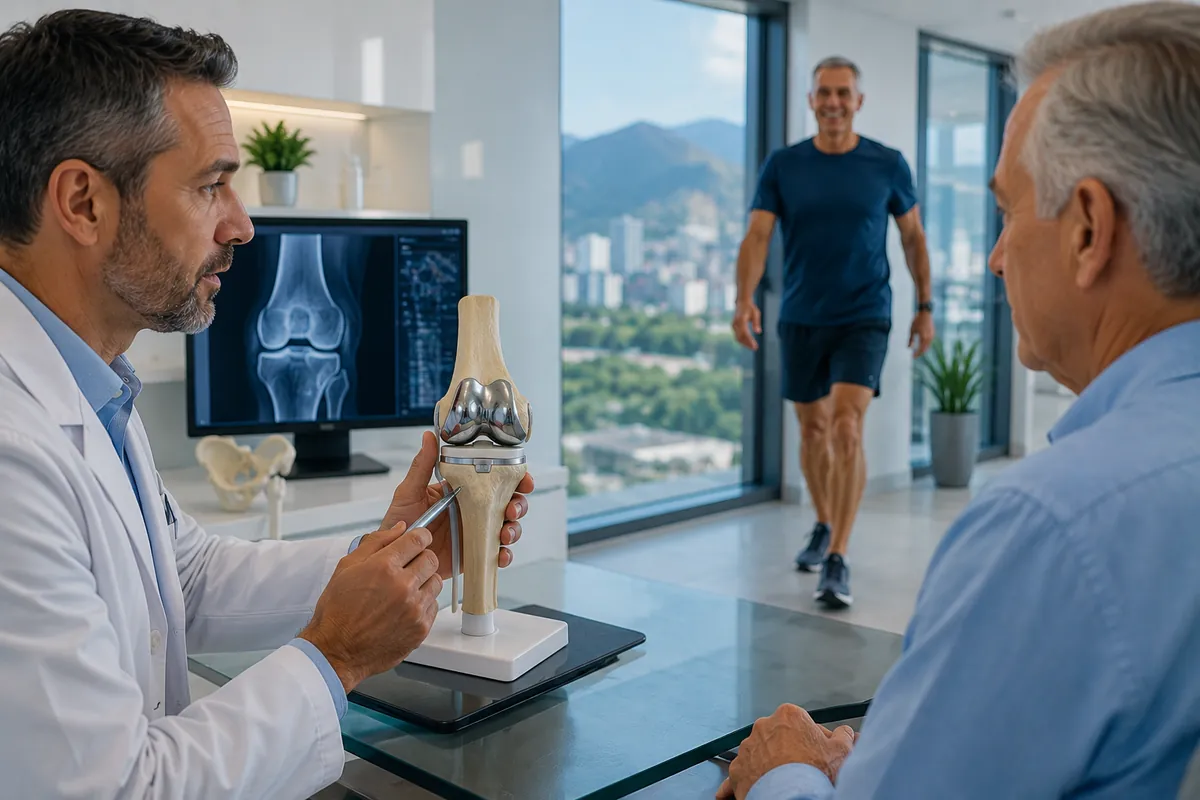
A shoulder replacement in Colombia replaces a worn or damaged shoulder joint with an artificial implant to relieve arthritis pain and restore movement. In Medellín, it starts near $13,000 USD — all-inclusive of the implant, hospital and early physical therapy — versus roughly $24,500 or more in the U.S. Two main designs exist: anatomic total shoulder (when the rotator cuff is intact) and reverse total shoulder (when the cuff is torn or the bone is fractured). Surgery is performed by a board-certified orthopedic shoulder surgeon in an accredited hospital. A typical stay is 10–16 days, largely so early rehab is supervised and you avoid long-haul flying while the clot risk is highest.
In Colombia
$13,000
USD from
In the U.S.
$24,500
USD average
Your saving
47%
less
What a shoulder replacement actually is
A shoulder replacement, known medically as shoulder arthroplasty, is an operation that removes the worn-out surfaces of the shoulder joint and replaces them with an artificial implant. The shoulder is a ball-and-socket joint: the rounded head of the upper arm bone (the humerus) sits against a shallow socket (the glenoid) on the shoulder blade. When the smooth cartilage that cushions these surfaces wears away — through arthritis, injury or years of use — bone grinds on bone, producing deep pain, stiffness and a shoulder that no longer does its job. A replacement restores a smooth, gliding surface so the joint can move without that grinding pain.
Unlike a cortisone injection or arthroscopic "clean-up," a shoulder replacement is a definitive treatment for advanced joint damage. It is one of the most reliable operations in orthopedics for taking away arthritis pain, and for most patients the biggest, fastest change is exactly that: the constant ache eases in a way that non-surgical measures could not achieve. Restoring motion and strength follows more gradually, through healing and physical therapy, but pain relief is usually the headline benefit and the reason most people finally decide to proceed.
It is important to be clear-eyed about what the operation is. A shoulder replacement is major surgery, performed under anesthesia in a hospital by an orthopedic surgeon, with a genuine, months-long recovery and a real course of rehabilitation. It is not a quick fix and not the first thing to try — it is what a good surgeon recommends after arthritis or a serious injury has genuinely worn the joint out and conservative care has stopped working. Understanding that up front is the foundation of a good outcome.
- It resurfaces the joint — worn ball and socket are replaced with metal and plastic components.
- Pain relief comes first — the grinding arthritis pain typically eases dramatically.
- Motion returns gradually — through healing and a structured physical-therapy program.
- It is major surgery — a considered step after conservative care has failed, not a first resort.
Anatomic total vs reverse total shoulder — and when reverse is used
There are two fundamentally different designs of shoulder replacement, and choosing between them is the single most important surgical decision. The difference comes down to one structure: the rotator cuff, the group of muscles and tendons that normally powers and stabilizes the shoulder. Which implant is right for you depends almost entirely on whether that cuff still works.
An anatomic total shoulder replacement recreates the joint's natural layout — a metal ball on the arm and a plastic socket on the shoulder blade, in the same positions nature put them. It gives excellent pain relief and motion, but it has one requirement: the rotator cuff must be intact, because the new joint still relies on those muscles to move and stabilize the arm. This is the classic choice for a patient with severe shoulder osteoarthritis and a healthy cuff.
A reverse total shoulder replacement does something ingenious: it swaps the positions, fixing the ball to the shoulder blade and the socket to the arm. That geometry changes the mechanics so the large, strong deltoid muscle can lift the arm even when the rotator cuff is gone. It was designed specifically for shoulders where the cuff is torn beyond repair and can no longer do its work. If an anatomic implant were used in that situation, the arm simply could not be raised — which is why the reverse design exists.
The most common reason a surgeon recommends the reverse design is rotator cuff tear arthropathy — a condition where a large, long-standing rotator cuff tear has led to arthritis and the ball riding up out of position, so the shoulder is both worn out and unable to lift. The reverse implant is also the preferred solution for certain complex fractures of the upper arm in older patients, for failed previous shoulder surgery, and for some cases of severe bone loss. Your surgeon determines which design fits your anatomy after examining you and reviewing imaging — this is not a choice made from a price list, and it is at the heart of the honest conversation you will have before anything is scheduled.
Why choose HealthBridge
What's included and why it matters
A shoulder replacement is only as good as the surgeon, the hospital and the rehabilitation behind it. Here is what a HealthBridge program is built around — and why each part matters.
Board-certified orthopedic surgeons
Your procedure is performed by an experienced, board-certified orthopedic shoulder surgeon — credentialed and trained to international standards. We do not book uncertified operators to shave the price.
Accredited hospitals
Surgery is done in a properly accredited hospital equipped for major joint replacement, with real anesthesia care and infection- and clot-prevention protocols — not a low-resource clinic.
All-inclusive price
Your quote covers the implant, the hospital stay, the surgeon and anesthesia team, and early physical therapy in one transparent USD figure — no separately billed surprises after you land.
The right implant for your shoulder
Anatomic or reverse total shoulder is chosen by the surgeon based on your rotator cuff, bone and diagnosis — using established global implant brands, not a design picked to hit a price.
Supervised early rehabilitation
Your recovery starts in Medellín under your surgeon and a physical therapist, so the sling, protected motion and your exercise plan are correct before you travel home.
Bilingual, end-to-end coordination
One accountable coordinator, in English or Spanish, from your first message through recovery — led by medical director Dra. Olga González, with airport transfers and post-op checks handled.
Implant materials and brands — what's inside a modern shoulder
Modern shoulder implants are made from materials that have been refined over decades of orthopedic use. The ball (or, in a reverse, the arm-side stem and the glenosphere) is typically a corrosion-resistant metal alloy such as cobalt-chromium or titanium; the socket surface is usually a highly cross-linked, high-density polyethylene (medical-grade plastic) designed to be smooth and wear-resistant. Components may be fixed to bone with surgical bone cement or, in some designs, with a porous surface that allows bone to grow directly onto the implant. Your surgeon selects the combination based on your bone quality, anatomy and the design being used.
The implants themselves come from the same established global orthopedic manufacturers whose devices are used in the United States and Europe — companies such as Stryker, Zimmer Biomet, DePuy Synthes and Arthrex, among others. This matters for a simple reason many international patients ask about: you are not receiving an inferior or unfamiliar device by having surgery in Colombia. Accredited Colombian hospitals implant the same brand-name systems, and your surgeon will tell you which one is planned for your case and why.
Two questions patients reasonably ask are about longevity and safety, and both deserve an honest answer. A well-implanted shoulder replacement is durable and, for most patients, lasts many years — often well over a decade — though no implant is guaranteed to last forever, and heavy demand or complications can shorten that. On safety, the components are inert and biocompatible; the real determinants of a good, lasting result are surgeon experience, correct implant choice and clean surgical technique, not the brand logo on the box. That is why our focus is on vetting the surgeon and the hospital, not on marketing a particular implant.
Why patients choose Colombia — and Medellín specifically
The cost difference is the headline, and it is real. A shoulder replacement that commonly runs $24,500 or more in the United States — often far higher once the hospital, surgeon, anesthesia and implant are billed separately — frequently starts near $13,000 USD in Medellín, and that Colombian figure is typically all-inclusive: the implant, the accredited hospital stay, the surgeon and anesthesia team, and your early physical therapy in one transparent price. Crucially, the gap comes from the lower cost of delivering care in Colombia, not from a cheaper implant or a cut-rate surgeon. When a price looks far below even the Colombian range, that is a warning sign, not a bargain.
But cost alone is not why Medellín has become a genuine destination for orthopedic care. Colombia has a strong, well-established medical system, and its board-certified orthopedic and shoulder surgeons are experienced and trained to international standards, operating in accredited hospitals equipped for complex joint replacement. The city itself makes recovery unusually comfortable: a spring-like climate year-round, the walkable, hotel-rich El Poblado district, and direct flights from Miami, Fort Lauderdale, New York, Houston and Panama City that put it a short hop from the U.S. and Central America.
What sets HealthBridge apart is that we treat this as medical care, not a shopping trip. Many "surgery package" operators abroad are sales machines that funnel patients to whoever is cheapest that week. Here, our medical director Dra. Olga González personally coordinates your care — vetting the surgeon match, confirming the hospital is accredited, and staying reachable in English or Spanish from your first message through your recovery. You get a named, accountable coordinator rather than a call center. If you are comparing options, our overviews of knee replacement and hip replacement in Colombia explain how the same standards apply across joints.
- Meaningful, honest savings — lower overhead, not lower standards, and an all-inclusive price.
- Board-certified orthopedic surgeons — experienced, credentialed, operating in accredited hospitals.
- Comfortable recovery base — spring-like Medellín, El Poblado, easy direct flights.
- One accountable coordinator — Dra. Olga González, bilingual, end to end.
Options
Types of shoulder replacement
- Anatomic total shoulder replacement
- The classic design that recreates the joint's natural layout — a metal ball on the arm and a plastic socket on the shoulder blade. Best for severe osteoarthritis when the rotator cuff is intact and can still power the joint.
- Reverse total shoulder replacement
- The ball and socket positions are swapped so the deltoid muscle can lift the arm without a working rotator cuff. The preferred choice for rotator cuff tear arthropathy, complex fractures and some failed prior surgeries.
- Partial replacement (hemiarthroplasty)
- Only the ball (humeral head) is replaced, leaving the natural socket in place. Used in selected cases such as certain fractures or when the glenoid is healthy, as decided by the operating surgeon.
- Shoulder resurfacing
- A bone-preserving option that caps the humeral head rather than removing it, in suitable younger or select patients. Suitability is limited and determined case by case after imaging and examination.
Am I a good candidate for a shoulder replacement?
A shoulder replacement is major surgery, so candidacy is a medical decision made by the surgeon after examining you and reviewing imaging — not a box everyone can tick. The core reason people qualify is advanced joint damage that no longer responds to conservative care. The most common driver is severe shoulder osteoarthritis: cartilage has worn away, bone rubs on bone, and the pain is constant — often disturbing sleep and stopping everyday tasks like reaching, dressing or lifting. When the joint is genuinely worn out, a replacement is frequently the treatment that finally works.
Several other conditions lead to a shoulder replacement. Rotator cuff tear arthropathy — a large, irreparable cuff tear that has caused arthritis and loss of overhead motion — is a classic reason for the reverse design. Complex fractures of the upper arm, especially in older patients where the bone cannot be reliably repaired, sometimes call for replacement rather than fixation. Rheumatoid or other inflammatory arthritis, avascular necrosis (loss of blood supply to the bone), and a failed previous shoulder surgery are further reasons a surgeon may recommend it.
Just as important is that conservative care has genuinely been tried and has stopped working. A responsible surgeon expects that reasonable non-surgical steps — activity modification, anti-inflammatory medication, physical therapy, and sometimes cortisone injections — have been used first. Surgery is what comes after those have failed to control the pain and disability, not instead of them.
Certain factors make surgery higher-risk or inadvisable, and an ethical surgeon will say so: active infection, significant uncontrolled heart or clotting disorders, uncontrolled diabetes, a non-functioning deltoid muscle (which the reverse design depends on), or unrealistic expectations. The honest bottom line is that candidacy is decided by the operating surgeon after a proper review of your history, examination and imaging — and sometimes the responsible answer is "not yet," or "a different procedure." That is a feature of good care, not a failure of it.
Why the stay is 10–16 days — and why it matters
One of the most common questions is why the stay in Medellín is 10 to 16 days rather than a quick in-and-out. The answer is safety and rehabilitation, and it is worth understanding because it is one of the ways a responsible program differs from a bargain one. After a shoulder replacement you do not simply fly home the next day; the early days are when your surgeon confirms the joint is healing well, manages pain, watches for any early complication, and gets your rehabilitation started under supervision before you travel.
The first reason is supervised early rehabilitation. The days right after surgery set the tone for your whole recovery — the sling is fitted correctly, gentle protected motion begins, and a physical therapist teaches you exactly what you may and may not do so you protect the repair while keeping the joint from stiffening. Doing this in Medellín, with your surgeon reachable, means problems are caught and corrected early rather than by video call from another country.
The second reason is flying and clot risk. Any major orthopedic surgery temporarily raises the risk of a blood clot in the legs (deep vein thrombosis, or DVT), which in rare cases can travel to the lungs. Long-haul flying — sitting still for hours in a pressurized cabin — is itself associated with clot risk, so combining a fresh major surgery with a long flight too soon is exactly what we avoid. Staying 10–16 days keeps you on the ground through the highest-risk early window, with early walking and other clot-prevention measures in place, until your surgeon clears you to fly.
Put simply, the stay is not padding — it is the window in which your surgeon confirms you have healed enough to travel safely and your rehabilitation is on track. Your surgeon gives the final fly-home clearance based on how you are actually doing, and we stay reachable afterward so your recovery does not fall off a cliff the moment you land.
Pricing
How much it costs in Colombia
| Option | In Colombia | In the U.S. |
|---|---|---|
| Anatomic total shoulder replacement | from ~$13,000 USD | ~$24,500+ USD |
| Reverse total shoulder replacement | individualized quote | $35,000–$50,000+ USD |
| Partial replacement (hemiarthroplasty) | quoted after assessment | $20,000–$35,000+ USD |
| Shoulder resurfacing (select cases) | quoted after assessment | $20,000–$35,000+ USD |
| Revision shoulder replacement | quoted after imaging review | $40,000–$60,000+ USD |
Reference 'from' prices in USD, subject to medical assessment.
Full breakdown, by area and by technique, in our guide to shoulder replacement cost in Colombia.
At a glance
Shoulder replacement: Colombia vs the United States
| Colombia (HealthBridge) | United States | |
|---|---|---|
| Total shoulder (from) | ~$13,000 USD, all-inclusive | ~$24,500+ USD |
| Reverse total shoulder | individualized quote | $35,000–$50,000+ USD |
| What's included | Implant + hospital + early PT | Often billed separately |
| Surgeon | Board-certified orthopedic, accredited hospital | Board-certified, at premium pricing |
| Wait time | Days–weeks | Weeks–months |
| Recovery setting | Spring-like Medellín, supervised, 10–16 days | At home |
Recovery timeline and why physical therapy is everything
Recovery from a shoulder replacement is a months-long process, and being honest about it prevents most disappointment. For the first few weeks your arm rests in a sling while the tissues heal, and you begin only the gentle, protected movements your surgeon and therapist approve — pendulum exercises and passive motion, where the arm is supported rather than actively lifted. This early phase protects the repair; pushing too hard too soon is one of the few ways to genuinely set yourself back.
Over the following weeks and months the program progresses in stages: from passive motion, to active-assisted movement, to active motion, and finally to strengthening. Each stage is gated by healing, not by the calendar alone, and your surgeon's protocol dictates the pace. Many patients notice meaningful pain relief relatively early — often the first and most welcome change — while regaining strength and a full, comfortable range of motion is the slower part, unfolding over roughly three to six months, and sometimes up to a year for the last gains.
This is why physical therapy is not optional — it is the operation's other half. The implant restores a smooth joint surface, but it is the rehabilitation that turns that into a shoulder you can actually use. Patients who commit to their therapy consistently do far better than those who don't; skipping it is the fastest route to a stiff, underperforming result. Before you fly home, your team makes sure you understand your exercises and gives you a plan you can continue with a therapist near you.
We are equally honest about limits and expectations. A replaced shoulder can restore comfortable daily function — reaching, dressing, sleeping without pain — and for many people far more, but it is not a bionic upgrade, and heavy overhead labor or high-impact loading is generally discouraged to protect the implant. The goal is a durable, pain-free, functional shoulder, and setting that expectation honestly at the start is part of a good result. You can read a fuller walk-through in our shoulder replacement in Colombia guide.
Safety, and planning your trip
Planning surgery abroad sounds daunting, but the point of a facilitator is that one team handles the logistics so you can focus on healing. It starts with a free, no-obligation assessment: you send your history, symptoms and any recent imaging (X-rays, CT or MRI reports) by WhatsApp, and Dra. González's team reviews your case, matches you with an appropriate board-certified orthopedic shoulder surgeon, and returns an itemized quote in USD. Because the right implant and plan depend on your anatomy, the final price follows the surgeon's review — not a fixed wall price.
Safety is not a slogan here; it is built into how we work. Surgery is performed in an accredited hospital equipped for major joint replacement, by a credentialed orthopedic surgeon, with proper anesthesia care and standard measures to reduce infection and clot risk. Our role as a facilitator is to protect you from the false economy of a bargain that cuts exactly these corners — HealthBridge does not perform surgery; we connect you with vetted surgeons in accredited facilities and will not book anyone into an under-resourced setting to hit a lower number.
- Free assessment. Share your history, symptoms and imaging by WhatsApp; receive honest guidance and an itemized, all-inclusive USD quote.
- Schedule & travel. Fly into Medellín's MDE airport — direct from Miami, Fort Lauderdale, New York, Houston and Panama City. We arrange transfers and help with a nearby hotel.
- Surgery & stay. Your operation is performed in an accredited hospital; plan for 10–16 days in Medellín for surgery, supervised early rehab and safe recovery.
- Fly-home clearance. Your surgeon clears you before you travel, once the highest-risk early window has passed — and we stay reachable afterward.
Throughout, our promise is simple: a safe, board-certified procedure, an honest plan, an all-inclusive price, and a named coordinator who stays with you. To go deeper before you decide, start with our joint replacement in Colombia overview and our shoulder replacement guide, then reach out from our medical tourism home page for a free assessment.
Meet your coordinator — Dra. Olga González
For a major operation where trust and safety are everything, it matters that a named, accountable physician oversees your journey rather than an anonymous booking desk. Dra. Olga González is HealthBridge's medical director and the person who personally coordinates your shoulder replacement — reviewing your case, matching you to a suitable board-certified orthopedic surgeon, confirming the hospital is accredited, and staying reachable in English or Spanish from your first message through your recovery.
To be clear about roles: Dra. González does not perform your surgery. The operation is carried out by an experienced, board-certified orthopedic shoulder surgeon in an accredited hospital, with proper anesthesia care throughout. Her job as medical director is to make sure you are matched to the right surgeon for your anatomy and diagnosis, that the setting meets real safety standards, and that you understand honestly what a shoulder replacement can and cannot do — including which design fits you — before anything is scheduled.
That posture — care over sales — is the whole point of using a facilitator like HealthBridge. You are not funneled to whoever is cheapest; you are guided by someone whose interest is a safe, well-matched outcome, and who will tell you plainly if surgery is not the right step yet or if a different procedure fits your shoulder better. When you travel to Medellín with us, you correspond with one bilingual team, you know who your surgeon is before you fly, and you leave with follow-up guidance you can share with your doctor and therapist at home. To begin, reach out from our home page for a free, no-obligation assessment.
How it works
Your medical journey, step by step
Part of our Joint Replacement Surgery program.
Free assessment & quote
Message us on WhatsApp with your case, records or photos. We review it and send a plan and quote in USD before you book a flight — at no cost.
Travel plan
We coordinate a board-certified specialist, accredited hospital, dates, accommodation and airport transfers in Medellín.
Procedure
You're treated by board-certified specialists in accredited facilities, with bilingual support at every step.
Recovery & follow-up
You recover in Medellín with included check-ups and WhatsApp follow-up once you're home.
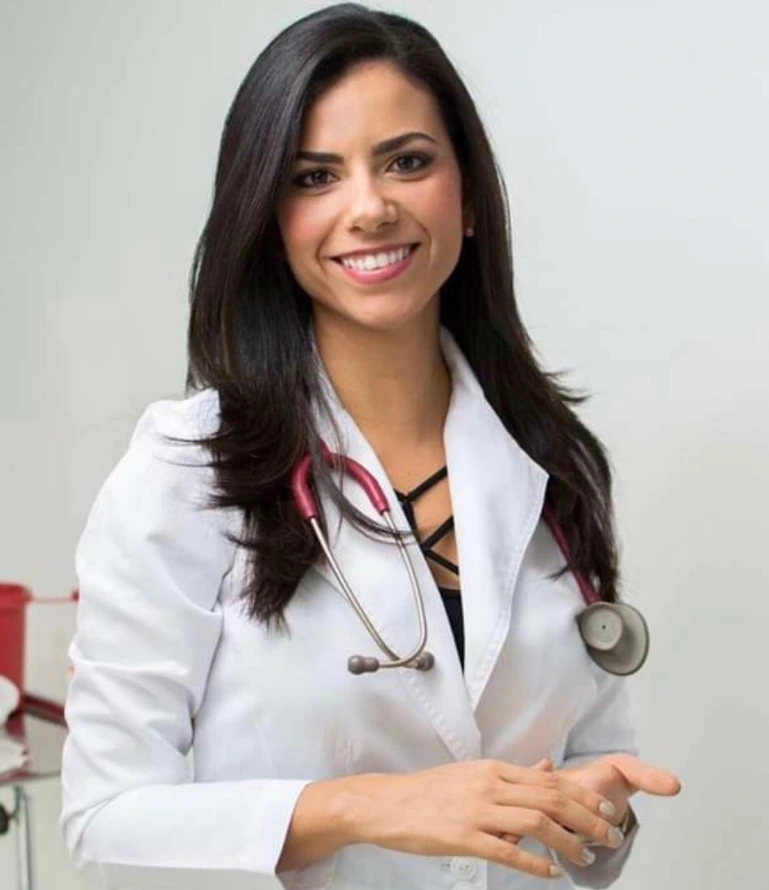
Your trusted physician
Dra. Olga González
Medical Director
Aesthetic Medicine Physician · Longevity & Regenerative Medicine · Health Coach in Nutrition · Universidad de San Martín
Dra. Olga González is the medical director of HealthBridge Medical Tourism. A physician trained at Universidad de San Martín and certified in aesthetic medicine, she has built her practice in El Poblado, Medellín, around longevity, regenerative medicine and biohacking. She personally coordinates each international patient's care — vetting surgeons, accredited hospitals and recovery plans — so that every traveler is treated by board-certified specialists and supported in their own language from the first message to the final follow-up.
- Aesthetic Medicine
- Regenerative & Longevity Medicine
- Biohacking
- Clinical Nutrition
Frequently asked questions
How much does a shoulder replacement cost in Colombia?
What is the difference between anatomic and reverse total shoulder replacement?
When is a reverse total shoulder replacement needed?
Am I a good candidate for a shoulder replacement?
How long do I need to stay in Medellín?
Why can't I fly home right after surgery?
How long is the recovery from a shoulder replacement?
Why is physical therapy so important?
What implants and brands are used?
How long does a shoulder replacement last?
Is having surgery in Colombia safe?
Does HealthBridge perform the surgery?
You may also consider
Other procedures in this specialty
Many patients combine procedures in a single trip. These are the ones we coordinate within the same specialty.
Medical references
What this page is based on
For each source we state which claim it supports, with a direct link, so you can check it yourself.
-
OrthoInfo (American Academy of Orthopaedic Surgeons) — Shoulder joint replacement
Backs both the description and the recovery timeline on this page: the damaged parts of the shoulder are removed and replaced with a prosthesis in a roughly two-hour operation, a sling is worn for 2 to 6 weeks, and simple activities such as eating and dressing resume within about two weeks.
-
INVIMA — Instituto Nacional de Vigilancia de Medicamentos y Alimentos (Colombia)
Colombia's own regulator, and where the products used in your treatment have to be registered: INVIMA supervises and controls medicines and biological products, medical devices and diagnostic equipment, and cosmetics marketed in Colombia.
Prices, length of stay and package contents are HealthBridge's own figures and do not come from these sources. The U.S. price we compare against comes from our own price study, where every figure is traced to a named U.S. clinic. None of these organizations is affiliated with or endorses HealthBridge.
Sources
Where to verify this information
We're not asking you to take our word for it. These are independent medical bodies whose guidance you can read directly before making any decision.
- OrthoInfo (American Academy of Orthopaedic Surgeons) — joint and bone conditions
- CDC Yellow Book — Medical Tourism: risks, planning and post-travel care
- MedlinePlus (U.S. National Library of Medicine) — patient health information
HealthBridge is not affiliated with or endorsed by these organizations. They are cited as independent reference.
Other specialties
Explore more treatments in Colombia

Ready to take the first step?
Send us your case on WhatsApp and get a personalized plan and quote — free, with no obligation.
El Poblado, Medellín · Mon–Fri 8:00 AM – 6:00 PM · Sat 9:00 AM – 1:00 PM (COT)