
Aesthetic medicine
Collagen Biostimulators in Colombia
Poly-L-lactic acid, calcium hydroxyapatite and polycaprolactone stimulate your own collagen instead of placing gel — a gradual, structural improvement in skin quality and facial support, led by a physician trained in both aesthetic and regenerative medicine.
- From ~$450 USD per vial
- Stimulates your own collagen
- Results build over 3–6 months
- Lasts 18 months–2+ years
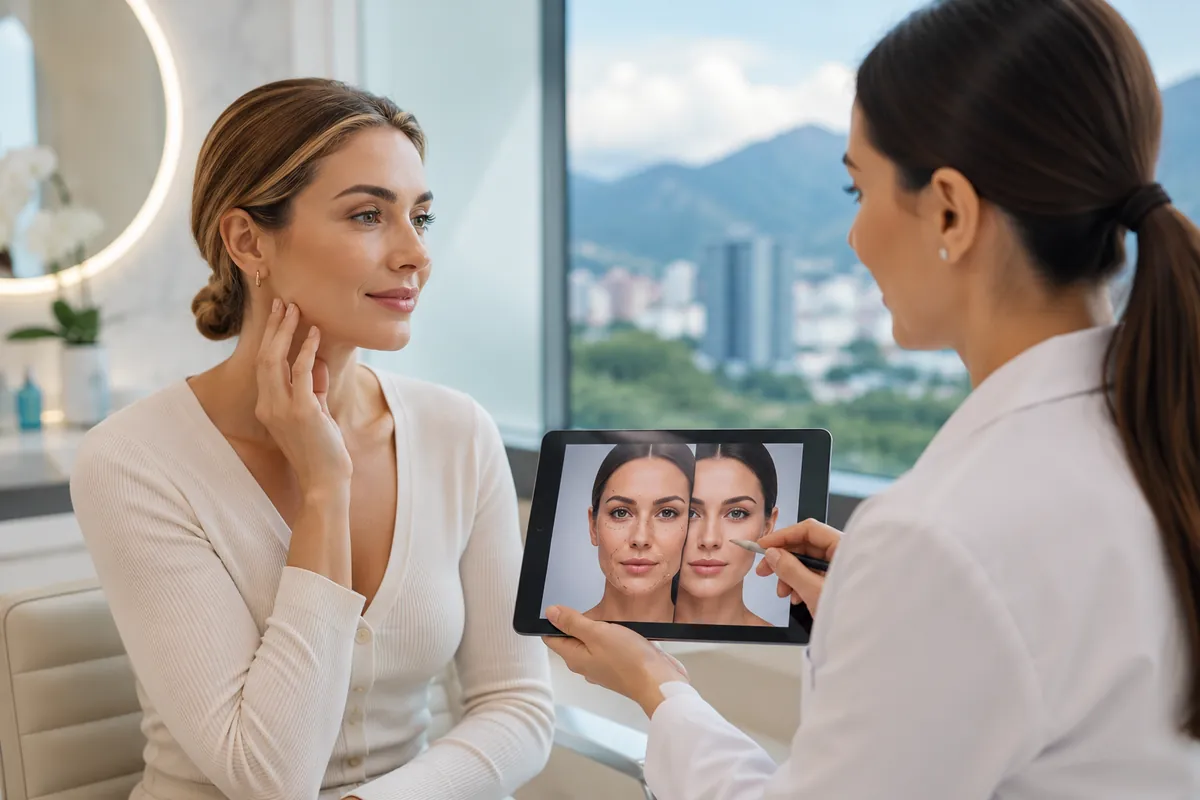
Collagen biostimulators work differently from fillers: instead of placing a gel that occupies space, they trigger your own fibroblasts to produce new collagen, and the product itself is reabsorbed. In Medellín treatment starts near $450 USD per vial, against roughly $900 to $1,500 in the United States. The trade-off is honest and important: results are gradual, appearing over three to six months rather than immediately, and a series of sessions is normally required. In exchange, results typically last 18 months to over two years and improve skin quality and facial support rather than adding volume to a specific point.
In Colombia
$450
USD from
In the U.S.
$1,000
USD average
Your saving
55%
less
What a biostimulator is, and why it is not a filler
A dermal filler occupies space: you inject gel and it holds volume where you placed it, immediately. A biostimulator does the opposite. It places a material that your body reacts to, prompting fibroblasts to lay down new collagen over the following months. The injected product is then reabsorbed. What remains is your own tissue.
That difference explains everything else about these treatments. Because you are growing collagen rather than placing gel, nothing much happens immediately — with poly-L-lactic acid in particular, any swelling you see on day one is water, not result, and it settles within days. Because collagen takes time to build, the effect appears over three to six months. And because it is your own tissue, the result reads as restored structure and better skin quality rather than as something added.
This also changes what they are good for. A filler is the right tool for a defined target — a lip, a chin, a tear trough. A biostimulator is the right tool for diffuse change: generalized volume loss across the midface, crepey skin on the neck or décolletage, an overall loss of firmness. If your concern is one specific fold or feature, our dermal fillers guide covers the better option, and if your lines come from muscle movement, see our Botox guide.
The three main products and how they differ
Poly-L-lactic acid (Sculptra) is the purest biostimulator: it adds essentially no immediate volume and works entirely by collagen stimulation over months. It suits generalized midface volume loss, temples, and body areas including buttocks and the crepey skin of arms and thighs. It normally requires a series — commonly two to three sessions spaced four to six weeks apart — and results last two years or more. It demands the most patience and rewards it.
Calcium hydroxyapatite (Radiesse) is a hybrid. Its gel carrier gives immediate lift, which then partially settles as the carrier reabsorbs, while the microspheres stimulate collagen that sustains the result over two to three months. Undiluted it is excellent for jawline definition and structural support; hyperdiluted it becomes a skin-quality treatment for neck, décolletage and hands. Results typically last 12 to 18 months. It is not used in lips.
Polycaprolactone (Ellansé) is a longer-acting biostimulator, available in formulations engineered to last from roughly one to four years depending on version. It gives some immediate correction plus sustained collagen stimulation. Its longevity is its attraction and also the reason to be conservative: with any product this durable, a result you dislike lasts a long time. There is also Profhilo and similar bio-remodelling hyaluronic acids, which sit between categories — technically hyaluronic acid, but used to improve hydration and skin quality across an area rather than to add volume.
Why choose HealthBridge
What is included and why it matters
Biostimulators reward patience, correct technique and honest expectation-setting more than almost any aesthetic treatment. Here is what our program is built around.
Led by a physician trained in regenerative medicine
Dra. Olga González specializes in aesthetic medicine and in longevity and regenerative medicine. A biostimulator is fundamentally regenerative — the agent is your own collagen.
Honest timeline from the first conversation
We tell you before you pay that little happens for six weeks and the real result is at three to six months. Most disappointment in this category comes from nobody explaining that.
Proper reconstitution and technique
Poly-L-lactic acid is reconstituted well in advance, not minutes before. Placement plane and even distribution are what separate a good result from nodules.
Massage protocol you actually get taught
You leave knowing exactly how and how often to massage at home for the following days. It sounds trivial and it is the single most effective thing you do to prevent nodules.
Conservative dosing, because there is no antidote
Unlike hyaluronic acid, biostimulators cannot be dissolved. That makes underdoing and adding later the correct approach, and we would rather do a second session than overtreat.
Total course quoted, not just per vial
Most protocols need more than one session and often more than one vial. You get the full plan and full cost upfront, which is the only way to compare quotes.
What they treat well — and what they do not
Biostimulators are at their best on generalized facial volume loss, where the whole midface has deflated rather than one area hollowing; on skin quality and firmness, including crepiness of the neck, décolletage, arms and knees; on temples and jawline for structural support; and on body areas such as buttocks, where poly-L-lactic acid can improve contour and skin texture without implants or fat transfer.
They are the wrong tool for several things, and being clear about this prevents disappointment. They cannot define a lip — biostimulators are not used in lips at all. They cannot fill a single deep fold precisely; that is filler work. They cannot treat dynamic expression lines, which need toxin. And they cannot lift significantly sagging skin: a biostimulator improves firmness and thickness, but it does not remove or reposition excess skin. If you have marked laxity, the honest answer is energy-based tightening or surgery, and we would rather say so than sell you a series of sessions that will not reach your goal.
They are also not an emergency treatment. If you need to look different in three weeks for an event, this is the wrong category entirely — choose a filler, or plan six months ahead.
The timeline: why patience is the whole treatment
More disappointment comes from timeline misunderstanding than from anything else, so here is the honest curve. Day one to three: you may look slightly fuller, but that is the reconstitution fluid and swelling, not result. It goes away, and many patients wrongly conclude the treatment failed at this point.
Weeks two to six: little visible change. This is the phase that tests people's faith, and it is entirely normal — collagen synthesis is under way but not yet visible. Months two to three: the change starts becoming apparent, usually described by patients as looking rested or firmer rather than as looking treated. Months three to six: the full result, which is also when the effect of a complete series is fairly assessed.
Two practical consequences follow. First, do not judge at week two, and do not let anyone sell you more product then. Second, sessions are spaced four to six weeks apart deliberately, so a full course takes two to four months from the first appointment. For international patients that usually means either planning treatment across two trips, or starting a series here and continuing at home. We will tell you honestly at assessment which applies to your plan rather than after you have booked.
Products
Which biostimulator suits which goal
- Poly-L-lactic acid (Sculptra)
- The purest biostimulator: almost no immediate volume, works entirely through collagen over months. Best for generalized midface loss, temples and body areas. Usually 2–3 sessions; lasts two years or more.
- Calcium hydroxyapatite (Radiesse)
- Hybrid: immediate lift from the gel carrier plus collagen stimulation that sustains it. Undiluted for jawline and structure; hyperdiluted for neck, décolletage and hands. Lasts 12–18 months. Not used in lips.
- Polycaprolactone (Ellansé)
- The longest-acting option, with formulations engineered from roughly one to four years. Some immediate correction plus sustained stimulation. Its durability is the attraction and the reason to dose conservatively.
- Bio-remodelling HA (Profhilo type)
- Technically hyaluronic acid but used to improve hydration and skin quality across an area rather than add volume. Sits between categories and suits crepey skin and early laxity.
- Body biostimulation
- Poly-L-lactic acid for buttock contour and skin texture, and for crepey skin on arms, thighs and knees — improving quality and firmness without implants or fat transfer.
Safety, nodules and the massage that actually matters
The common side effects are the familiar ones: swelling, bruising and tenderness for a few days. The complication specific to this category is nodules — small firm lumps that can form if product is distributed unevenly or placed too superficially. They are the reason biostimulator technique is different from filler technique.
Two things reduce that risk substantially, and both are within your control to check. The first is proper reconstitution and dilution, particularly for poly-L-lactic acid, which should be reconstituted well in advance rather than minutes before injection. The second is massage: the physician massages thoroughly at the end of the session, and you continue at home for several days. Clinics commonly describe this as a schedule — a few minutes, several times a day, for several days. It sounds trivial and it is not; it is the single most effective thing a patient does to prevent nodules.
The other honest point is reversibility, or the lack of it. Hyaluronic acid fillers can be dissolved with hyaluronidase. Biostimulators cannot. Poly-L-lactic acid, calcium hydroxyapatite and polycaprolactone have no antidote, and while nodules can often be managed and the products do eventually reabsorb, you cannot undo a result next week. That is precisely why conservative dosing, correct plane and an experienced injector matter more here than with hyaluronic acid, not less — and why we would rather do a second session than overtreat in the first.
Who is a good candidate
The best candidates share a profile: generalized volume loss or skin laxity rather than one discrete concern, realistic expectations about a gradual result, patience for a series over months, and a preference for looking progressively better rather than visibly treated. Biostimulators suit people who dislike the idea of an obvious change after a single appointment, which is a large share of patients over forty.
They also suit people who want duration. Someone tired of returning every six to twelve months for filler often prefers a treatment measured in years, accepting slower onset in exchange.
Poor candidates include anyone needing a result for an event in the near term; anyone whose concern is a single fold, a lip or a dynamic line; anyone with significant skin laxity who actually needs tightening or surgery; and anyone unwilling to do the home massage. Medical exclusions include active skin infection at the site, autoimmune and connective tissue disease requiring individual assessment, pregnancy and breastfeeding, and known hypersensitivity. A history of keloid or hypertrophic scarring warrants discussion. And anyone with prior permanent filler in the area needs careful evaluation before layering a biostimulator over it.
Pricing
How much it costs in Colombia
| Option | In Colombia | In the U.S. |
|---|---|---|
| Poly-L-lactic acid, per vial | from ~$450 USD | $900–$1,500 USD |
| Full facial course (2–3 sessions) | ~$1,100–$2,200 USD | $2,500–$5,000 USD |
| Calcium hydroxyapatite, jawline | from ~$500 USD | $1,000–$1,600 USD |
| Neck and décolletage, hyperdiluted | from ~$550 USD | $1,200–$2,000 USD |
| Body (buttocks, arms), per session | quoted after assessment | $1,500–$3,500 USD |
Reference 'from' prices in USD, subject to medical assessment.
At a glance
Biostimulators: Colombia vs the United States
| Colombia (HealthBridge) | United States | |
|---|---|---|
| Per vial | from ~$450 USD | $900–$1,500 USD |
| Full course (2–3 sessions) | ~$1,100–$2,200 USD | $2,500–$5,000 USD |
| Radiesse, jawline contour | from ~$500 USD | $1,000–$1,600 USD |
| Neck / décolletage (hyperdiluted) | from ~$550 USD | $1,200–$2,000 USD |
| Duration | 18 months–2+ years | Same product, same duration |
| Wait time | Days | Days–weeks |
Cost, sessions and how to compare quotes
In Medellín, biostimulator treatment starts near $450 USD per vial, against roughly $900 to $1,500 in the United States for the same products. The number that matters, though, is not the per-vial price but the cost of a full course, because most protocols involve more than one session and often more than one vial per session.
A realistic full-face poly-L-lactic acid course commonly runs two to three sessions with one to two vials each, so ask any clinic for the total plan and total cost rather than the headline per-vial figure. A clinic quoting only per vial is not giving you a comparable number, here or anywhere. Calcium hydroxyapatite for jawline contouring may need only one session; hyperdiluted skin-quality treatment of neck and décolletage typically needs a series.
Because sessions are spaced four to six weeks apart, international patients usually plan one of two ways: a first session during a trip with the series continued at home, or two trips a month or two apart. Each visit itself needs only 1 to 3 days with minimal downtime. Our guide for patients traveling from the United States covers logistics, and many patients combine a biostimulator session with toxin or fillers in the same visit.
Why this treatment fits our program
Of everything in aesthetic medicine, biostimulators sit closest to what our medical director actually specializes in. Dra. Olga González is trained in aesthetic medicine and in longevity and regenerative medicine, and a biostimulator is fundamentally a regenerative treatment: the therapeutic agent is your own collagen, prompted rather than replaced.
That framing also sets the honest boundary. Stimulating collagen with a well-studied, reabsorbable polymer is an established aesthetic treatment with a clear mechanism — it is not the same category as the investigational regenerative therapies we describe carefully elsewhere, such as those in our longevity and regenerative medicine program. We keep those distinctions clear because blurring them is how patients get sold hope.
At HealthBridge, every treatment is performed by a licensed physician under Colombian regulations after an individualized assessment, using registered products. We will tell you when a filler would serve your goal better, when your laxity needs tightening or surgery rather than collagen stimulation, and when the sensible plan is fewer sessions than you expected. Ask us which product, how many vials, how many sessions, and what the total cost of the full course is — those four questions make any quote comparable.
Combining biostimulators with other treatments
Biostimulators are rarely the whole plan, and they work well alongside other treatments because they solve a different problem. A common and sensible combination is biostimulator for overall structure and skin quality, filler for specific definition, and toxin for dynamic lines — each doing what it is actually good at rather than one product being stretched to cover everything.
Sequencing matters. Because the biostimulator result develops over months, it usually makes sense to start it first and assess what you still want at three to six months, rather than placing filler everywhere on day one and discovering later that you needed less. Patients who do it in that order frequently end up using less filler overall, which is both cheaper and more natural.
Energy-based skin tightening is complementary rather than competing, addressing laxity that collagen stimulation alone will not resolve. And for patients considering surgery, a biostimulator can be a reasonable step while deferring an operation — but it is not a substitute for one, and our aesthetic medicine and plastic surgery page sets out honestly where that line falls for each goal.
How it works
Your medical journey, step by step
Part of our Plastic Surgery & Aesthetic Medicine program.
Free assessment & quote
Message us on WhatsApp with your case, records or photos. We review it and send a plan and quote in USD before you book a flight — at no cost.
Travel plan
We coordinate a board-certified specialist, accredited hospital, dates, accommodation and airport transfers in Medellín.
Procedure
You're treated by board-certified specialists in accredited facilities, with bilingual support at every step.
Recovery & follow-up
You recover in Medellín with included check-ups and WhatsApp follow-up once you're home.

Your trusted physician
Dra. Olga González
Medical Director
Aesthetic Medicine Physician · Longevity & Regenerative Medicine · Health Coach in Nutrition · Universidad de San Martín
Dra. Olga González is the medical director of HealthBridge Medical Tourism. A physician trained at Universidad de San Martín and certified in aesthetic medicine, she has built her practice in El Poblado, Medellín, around longevity, regenerative medicine and biohacking. She personally coordinates each international patient's care — vetting surgeons, accredited hospitals and recovery plans — so that every traveler is treated by board-certified specialists and supported in their own language from the first message to the final follow-up.
- Aesthetic Medicine
- Regenerative & Longevity Medicine
- Biohacking
- Clinical Nutrition
Frequently asked questions
How much do biostimulators cost in Colombia?
Treatment in Medellín starts near $450 USD per vial, against roughly $900 to $1,500 in the United States. The figure that actually matters is the cost of the full course, since most protocols need two to three sessions and often more than one vial each — a full facial course commonly runs about $1,100 to $2,200 here. Ask any clinic for the total plan and total cost, not just the per-vial price.
When do Sculptra results appear?
Gradually, over three to six months. In the first days you may look slightly fuller, but that is reconstitution fluid and swelling rather than result, and it settles. Weeks two to six typically show little visible change, which is normal and where most people wrongly conclude it failed. Real change becomes apparent around months two to three, with the full result at three to six months.
How is a biostimulator different from a filler?
A filler places gel that occupies space immediately. A biostimulator places a material your body reacts to, prompting your own fibroblasts to make new collagen over months, after which the product itself is reabsorbed. So a filler is right for a defined target like a lip or chin, while a biostimulator suits diffuse change — generalized volume loss, crepey skin, overall firmness.
How many sessions will I need?
Usually two to three for poly-L-lactic acid, spaced four to six weeks apart, so a full course takes two to four months from the first appointment. Calcium hydroxyapatite for jawline contouring may need only one session, while hyperdiluted skin-quality treatment of the neck and décolletage typically needs a series. Your plan is set at assessment, not sold as a fixed package beforehand.
How long do results last?
Longer than fillers, which is much of the appeal. Poly-L-lactic acid results typically last two years or more, calcium hydroxyapatite 12 to 18 months, and polycaprolactone from roughly one to four years depending on the formulation used. Because you are maintaining your own collagen rather than a gel, the fade is gradual.
Can biostimulators be dissolved if I do not like the result?
No, and this is the most important difference from hyaluronic acid. Poly-L-lactic acid, calcium hydroxyapatite and polycaprolactone have no antidote equivalent to hyaluronidase. They do eventually reabsorb and nodules can often be managed, but you cannot undo a result next week. That is exactly why conservative dosing and an experienced injector matter more here, not less.
What are nodules and how do I avoid them?
Small firm lumps that can form when product is distributed unevenly or placed too superficially. Two things reduce the risk substantially: proper reconstitution and dilution — poly-L-lactic acid should be reconstituted well in advance, not minutes before — and massage. The physician massages thoroughly at the end of the session and you continue at home for several days. It sounds trivial and it is the most effective thing you do.
Can biostimulators lift sagging skin?
No. They improve firmness, thickness and skin quality, and they restore structural support where volume has been lost. But they do not remove or reposition excess skin. If you have marked laxity, the honest answer is energy-based tightening or surgery, and we will tell you that rather than sell you a series of sessions that cannot reach your goal.
Are they used in the lips?
No. Biostimulators are not used in lips — calcium hydroxyapatite in particular is unsuitable there because of its firmness and nodule risk. Lips are hyaluronic acid territory, where a soft, flexible product that moves naturally with speech and expression is what you want, and where reversibility is a genuine advantage.
Can I combine them with Botox and fillers?
Yes, and it is a sensible combination because each solves a different problem: biostimulator for overall structure and skin quality, filler for specific definition, toxin for dynamic lines. Sequencing matters — starting the biostimulator first and reassessing at three to six months often means you need less filler overall, which is both cheaper and more natural.
How do international patients manage a series of sessions?
Usually one of two ways: a first session during a trip with the series continued at home, or two trips spaced a month or two apart. Each visit itself needs only one to three days with minimal downtime, and many patients combine a session with toxin or fillers. We tell you at assessment which approach fits your plan rather than after you have booked.
Who should not have a biostimulator?
Anyone needing a result for an event in the near term, since this is a gradual treatment; anyone whose concern is a single fold, a lip or a dynamic line; and anyone with significant laxity who really needs tightening or surgery. Medical exclusions include active skin infection at the site, pregnancy and breastfeeding, known hypersensitivity, and autoimmune or connective tissue disease requiring individual assessment.
You may also consider
Other procedures in this specialty
Many patients combine procedures in a single trip. These are the ones we coordinate within the same specialty.
BBL in Colombia
from $3,800 USD · stay 7–12 days
Mommy Makeover in Colombia
from $6,500 USD · stay 10–14 days
Liposuction in Colombia
from $3,500 USD · stay 7–10 days
Rhinoplasty in Colombia
from $4,000 USD · stay 7–10 days
Tummy Tuck in Colombia
from $4,000 USD · stay 7–10 days
Breast Augmentation in Colombia
from $3,500 USD · stay 5–7 days
Botox in Colombia
from $180 USD · stay 1–3 days
Dermal Fillers in Colombia
from $320 USD · stay 1–3 days
Sources
Where to verify this information
We're not asking you to take our word for it. These are independent medical bodies whose guidance you can read directly before making any decision.
- American Society of Plastic Surgeons — patient safety resources
- CDC Yellow Book — Medical Tourism: risks, planning and post-travel care
- MedlinePlus (U.S. National Library of Medicine) — patient health information
HealthBridge is not affiliated with or endorsed by these organizations. They are cited as independent reference.
Other specialties
Explore more treatments in Colombia


Ready to take the first step?
Send us your case on WhatsApp and get a personalized plan and quote — free, with no obligation.
El Poblado, Medellín · Mon–Fri 8:00 AM – 6:00 PM · Sat 9:00 AM – 1:00 PM (COT)