
Dental & implants · Medellín, Colombia
All-on-4 in Colombia — Full-Arch Fixed Dental Implants in Medellín
A full arch of fixed teeth on four to six implants in Medellín, planned with 3D imaging and placed by board-certified implantologists and prosthodontists using Straumann and Nobel Biocare systems — from about $5,500 USD per arch, with a typical first trip of 5–7 days. Coordinated end to end by our medical director, Dra. Olga González.
- Board-certified implantologists
- Straumann & Nobel Biocare
- From ~$5,500 USD / arch
- Fixed provisional teeth on-trip
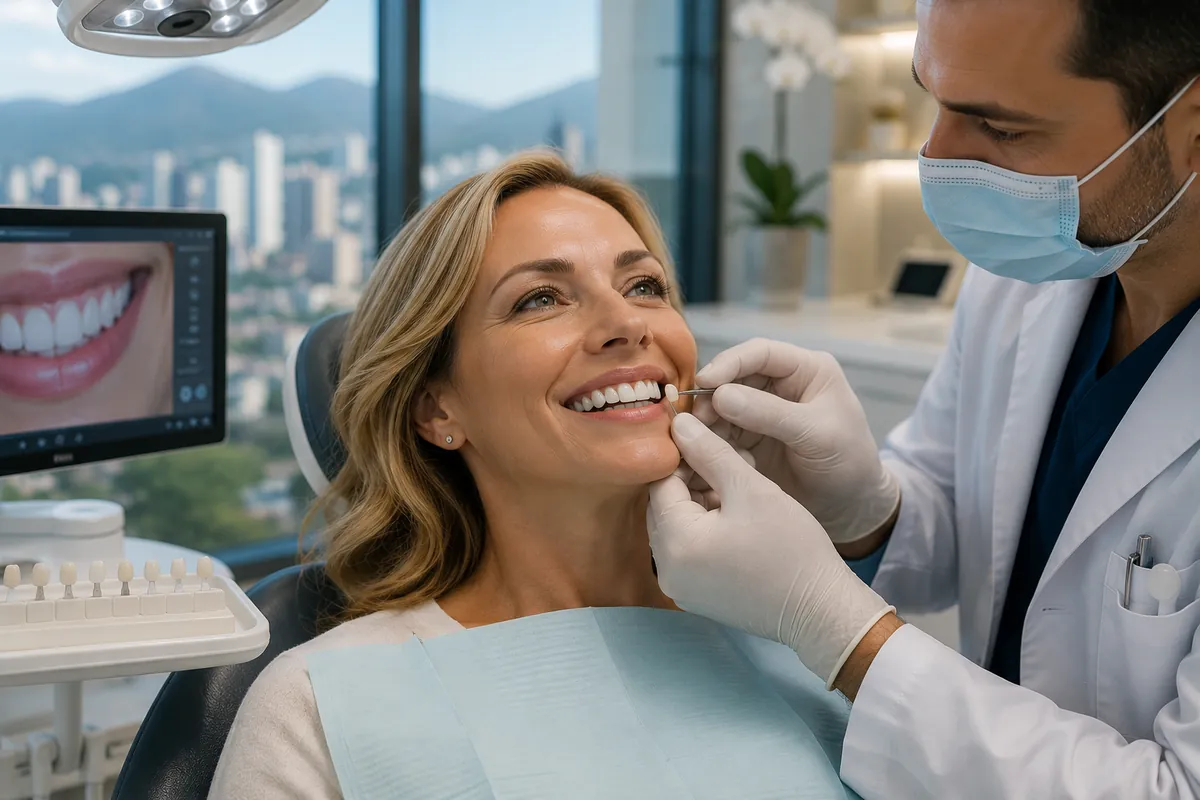
All-on-4 in Colombia replaces a whole arch of missing or failing teeth with a fixed bridge on four implants (All-on-6 uses six), planned with 3D CBCT imaging and placed by a board-certified implantologist. In Medellín it starts near $5,500 USD per arch, versus roughly $20,000–$25,000+ in the U.S. Most suitable patients receive a fixed provisional ("teeth in a day") on the first 5–7 day trip; the stronger final prosthesis (acrylic or zirconia) follows after the implants heal over 3–6 months — often on a second, shorter trip. It is a fixed alternative to dentures, not a removable plate. Surgeon and planning quality matter more than price.
In Colombia
$5,500
USD from
In the U.S.
$25,000
USD average
Your saving
78%
less
What All-on-4 and All-on-6 actually are
All-on-4 and All-on-6 are full-arch dental implant solutions: instead of replacing teeth one at a time, an entire upper or lower arch of teeth is restored with a single fixed bridge anchored to just four or six implants. The name is literal — "all" of the teeth on "four" (or six) implants. It is designed for people who have lost most or all of their teeth in a jaw, or whose remaining teeth are failing from advanced decay or gum disease and need to be removed. If you are missing only one or a few teeth, standard single dental implants are usually the better route; All-on-4 is specifically a whole-arch answer.
The clever part is the geometry. Two implants are placed vertically at the front of the jaw, and — in the classic All-on-4 protocol — the two rear implants are tilted at an angle to engage the denser, more available bone and to avoid sensitive structures like the sinus in the upper jaw or the nerve in the lower jaw. This angulation is what lets four implants safely support a full bridge and, in most cases, avoids the need for bone grafting. All-on-6 simply adds two more implants to spread the chewing load across more support points, which is often preferred when bone quality allows or for the upper arch.
The result is a set of teeth that is fixed in place — it does not come out. That is the central difference from a conventional denture. A denture rests on the gums, can slip, covers the palate, limits what you can bite, and often needs adhesive; a full-arch implant bridge is screwed onto implants that fuse with your bone, so it feels and functions far more like natural teeth. For many patients the change is not cosmetic vanity but the ability to eat, speak and smile normally again after years of struggling.
- A whole arch on few implants — four (All-on-4) or six (All-on-6) support all the teeth.
- Fixed, not removable — the bridge is screwed in; it does not come out at night.
- Tilted implants — capture strong bone and usually avoid grafting.
- For edentulous or failing arches — not for single missing teeth.
"Teeth in a day" — and the honest timeline
The phrase you will see everywhere is "teeth in a day" or immediate load, and it is real — but it is important to understand exactly what happens, because the marketing can blur it. In a suitable patient, the implants are placed and a fixed provisional bridge is attached the same day or within a few days, so you leave your first trip with a full set of non-removable teeth. You do not walk around toothless. That is a genuine, life-changing benefit and it is why All-on-4 became so popular.
What "teeth in a day" does not mean is that your final teeth are finished that day. The bridge you receive immediately is a provisional — a strong, good-looking temporary made to protect the implants while they fuse to the bone (a process called osseointegration) over roughly three to six months. During that window you eat a soft diet and let the bone heal. Only afterward is the definitive prosthesis — a more durable, more refined final bridge in high-grade acrylic or zirconia — fabricated and fitted. Any honest provider will tell you this plainly.
Because HealthBridge coordinates dental tourism, the timeline has to be planned around travel, and there are a few legitimate ways it is handled. The most common is a two-trip plan: a first trip of about 5–7 days for extractions, implant placement and the fixed provisional, then a second, shorter trip after the 3–6 month healing period to fit the finished final prosthesis. In some cases, where the bite and records allow, the final can be fabricated from precise records and impressions and shipped, or fitted with fewer visits. Which path fits you depends on your anatomy and healing — and your implantologist and prosthodontist decide it, not a brochure.
We are deliberate about setting this expectation because the single most common disappointment in full-arch tourism is a patient who believed one trip would deliver a permanent, finished smile. It usually will deliver fixed teeth on the first trip — just provisional ones. Planning for the second phase from the start is what keeps the whole process safe and predictable. You can read a fuller walkthrough in our All-on-4 implants in Colombia guide.
Why choose HealthBridge
What's included and why it matters
A full-arch reconstruction is only as good as the planning, the implants and the clinicians behind it. Here is what a HealthBridge All-on-4 / All-on-6 program is built around — and why each part matters.
Board-certified implantologists & prosthodontists
Your implants are placed by a credentialed implantologist and your bridge designed by a prosthodontist — high-volume in full-arch work. We do not book uncertified operators to shave the price.
Straumann & Nobel Biocare systems
We use the same globally recognized implant brands trusted worldwide — including Nobel Biocare, which pioneered the original All-on-4 protocol. Real systems, not unbranded substitutes.
CBCT-planned, guided surgery
Every case is planned on a 3D CBCT scan, often with a surgical guide, so implant angles, bone and vital structures are mapped before surgery — the standard you'd expect at a top clinic anywhere.
Fixed provisional teeth on your first trip
Suitable patients leave the first 5–7 day trip with a fixed provisional bridge — never toothless. We explain honestly that the definitive prosthesis follows after healing.
Bilingual, two-phase coordination
One accountable coordinator, in English or Spanish, across both trips and the months between — led by medical director Dra. Olga González, with transfers and appointments handled.
Honest, itemized USD pricing
You receive a clear, per-arch itemized quote in USD after a proper review, with materials, arch count and any grafting spelled out — no bait pricing and no surprises after you land.
Why patients choose Colombia — and Medellín specifically
The cost gap is the reason most people start looking abroad, and for full-arch work it is dramatic. A single arch of All-on-4 commonly runs $20,000 to $25,000 or more at a U.S. practice, and a full-mouth (both arches) can reach $40,000–$60,000+. In Medellín, a single arch frequently starts near $5,500 USD, so even after flights and a hotel the savings on a full-mouth reconstruction can run well into five figures. Crucially, that gap comes from the lower cost of operating in Colombia — not from cheaper implants or a rushed surgeon. When a full-arch quote looks far below even the Colombian range, treat it as a warning, not a bargain.
But price alone is not why Medellín has become a serious dental-implant destination. Colombia has a deep pool of board-certified implantologists and prosthodontists who do high volumes of full-arch cases, work with the same premium implant systems used worldwide — Straumann and Nobel Biocare, the company that pioneered the original All-on-4 protocol — and plan cases with the same CBCT 3D imaging and guided surgery you would expect at a top clinic anywhere. The technology and the brands are not a downgrade.
Medellín also happens to be an unusually comfortable place to recover: a spring-like climate year-round, the walkable, hotel-rich El Poblado district, and direct flights from Miami, Fort Lauderdale, New York, Houston and Panama City. That matters for a treatment that involves at least one longer trip. What sets HealthBridge apart is that we treat this as medical care, not a shopping trip — our medical director Dra. Olga González personally coordinates your case, confirms your clinician's credentials, and stays reachable in English or Spanish from your first message through both phases of treatment.
- Meaningful, honest savings — lower overhead, not lower-grade implants.
- Board-certified implantologists & prosthodontists — high-volume, credentialed.
- Real brands & planning — Straumann, Nobel Biocare, CBCT-guided surgery.
- One accountable coordinator — Dra. Olga González, bilingual, across both trips.
Am I a candidate? Bone, grafting and zygomatic implants
Full-arch implants suit a wide range of patients, but candidacy is a clinical decision made after a CBCT scan and examination, not something you can settle from a photo. The core question is bone: implants need enough volume and density of jawbone to anchor into. The good news is that the All-on-4 protocol was specifically designed to work with less bone than traditional implants require — by tilting the rear implants to capture the strongest available bone, most patients can avoid bone grafting entirely, which is a large part of its appeal.
When there genuinely is not enough bone, there are honest options rather than a flat no. Localized bone grafting or, in the upper jaw, a sinus lift can rebuild volume, though this adds healing time and can affect the timeline and cost. For severe upper-jaw bone loss, some cases are solved with zygomatic implants — longer implants anchored in the dense cheekbone (zygoma) rather than the resorbed jaw. Zygomatic implants are an advanced technique that only appropriately trained implantologists should perform, and they are planned case by case; we match such cases only to clinicians with the right experience.
Beyond bone, a good candidate is in reasonable general health, has gum disease and infection under control (or treatable first), and is either a non-smoker or willing to stop, since smoking meaningfully raises the risk of implant failure. Uncontrolled diabetes, certain medications (including some bone medications), and heavy grinding all need to be discussed and managed. Age itself is rarely a barrier — many full-arch patients are older adults — but overall health and healing capacity matter.
The honest bottom line is that your implantologist decides candidacy, and sometimes the responsible answer is "you need grafting first," "All-on-6 rather than All-on-4," or "let's treat your gums before we plan anything." That care is the point of using a facilitator that vets clinicians, rather than booking the cheapest quote you can find online. If you are weighing full-mouth options more broadly, our full-mouth reconstruction overview explains how these treatments compare.
Options
Full-arch implant options
- All-on-4
- A full arch on four implants — two straight in front, two tilted at the back to capture strong bone and usually avoid grafting. The classic, well-documented protocol; efficient and cost-effective for many edentulous patients.
- All-on-6
- A full arch on six implants, distributing chewing forces across more support points and adding redundancy. Often preferred when bone quality allows or for the upper jaw, at a somewhat higher cost than All-on-4.
- Zygomatic implants
- For severe upper-jaw bone loss, longer implants are anchored in the dense cheekbone (zygoma) rather than the resorbed jaw, sometimes avoiding extensive grafting. An advanced technique performed only by appropriately trained implantologists, planned case by case.
- Acrylic vs zirconia final prosthesis
- The definitive bridge is made in high-quality acrylic on a titanium bar (lighter, easier to repair, lower cost) or monolithic zirconia (stronger, more wear-resistant, more durable, pricier). The prosthodontist matches the material to your bite, habits and budget.
Materials and the final prosthesis — acrylic vs zirconia
Once the implants have integrated, the choice that most affects the look, feel, durability and price of your result is the material of the final bridge. There are two mainstream options, and a good prosthodontist will walk you through the trade-offs rather than defaulting to one. The first is acrylic (resin) teeth on a titanium bar: the bridge uses high-quality acrylic teeth reinforced by a metal framework. It looks natural, is lighter, is somewhat easier and cheaper to repair, and is the same class of prosthesis used in the original All-on-4 concept.
The second is monolithic zirconia: a full-arch bridge milled from a single block of very strong, tooth-colored ceramic. Zirconia is harder, more stain- and wear-resistant, and generally more durable than acrylic, with an excellent, lifelike appearance. The trade-offs are that it costs more, is heavier, and if it ever fractures it is harder to repair than acrylic. Many patients choose acrylic for the provisional and definitive first bridge and upgrade to zirconia later, or go straight to zirconia for the final if longevity is the priority and the budget allows.
There is no single "best" material for everyone — it depends on your bite forces, budget, whether you grind your teeth, and how you weigh durability against reparability and cost. The right answer comes from the prosthodontist who designs your bridge, and it is exactly the kind of decision we make sure you understand before you commit. Whatever the material, the finished teeth are designed for your face and bite, and if you are also considering front-tooth cosmetics, our dental veneers in Colombia page covers those separately.
- Acrylic on titanium bar — natural look, lighter, easier and cheaper to repair.
- Monolithic zirconia — stronger, more wear- and stain-resistant, more durable, pricier.
- Provisional first — the immediate bridge is always a temporary, regardless of final material.
- Prosthodontist-led choice — matched to your bite, habits and budget, not a default.
Recovery, maintenance and how long it lasts
Full-arch implant surgery is generally less painful than patients expect — most describe soreness and swelling for a few days that is well controlled with ordinary medication, especially compared with the years of dental problems that led them here. The key early rule is diet: you wear the fixed provisional bridge and eat a soft diet during the three-to-six-month integration period, because loading the implants too hard too soon can compromise healing. Good oral hygiene from day one is essential, and your clinician will show you how to clean thoroughly around and under the bridge.
That cleaning routine is not just for healing — it is for life. A full-arch bridge does not decay, but the gum and bone around the implants can become inflamed (peri-implantitis) if plaque is allowed to build up, and that is the leading cause of long-term implant problems. Daily cleaning under the bridge with the tools your prosthodontist recommends, plus periodic professional maintenance visits to check the implants, screws and bite, is what protects your investment. This is a treatment that rewards diligence.
Done well and looked after, the results are long-lasting. The implants themselves — the titanium posts in your bone — are designed to last many years, often decades, with high documented success rates for well-planned cases. The prosthesis on top is the part that wears: an acrylic bridge may need refurbishment or replacement over the years, while zirconia tends to last longer. Occasional maintenance of the visible teeth is normal and expected; it does not mean the implants have failed.
It is also worth setting expectations against the alternative you may be leaving behind. A conventional denture is cheaper up front but sits on the gums, can accelerate bone loss over time, and never feels fully secure. A full-arch implant bridge costs more but restores fixed, stable chewing function and helps preserve jawbone by loading it the way natural teeth do. For the right patient, that difference in daily life is the whole reason to do it.
Pricing
How much it costs in Colombia
| Option | In Colombia | In the U.S. |
|---|---|---|
| All-on-4 (per arch) | from ~$5,500 USD | ~$20,000–$25,000+ USD |
| All-on-6 (per arch) | individualized quote | $24,000–$30,000+ USD |
| Full mouth (both arches) | individualized quote | $40,000–$60,000+ USD |
| Zygomatic implants (per arch) | quoted after assessment | $30,000–$40,000+ USD |
| Zirconia final upgrade (per arch) | quoted after assessment | $4,000–$8,000+ USD add-on |
Reference 'from' prices in USD, subject to medical assessment.
Full breakdown, by area and by technique, in our guide to All-on-4 cost in Colombia.
At a glance
All-on-4: Colombia vs the United States
| Colombia (HealthBridge) | United States | |
|---|---|---|
| All-on-4 (per arch, from) | ~$5,500 USD | ~$20,000–$25,000+ USD |
| Full mouth (both arches) | significantly lower | $40,000–$60,000+ USD |
| Implant brands | Straumann, Nobel Biocare | Straumann, Nobel Biocare |
| Planning | CBCT-guided, board-certified | CBCT-guided, at premium pricing |
| First-trip provisional | Fixed teeth in 5–7 days | Fixed teeth, over weeks–months |
| Recovery setting | Spring-like Medellín, concierge | At home |
Per-arch vs full-mouth — planning cost and trips
One point that confuses many patients is that full-arch pricing is quoted per arch. All-on-4 restores one jaw — upper or lower. If you need both jaws restored (a "full-mouth" or "full-set" case), that is two arches, and the cost and surgery are roughly doubled, though doing both together can be efficient. So a headline "from ~$5,500 per arch" means a full upper-and-lower reconstruction starts around twice that before materials and any grafting — still a fraction of the U.S. equivalent, which commonly runs $40,000–$60,000+ for both arches.
Because the true price depends on how many arches you need, whether you choose All-on-4 or All-on-6, the final material (acrylic vs zirconia), and whether grafting or zygomatic implants are involved, we do not post a single wall price. Instead, after a free assessment — where you send photos, any recent X-rays or a CBCT, and your history — you receive an itemized quote in USD that reflects your actual plan. That honesty up front is deliberate: full-arch work is too individual for a one-number promise.
Planning the trips is the other half. A typical program is a first trip of about 5–7 days for surgery and the fixed provisional, then a return trip after healing for the definitive prosthesis; some cases compress or extend this depending on anatomy and the finishing approach. We help you sequence flights, hotel and appointments around both phases so you are never guessing. Throughout, our promise is not the lowest possible number — it is a safe, well-planned, board-certified reconstruction with a named coordinator. Start from our medical tourism home page or read the full-mouth reconstruction guide first.
- Quoted per arch. Both jaws = two arches; plan and budget accordingly.
- Individualized quote. Arch count, All-on-4 vs 6, material and grafting all move the price.
- Two-phase trips. First trip for surgery + provisional; return for the final prosthesis.
- Coordinated logistics. Flights, hotel and appointments sequenced across both phases.
Meet your coordinator — Dra. Olga González
For a treatment that spans surgery, months of healing and usually two trips, it matters that a named, accountable physician oversees the whole journey rather than an anonymous booking desk. Dra. Olga González is HealthBridge's medical director and the person who personally coordinates your full-arch case — reviewing your history and imaging, matching you to a suitable board-certified implantologist and prosthodontist, confirming the clinic's credentials and technology, and staying reachable in English or Spanish from your first message through the delivery of your final prosthesis.
To be clear about roles: Dra. González does not perform your surgery or make your prosthesis. The implants are placed by an experienced, board-certified implantologist, and the bridge is designed by a prosthodontist. Her job as medical director is to make sure you are matched to the right clinicians for your anatomy and goals, that the plan — including whether you need All-on-4 or All-on-6, grafting, or a two-trip timeline — is explained to you honestly, and that you understand what full-arch implants can and cannot do before anything is scheduled.
That posture — care over sales — is the whole point of using a facilitator like HealthBridge. You are not funneled to whoever quotes the lowest number this week; you are guided by someone whose interest is a safe, durable result, and who will tell you plainly if you need preliminary treatment first or if your expectations about a one-trip permanent smile need adjusting. It is the standard we hold across every full-arch case.
When you travel to Medellín with us, you correspond with one bilingual team, you know who your implantologist and prosthodontist are before you fly, and you leave with maintenance guidance you can share with your dentist at home. To begin, reach out from our home page for a free, no-obligation assessment, and read the All-on-4 in Colombia guide first so you arrive genuinely informed.
How it works
Your medical journey, step by step
Part of our Cosmetic Dentistry & Veneers program.
Free assessment & quote
Message us on WhatsApp with your case, records or photos. We review it and send a plan and quote in USD before you book a flight — at no cost.
Travel plan
We coordinate a board-certified specialist, accredited hospital, dates, accommodation and airport transfers in Medellín.
Procedure
You're treated by board-certified specialists in accredited facilities, with bilingual support at every step.
Recovery & follow-up
You recover in Medellín with included check-ups and WhatsApp follow-up once you're home.
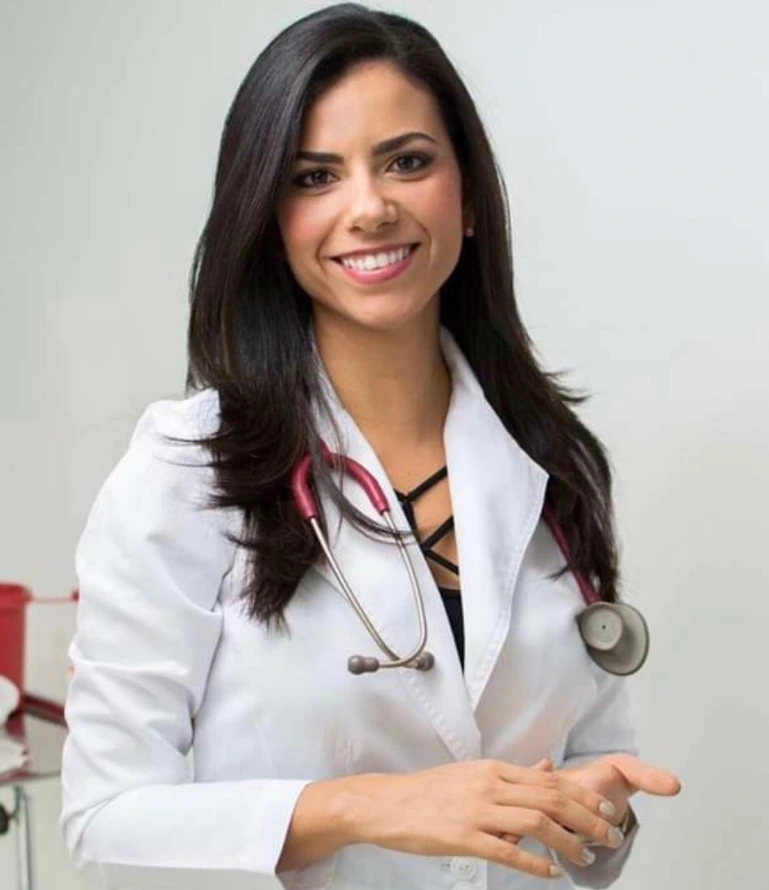
Your trusted physician
Dra. Olga González
Medical Director
Aesthetic Medicine Physician · Longevity & Regenerative Medicine · Health Coach in Nutrition · Universidad de San Martín
Dra. Olga González is the medical director of HealthBridge Medical Tourism. A physician trained at Universidad de San Martín and certified in aesthetic medicine, she has built her practice in El Poblado, Medellín, around longevity, regenerative medicine and biohacking. She personally coordinates each international patient's care — vetting surgeons, accredited hospitals and recovery plans — so that every traveler is treated by board-certified specialists and supported in their own language from the first message to the final follow-up.
- Aesthetic Medicine
- Regenerative & Longevity Medicine
- Biohacking
- Clinical Nutrition
Frequently asked questions
How much does All-on-4 cost in Colombia?
What is the difference between All-on-4 and All-on-6?
Is this really "teeth in a day"?
How many trips to Colombia will I need?
Will I need bone grafting?
Is All-on-4 better than dentures?
Acrylic or zirconia — which final prosthesis is better?
How long do full-arch implants last?
Does it hurt, and what is recovery like?
Am I a candidate for All-on-4?
What brands of implants do you use?
Does HealthBridge perform the treatment?
You may also consider
Other procedures in this specialty
Many patients combine procedures in a single trip. These are the ones we coordinate within the same specialty.
Medical references
What this page is based on
For each source we state which claim it supports, with a direct link, so you can check it yourself.
-
American Dental Association (MouthHealthy) — Implants
Backs how we describe implants and who they suit: titanium posts surgically placed in the jaw, around which the bone grows to hold them in place (osseointegration, which can take several months), and the ADA's point that health matters more than age — diabetes or tobacco use can slow healing.
-
Pjetursson et al., systematic review of survival and complication rates of implant-supported fixed dental prostheses, Clinical Oral Implants Research 2012 (PMID 23062125)
Backs the survival figures we quote instead of a vague “implants last a lifetime”: 95.6% of implants supporting fixed prostheses survived at 5 years and 93.1% at 10 years — but only 66.4% of patients were free of any complication at 5 years, which is why maintenance check-ups are part of the plan.
-
INVIMA — Instituto Nacional de Vigilancia de Medicamentos y Alimentos (Colombia)
Colombia's own regulator, and where the products used in your treatment have to be registered: INVIMA supervises and controls medicines and biological products, medical devices and diagnostic equipment, and cosmetics marketed in Colombia.
Prices, length of stay and package contents are HealthBridge's own figures and do not come from these sources. The U.S. price we compare against comes from our own price study, where every figure is traced to a named U.S. clinic. None of these organizations is affiliated with or endorses HealthBridge.
Sources
Where to verify this information
We're not asking you to take our word for it. These are independent medical bodies whose guidance you can read directly before making any decision.
- American Dental Association — oral health topics
- CDC Yellow Book — Medical Tourism: risks, planning and post-travel care
- MedlinePlus (U.S. National Library of Medicine) — patient health information
HealthBridge is not affiliated with or endorsed by these organizations. They are cited as independent reference.
Other specialties
Explore more treatments in Colombia
Ready to take the first step?
Send us your case on WhatsApp and get a personalized plan and quote — free, with no obligation.
El Poblado, Medellín · Mon–Fri 8:00 AM – 6:00 PM · Sat 9:00 AM – 1:00 PM (COT)