
Dental & Veneers
Dental Bridges in Colombia: Types, Cost and How They Compare to Implants
In Medellín from $300 USD · 5–7 day stay Get a free quote →
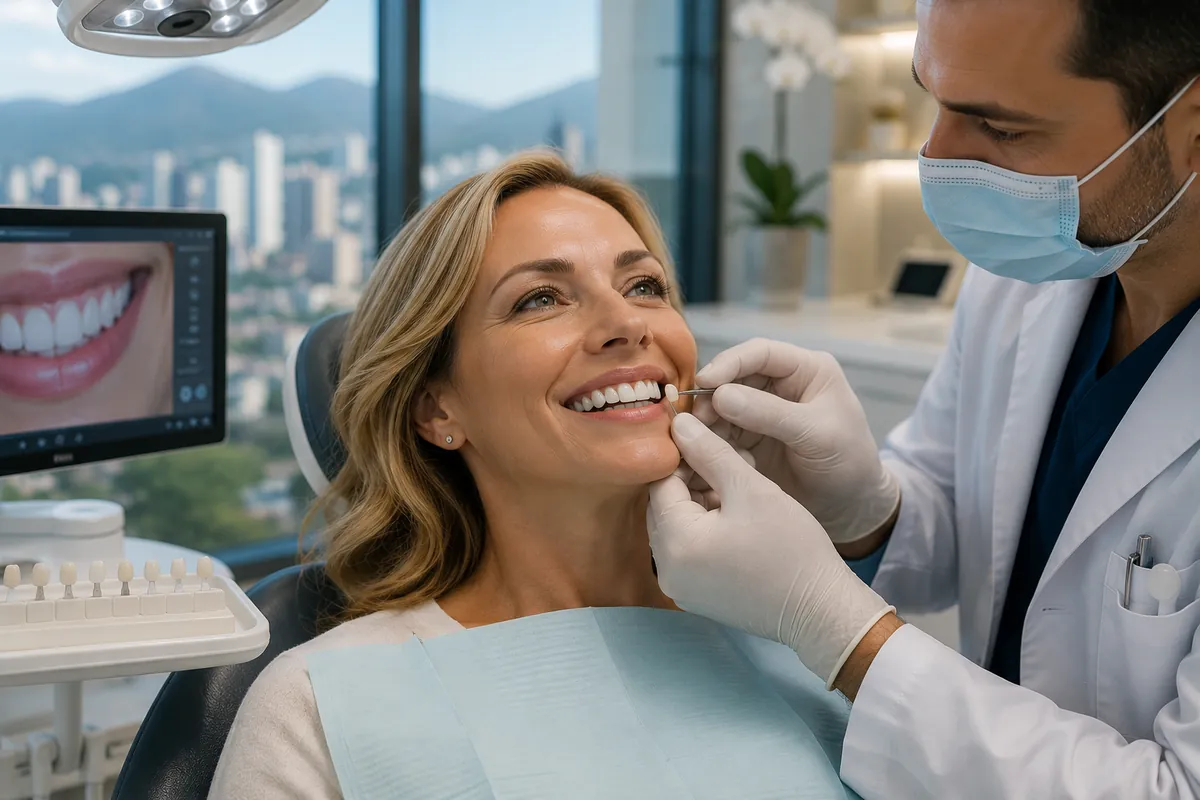
What Is a Dental Bridge?
A dental bridge is a fixed restoration that literally bridges the gap created when you lose one or more teeth. It consists of one or more artificial teeth, called pontics, held in place by supports on either side of the space. Those supports are usually the natural teeth next to the gap, which are covered with crowns, or dental implants placed in the jaw. Once cemented, a bridge is not removable by the patient, so it looks and functions much like your own teeth.
Replacing a missing tooth is about far more than appearance. When a gap is left open, the neighboring teeth tend to tilt and drift into the space, the opposing tooth can over-erupt, and your bite gradually falls out of alignment. This can make chewing less efficient and cleaning more difficult, which raises the risk of decay and gum problems over time. A well-made bridge restores your ability to chew and speak clearly and keeps the surrounding teeth in their proper positions.
Bridges are one of the oldest and most reliable tooth-replacement solutions in dentistry, and modern materials have made them stronger and more natural-looking than ever. They are part of the broader field of cosmetic dentistry in Colombia, which ranges from whitening and veneers to full-mouth rehabilitation. Whether a bridge is right for you depends on how many teeth are missing, the health of the teeth around the gap, and your long-term goals, all of which a dentist assesses during your evaluation.
The Four Main Types of Dental Bridge
Not all bridges are built the same way. The right design depends on where the gap sits in your mouth, how many teeth are missing, and the condition of the teeth or bone around the space.
A traditional bridge is the most common. A pontic is suspended between two crowns that cap the natural teeth on each side of the gap. It is strong and well suited to replacing one or several teeth when healthy teeth flank the space, but it does require those neighbors to be reshaped to receive the crowns.
A cantilever bridge is anchored to a supporting tooth on only one side. It is useful when there is a natural tooth on just one side of the gap. Because all the chewing force lands on a single anchor, dentists reserve this design for lower-stress areas and choose it selectively.
A Maryland or bonded bridge uses a pontic held by thin metal or porcelain wings that are cemented to the backs of the adjacent teeth, instead of full crowns. Its big advantage is that it preserves far more of the neighboring tooth structure, but it is less rugged than a traditional bridge, so it is typically used for front teeth where the biting load is lighter.
An implant-supported bridge is anchored to dental implants rather than natural teeth. When several adjacent teeth are missing, a small number of implants can support a multi-tooth bridge without touching the natural teeth at all. It is the most stable option and protects the jawbone, though it takes longer and costs more. If you are weighing this route, our guide to dental implants in Colombia explains the process in detail.
Materials: Porcelain, Zirconia and E-max
The material your bridge is made from affects how strong it is, how natural it looks, and how long it lasts. Your dentist will recommend an option based on which teeth are being replaced and the demands of your bite.
Porcelain-fused-to-metal (PFM) is a long-established choice that combines a metal substructure for strength with a porcelain outer layer for a tooth-like appearance. PFM bridges are durable and cost-effective and have decades of clinical history. Their main drawback is that a faint dark line can sometimes show at the gumline over the years as gums recede, which is why they are often chosen for back teeth where esthetics matter less.
Zirconia is a modern ceramic prized for its exceptional strength and its ability to be milled with precision. It is metal-free, highly biocompatible, and resists chipping, which makes it a popular choice for both front and back teeth and for longer-span or implant-supported bridges that must withstand heavy forces.
E-max (lithium disilicate) is an all-ceramic material celebrated for its lifelike translucency, closely mimicking the light-reflecting quality of natural enamel. It delivers outstanding esthetics for visible front teeth, though it is generally reserved for shorter spans because it is less suited to very high-load situations than zirconia. A skilled dentist will match the material to the location and function of the bridge so you get the best balance of strength and appearance.
Bridge vs. Implant vs. Partial Denture
A bridge is one of three common ways to replace missing teeth, and an honest comparison matters because each has genuine trade-offs. There is no single best option for everyone; the right choice depends on your anatomy, budget, timeline and priorities.
The biggest honest caveat with a traditional bridge is that it requires reshaping the healthy teeth on either side of the gap so they can hold crowns. If those neighbors are already crowned or damaged, that is efficient. If they are pristine, some patients prefer not to alter them. A dental implant, by contrast, is placed directly into the jaw and leaves the neighboring teeth untouched, and because it stimulates the bone, it helps prevent the bone loss that naturally follows tooth loss. The trade-off is that implants cost more and take several months to complete because the bone must heal around the post. A partial denture is the most economical and least invasive option, but it is removable, can feel less stable, and many people find it less comfortable for daily chewing. The table below summarizes the practical differences.
| Factor | Dental Bridge | Dental Implant | Partial Denture |
|---|---|---|---|
| Neighboring teeth | Must be reshaped for crowns (traditional) | Left untouched | Left untouched |
| Bone preservation | Does not stop bone loss under the gap | Stimulates and preserves bone | Does not stop bone loss |
| Timeline | About one to two weeks | Several months | A few weeks |
| Stability | Fixed, feels natural | Fixed, most stable | Removable, less stable |
| Relative cost | Moderate | Highest | Lowest |
| Typical longevity | Roughly 10-15 years with care | Can last decades | Around 5-8 years |
For a fuller comparison of removable versus fixed solutions, see our article on dentures vs implants. The right dentist will lay out these options plainly rather than pushing a single one.
Why a Bridge Suits Medical Travel: Timeline and Care
One of the practical reasons a bridge appeals to international patients is speed. Because a traditional or Maryland bridge relies on your existing teeth rather than on osseointegration, there is no months-long wait for bone to fuse to an implant. The process usually takes two visits over roughly one to two weeks: at the first appointment the dentist prepares the anchor teeth and takes impressions, a temporary bridge is placed, and once the laboratory fabricates the final restoration it is fitted and cemented. That compressed timeline fits neatly into a single trip to Medellín.
An implant-supported bridge is the exception, since it requires healing time; in those cases your dentist may sequence the treatment across two trips or coordinate remote follow-up. Dra. Olga Gonzalez, our coordinator, helps map out a realistic schedule before you travel so your stay is planned around your specific treatment rather than a generic package.
Caring for a bridge is straightforward but important for its longevity. You brush normally, but you also need to clean underneath the pontic where it meets the gum, using a floss threader, interdental brush or a water flosser to remove plaque that a regular string cannot reach. Regular professional cleanings and check-ups protect the anchor teeth, because the bridge is only as healthy as the teeth or implants supporting it. With good hygiene, a quality bridge commonly lasts ten to fifteen years or more, and avoiding very hard foods and treating any grinding habit helps it last even longer.
Cost in Colombia vs. the U.S. and Why Medellín
Cost is one of the main reasons patients look abroad. In the United States a traditional three-unit bridge commonly runs into the thousands of dollars, and the figure climbs further for implant-supported designs or premium ceramics. In Colombia, comparable work by a board-certified dentist or prosthodontist typically costs a substantial fraction of that, often a saving of well over half. The difference reflects lower operating and living costs in Colombia, not a compromise on materials or standards; the same zirconia, E-max and PFM systems used in North America are used in accredited Medellín clinics.
When you compare quotes, look closely at what is included. A transparent estimate should specify the number of units, the material, the anchor preparation, the temporary bridge and the follow-up visits, so you are comparing like with like. HealthBridge helps you obtain clear, itemized quotes and never asks you to decide on price alone.
It is important to be clear about who we are. HealthBridge is a facilitator, not a clinic. We connect you with independent, board-certified dentists and prosthodontists working in accredited facilities, verify their credentials, and coordinate consultations, scheduling, logistics and aftercare so your trip runs smoothly. Dra. Olga Gonzalez serves as our medical coordinator and guides you in plain language through every step. You can learn more about our approach on the HealthBridge home page. Medellín adds a mild spring-like climate, modern clinics, bilingual support and direct flights from several U.S. cities, so for the right patient a dental bridge here means quality care, a convenient timeline and meaningful savings in a single trip.
Considering dental & veneers in Colombia?
See the procedure, pricing and the process for international patients on our Cosmetic Dentistry & Veneers.
Procedure guides: Dental Implants Colombia · All-on-4 in Colombia: Cost from $5,500 per Arch
«Be wary of a per-tooth quote with no whole-mouth plan. What defines the result is not each veneer, it is how they all look together when you speak.»

Dra. Olga González, Medical Director, HealthBridge Medical Tourism, Aesthetic Medicine Physician · Longevity & Regenerative Medicine · Health Coach in Nutrition