
Dental & Veneers
Dentures vs Dental Implants: Which Is Right for You?
In Medellín from $300 USD · 5–7 day stay Get a free quote →
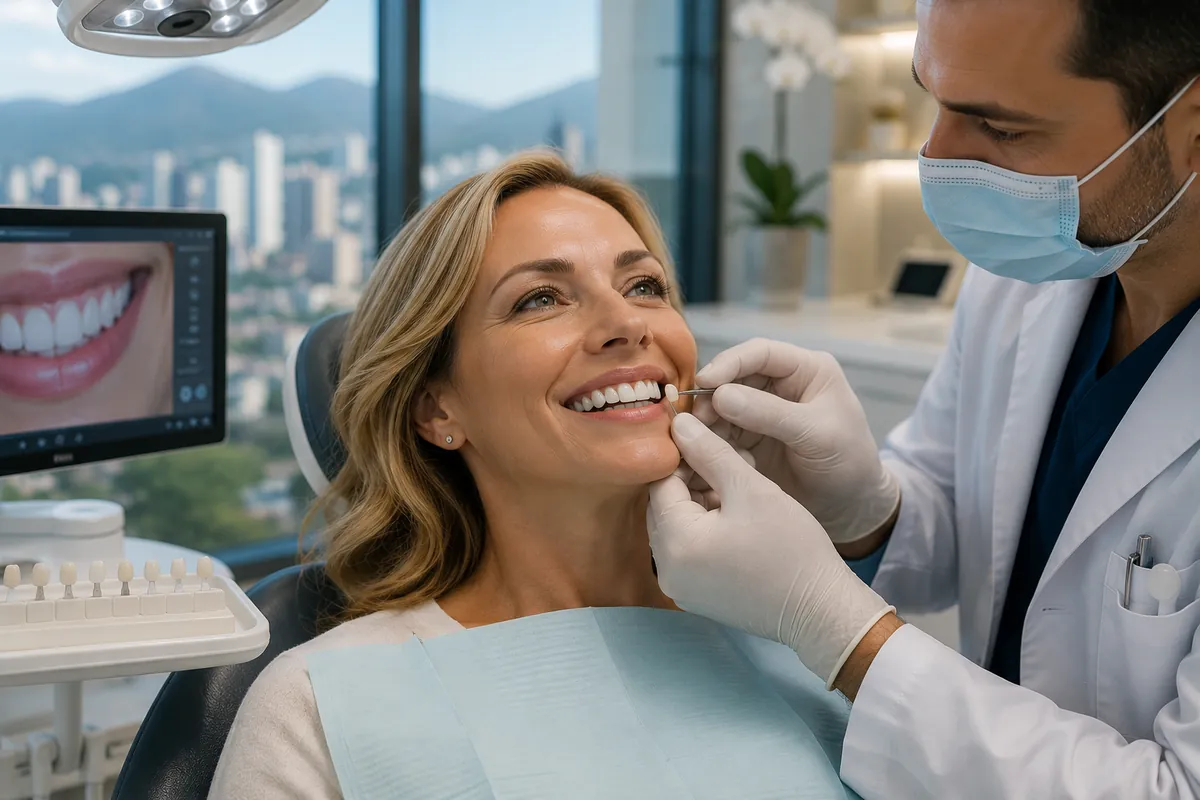
How Removable Dentures Work
Dentures are removable appliances that replace missing teeth and the surrounding gum tissue. A complete denture rests directly on the gums and, in the upper jaw, uses suction against the palate to stay in place; a partial denture clasps onto your remaining natural teeth to fill the gaps between them. They are the oldest and most widely used tooth-replacement solution, and for good reason: they are non-surgical, relatively fast to make and by far the most affordable way to restore a full smile.
The trade-offs are in stability and feel. Because a denture simply sits on top of the gums rather than being anchored into bone, it can shift when you chew or speak, and many wearers rely on adhesive to keep it secure. Chewing efficiency is noticeably lower than with natural teeth, so hard or sticky foods can be difficult. Covering the palate can also dull your sense of taste and temperature. None of this makes dentures a poor choice, but it explains why some patients eventually look for something more stable.
Modern dentures are far better made than the ones previous generations wore, with natural-looking acrylic teeth and a comfortable fit when crafted well. For someone who has lost most or all of their teeth and wants an affordable, non-surgical result, a well-fitted denture can restore both function and confidence. If you are still exploring what a smile makeover can involve, our overview of cosmetic dentistry in Colombia covers the broader range of treatments available.
How Dental Implants Work
A dental implant replaces the root of a missing tooth, not just the crown you see. The dentist places a small titanium post into the jawbone, where over the following months it fuses with the surrounding bone in a natural process called osseointegration. Once healed, the implant becomes a stable anchor onto which a custom crown, bridge or denture is attached. The result is a replacement tooth that is fixed in place and behaves remarkably like the tooth you lost.
Because the implant is embedded in bone, it does not move when you chew, and chewing power is close to that of a natural tooth. There is no palate to cover, so taste and speech are unaffected, and there is no adhesive to manage. Day to day, most patients simply brush and floss around an implant as they would a natural tooth, which many find easier than removing and cleaning an appliance every night.
The trade-offs are cost, time and surgery. Each implant requires a minor surgical procedure and a healing period of several months before the final tooth is fitted, and the price per tooth is higher than a denture. Candidacy also matters: you need enough healthy bone to hold the implant, though bone grafting can often build up areas that have thinned. To see how a full treatment unfolds from consultation to final crown, our dental implants guide walks through each stage, and you can review the procedure itself on our dental implants page.
The Middle Ground: Implant-Supported Options
The choice is not simply all-or-nothing between a loose denture and a full set of individual implants. Some of the most popular solutions today sit in between, using a small number of implants to secure a denture or bridge. These options give you much of the stability of implants at a lower cost than replacing every tooth on its own.
An implant-supported overdenture uses two to four implants to snap a removable denture firmly into place. You still take it out to clean it, but it no longer slips or requires adhesive, and chewing improves dramatically. It is a popular upgrade for denture wearers who are tired of movement but want to keep costs moderate.
A fixed full-arch solution goes a step further. Techniques such as All-on-4 use four (sometimes more) strategically angled implants to support a complete fixed bridge that you never remove; it stays in your mouth like natural teeth and is cleaned in place. All-on-4 is often possible even for patients with some bone loss, because the angled placement makes the most of available bone and can frequently avoid extensive grafting. For someone replacing an entire arch, these approaches deliver fixed, stable teeth at a far lower cost than a dozen or more separate implants.
Side-by-Side Comparison
The right answer depends on your priorities. If lowest up-front cost and a non-surgical path matter most, dentures lead. If long-term comfort, chewing power and preserving your jawbone matter most, implants lead. The table below summarizes the practical differences most patients weigh.
| Factor | Removable Dentures | Dental Implants |
|---|---|---|
| Up-front cost | Lowest | Higher per tooth |
| Stability | Can shift; may need adhesive | Fixed and secure |
| Chewing power | Reduced | Close to natural teeth |
| Jawbone preservation | No; bone shrinks over time | Yes; stimulates and preserves bone |
| Surgery required | No | Yes, minor |
| Treatment time | Weeks | Several months (with healing) |
| Daily care | Remove and clean nightly | Brush and floss like natural teeth |
| Typical longevity | 5-8 years, periodic relining | 15+ years, often lifelong |
One difference deserves emphasis because it is easy to overlook: bone preservation. When a tooth is lost, the jawbone beneath it slowly resorbs because nothing is stimulating it. Dentures do not stop this, which is why they need periodic relining and why long-term wearers can develop a sunken facial appearance. Implants transmit chewing force into the bone much like natural roots, keeping it healthy and maintaining facial structure over the years.
Who Is a Good Candidate for Each?
Almost anyone can wear dentures. They require no surgery and no minimum amount of bone, which makes them the default option when health, budget or bone volume rules out implants, or when a patient simply prefers a non-surgical route. For many people they are a sensible, effective and dignified choice.
Implants ask more of a candidate. The most important requirement is enough healthy jawbone to hold the post; where bone has thinned, a graft can often rebuild it, though this adds time and cost. Good general health supports healing, so conditions such as poorly controlled diabetes need to be managed, and smoking meaningfully lowers implant success because nicotine restricts the blood supply the bone needs to heal. Your dentist will take scans and review your medical history to confirm you are a suitable candidate before recommending a plan.
Budget is part of candidacy too, and it is where treatment abroad reshapes the decision. A patient who could only afford dentures at home may find that fixed implants become realistic at Colombian prices. Because the choice is so individual, an honest evaluation with a qualified dentist matters more than any general rule. HealthBridge is a facilitator, not a clinic, and our coordinator, Dra. Olga Gonzalez, helps you obtain a clear assessment so you can compare your real options. You can learn how we work on the HealthBridge home page.
Cost, Longevity and Treating in Colombia
Longevity is a large part of the value equation. A well-made denture typically lasts around five to eight years and needs periodic relining as the underlying gum and bone change shape. Implants, by contrast, are designed to last far longer; the titanium post itself is often a lifelong fixture, and only the crown on top may eventually need replacement after many years. Viewed over a decade or two, the higher up-front cost of an implant is offset by its durability and by the bone health it protects.
Cost is where medical tourism changes the conversation. In the United States a single implant with its crown frequently runs several thousand dollars, and full-arch solutions climb much higher. In Colombia, the same treatment performed by qualified, board-certified dentists and prosthodontists commonly costs 50 to 70 percent less. The saving comes from lower operating and living costs, not from lower standards; Medellín's clinics use the same implant systems and imaging technology found in North America.
That difference is why some patients who assumed dentures were their only affordable option find that fixed implants are within reach when they treat abroad. When you compare quotes, look at what each includes: the implant, the abutment, the crown, imaging and follow-up care should all be itemized. HealthBridge helps you obtain transparent quotes and coordinates consultations, logistics and aftercare so you can focus on your treatment. For a full picture of implant options and prices in Medellín, see our dental implants guide. Whichever path you choose, the goal is the same: comfortable, confident function restored by the right team for your situation.
Considering dental & veneers in Colombia?
See the procedure, pricing and the process for international patients on our Cosmetic Dentistry & Veneers.
Procedure guides: Dental Implants Colombia · All-on-4 in Colombia: Cost from $5,500 per Arch
«A well-made veneer lasts years, not forever, and in most cases it means removing some enamel: that is a decision you cannot undo. The patient has a right to know that beforehand, not afterwards.»

Dra. Olga González, Medical Director, HealthBridge Medical Tourism, Aesthetic Medicine Physician · Longevity & Regenerative Medicine · Health Coach in Nutrition