
Dental & Veneers
Professional Teeth Whitening in Colombia: An Honest Guide
In Medellín from $300 USD · 5–7 day stay Get a free quote →
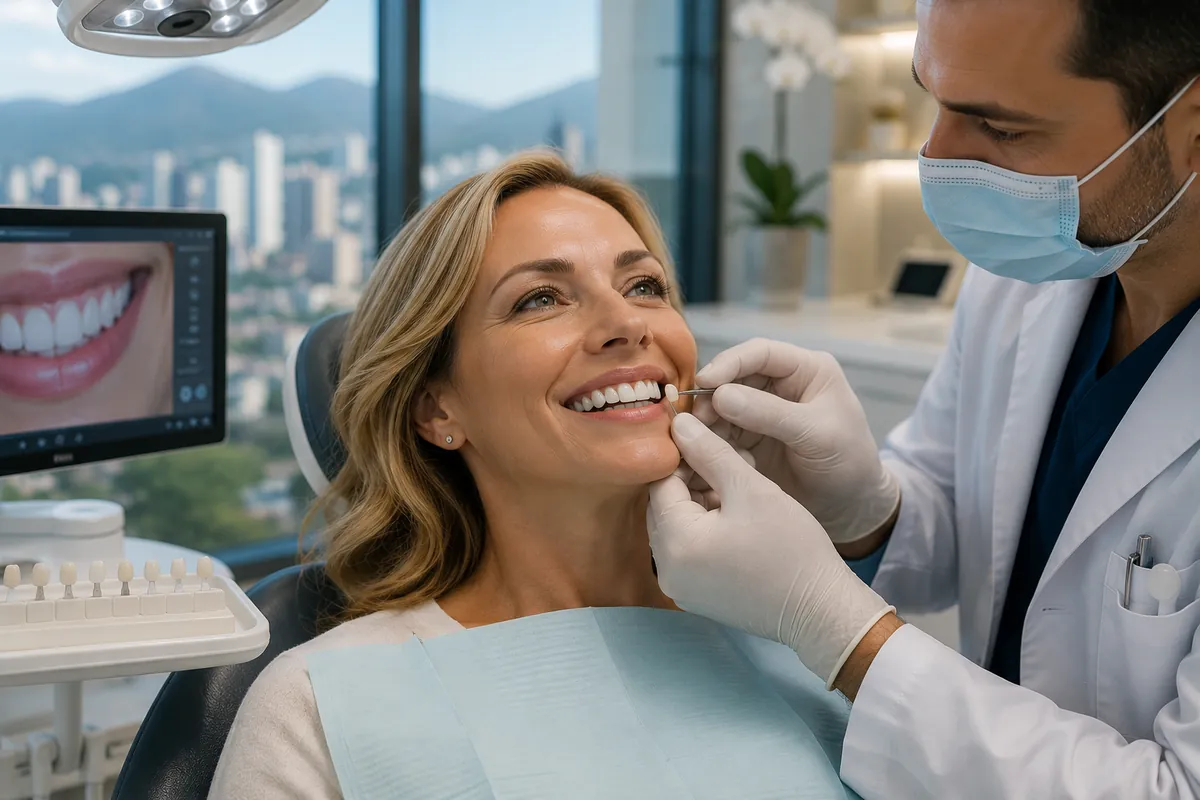
In-Office, Take-Home and Over-the-Counter: The Real Differences
Teeth whitening is not one product but a spectrum of options that differ in strength, supervision and results. Understanding where each one sits helps you choose wisely and avoid disappointment. The three broad categories are professional in-office whitening, dentist-supervised take-home trays, and over-the-counter (OTC) products you buy without a dentist.
Professional in-office whitening is the fastest and most powerful option. A board-certified dentist protects your gums and lips, applies a higher-strength hydrogen peroxide gel, and often activates it with a special light or laser. Because the concentration is controlled and the soft tissues are shielded, the dentist can use a stronger formula safely than anything sold to the public, producing a visible change in a single appointment of about an hour.
Dentist-supervised take-home trays sit in the middle. The dentist takes impressions and makes custom trays molded to your teeth, then gives you a professional-grade gel to use at home for a set number of days. Because the trays fit precisely, the gel stays on the enamel and off the gums, giving even results with less sensitivity. Many patients combine an in-office session with take-home trays for maintenance.
Over-the-counter strips, pens and toothpastes are the weakest. They use low peroxide concentrations and one-size-fits-all delivery, so results are modest, slow and sometimes uneven, and ill-fitting trays can irritate gums. They can help with mild surface stains, but they cannot match supervised treatment. To explore professional options, see our overview of cosmetic dentistry in Colombia.
What Causes Staining and Why It Matters
To set realistic expectations, it helps to understand why teeth darken in the first place. Dental staining falls into two main types, and they respond very differently to whitening. Knowing which kind you have is the first step toward the right treatment.
Extrinsic stains sit on the surface of the enamel and come mostly from what we eat and drink. Coffee, tea, red wine, dark sodas and deeply colored foods leave pigments that build up over time, and tobacco use is one of the strongest contributors. These surface stains are exactly what whitening targets best, which is why a coffee or wine drinker often sees a dramatic improvement after professional treatment.
Intrinsic stains come from within the tooth. They can be caused by aging, certain medications such as tetracycline taken in childhood, excess fluoride during tooth development, trauma to a tooth, or simply the natural color you were born with. Because the discoloration lives in the deeper dentin layer rather than on the surface, intrinsic stains respond more slowly and less completely to whitening, and sometimes barely at all.
A good cosmetic dentist examines your teeth before recommending whitening so you know what to expect. If your discoloration is mostly extrinsic, whitening is likely to delight you. If it is deeply intrinsic, the dentist will tell you honestly that another approach may serve you better, rather than selling you a treatment that cannot deliver.
Realistic Results: When Veneers Are the Better Choice
Whitening is a wonderful treatment, but honesty about its limits is what separates responsible cosmetic dentistry from marketing. The single most important thing to understand is that whitening only works on natural tooth enamel. It does not change the color of porcelain veneers, crowns, tooth-colored fillings or bonding, because those materials are not affected by peroxide.
This has a practical consequence. If you have visible crowns or fillings on your front teeth and you whiten the natural teeth around them, the dental work will suddenly look darker by comparison and may no longer match. For this reason, dentists often plan whitening before replacing old restorations, so the new work can be matched to your brighter shade.
There are also cases where whitening simply will not achieve the smile you want. Deep intrinsic stains, teeth darkened by trauma, significant chips or gaps, and old mismatched dental work are challenges that bleaching cannot fully solve. In those situations, porcelain veneers, thin custom shells bonded to the front of the teeth, are often the better long-term solution because they cover the underlying color entirely and reshape the tooth at the same time.
A trustworthy dentist will guide you toward whichever option genuinely fits your goals. If you are weighing both paths, our guide to dental veneers cost in Colombia explains when veneers make sense and what they involve, so you can make an informed decision rather than a rushed one.
Safety and Managing Sensitivity
Professional teeth whitening is considered very safe when performed or supervised by a qualified dentist. The peroxide gels used in cosmetic whitening have a long track record, and the most common side effect, temporary tooth sensitivity, is manageable and short-lived. This is precisely why dentist supervision matters more than the brand of gel.
The most frequent experience is a brief increase in sensitivity to cold or temperature in the days after treatment, along with possible minor, temporary gum irritation if gel contacts the soft tissue. These effects almost always fade within a day or two. A dentist reduces them by protecting your gums, controlling the concentration and tailoring the timing to your teeth, advantages that over-the-counter kits with their generic trays cannot match.
To keep sensitivity comfortable, dentists often recommend using a toothpaste made for sensitive teeth before and after whitening, spacing out sessions when needed, and avoiding very hot or cold foods for a short period. Patients with a lot of existing tooth decay, gum disease, exposed roots or untreated cavities should have those issues addressed first, because whitening is for healthy teeth. This is also why a proper exam beforehand is part of responsible care, and why HealthBridge works only with board-certified cosmetic dentists.
Combining Whitening With a Smile Makeover
For many international patients, whitening is not a standalone treatment but the opening step of a larger transformation. Because it is quick and affordable, it pairs naturally with other cosmetic dental work, and a thoughtful dentist sequences everything so the final result is harmonious.
A smile makeover is a coordinated plan that may combine whitening, veneers, bonding, gum contouring and replacement of old restorations to redesign the whole smile. Whitening usually comes early in the plan because it establishes the base shade of your natural teeth, allowing any veneers, crowns or fillings to be color-matched to a brighter, more youthful result rather than to dull, aged enamel.
This is one reason Medellín has become a popular destination for cosmetic dentistry. In a single trip, you can complete a professional whitening, have veneers placed if you need them, and address other small details, all under one coordinated treatment plan. Our article on the smile makeover process in Medellín walks through how these procedures fit together and what a typical timeline looks like, so you can plan your visit with realistic expectations.
Cost, Maintenance and Why Medellín
Cost is one of the clearest advantages of whitening your teeth in Colombia. Professional whitening is already one of the most affordable cosmetic dental treatments anywhere, and in Colombia it costs a fraction of typical U.S. prices while still being performed by qualified, board-certified cosmetic dentists in modern clinics. Because the procedure is quick, many patients have it done early in their stay and combine it with other treatments.
The exact price depends on whether you choose in-office whitening, custom take-home trays, or both, and your dentist will give you a clear quote after examining your teeth. HealthBridge helps you obtain transparent, itemized estimates so you understand what is included before you travel. As a facilitator rather than a clinic, we coordinate your consultation, vetting and logistics, and our medical director and coordinator, Dra. Olga Gonzalez, guides you in plain language through every step. You can learn more about how we work on the HealthBridge home page.
Whitening is not permanent, and being honest about maintenance matters. Results typically last from several months to a few years depending on your habits. Coffee, tea, red wine and tobacco gradually re-stain the enamel, so dentists recommend simple upkeep: good daily brushing, periodic touch-ups with your take-home trays, and limiting strongly colored foods and drinks. With reasonable care, a single professional treatment keeps your smile noticeably brighter for a long time.
Medellín combines skilled cosmetic dentists, modern clinics and a welcoming environment for international patients, along with a mild spring-like climate and convenient flights from many U.S. cities. For the right patient, a quick whitening, or a whitening that becomes the start of a full smile makeover, delivers world-class care and meaningful savings in a single trip.
Considering dental & veneers in Colombia?
See the procedure, pricing and the process for international patients on our Cosmetic Dentistry & Veneers.
Procedure guides: Dental Implants Colombia · All-on-4 in Colombia: Cost from $5,500 per Arch
«Veneers go onto a healthy mouth. If there is decay, gum disease or a bite problem, that gets treated first, even if it delays the cosmetic result.»

Dra. Olga González, Medical Director, HealthBridge Medical Tourism, Aesthetic Medicine Physician · Longevity & Regenerative Medicine · Health Coach in Nutrition