
Plastic Surgery
Botox Aftercare: The First 24 Hours, and Whether You Can Fly
In Medellín from $3,500 USD · 7–12 day stay Get a free quote →
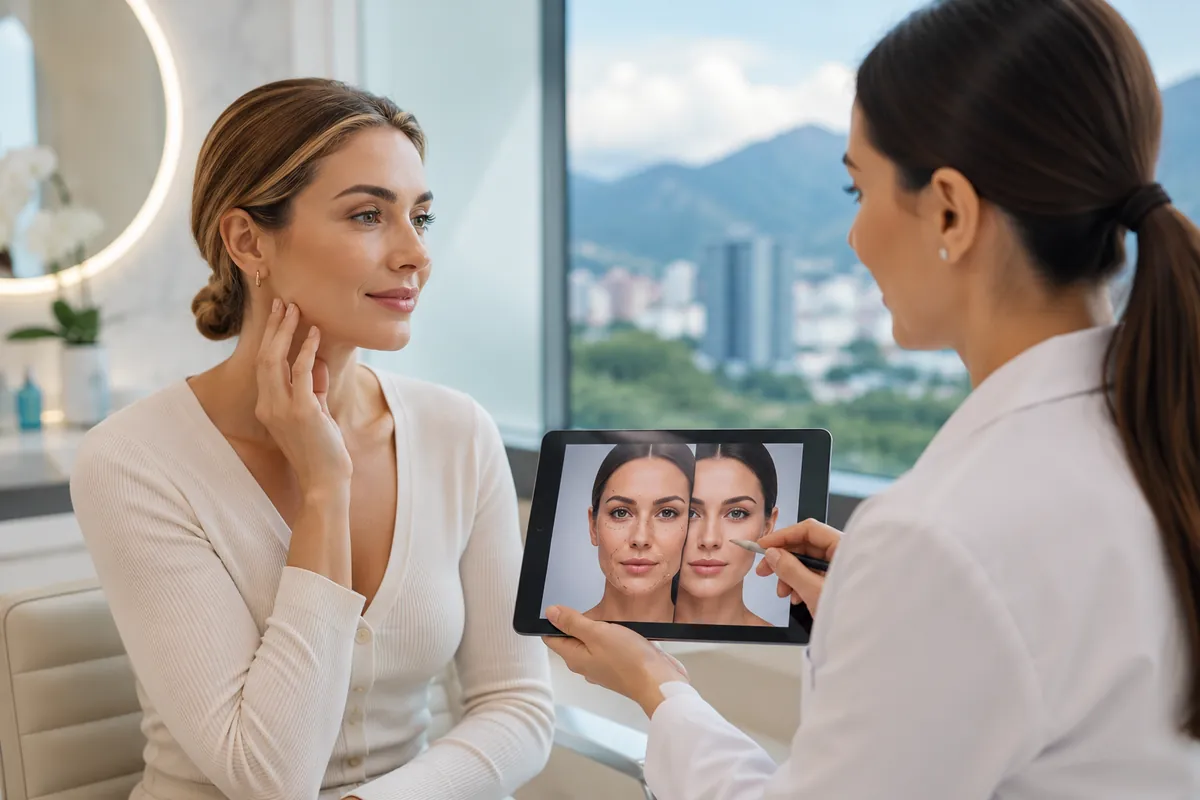
The first four hours
Two instructions are worth following carefully, and both come from the same logic: for a short period after injection, the product is still settling into the target muscle, and anything that moves it somewhere unintended is what causes the complications people worry about.
Stay upright. Avoid lying flat, bending over for long periods or putting your head down for roughly four hours. This one is precautionary rather than firmly proven, but it costs you nothing and the downside it guards against — product migrating toward the eyelid — is genuinely unpleasant.
Do not rub, press or massage the treated areas. This matters more than the upright rule. No facial, no cleansing massage, no resting your forehead on your hand at a desk, no tight hat or headband. Mechanical pressure is the plausible route by which toxin reaches a muscle it was not meant to reach.
Small raised bumps at the injection points are normal and settle within about an hour. Pinpoint bruising is common, especially around the eyes, and covers easily with makeup once a few hours have passed. You can eat, drink, work, talk and go about your day — this is not a recovery, it is a set of small precautions.
The first 24 to 48 hours
- Strenuous exercise: skip it until the next day. Raised blood flow and repeated bending are the reasons given, and while the evidence is thin, waiting one day is not a real cost.
- Heat: sauna, steam, hot yoga and sunbeds are best avoided for 24 to 48 hours, mostly because heat increases blood flow and the likelihood of bruising.
- Alcohol: worth avoiding for about 24 hours, and ideally for a day beforehand too, since it dilates vessels and makes bruising more likely.
- Sleeping: for the first night, sleep on your back if you can. Pressing your face into a pillow is the same mechanical-pressure concern as rubbing.
- Makeup: fine after a few hours, applied gently rather than rubbed in.
- Anti-inflammatories and supplements: ibuprofen, aspirin, fish oil and vitamin E all increase bruising. Where medically safe, pausing them for a couple of days before treatment does more good than anything you do afterwards. Never stop a prescribed blood thinner without asking the doctor who prescribed it.
Facials, massage, microdermabrasion, microneedling and radiofrequency should wait about two weeks. By then the toxin has bound and settled, and there is nothing left to displace.
Can you fly after Botox?
Yes. There is no evidence that cabin pressure, altitude or air travel affects botulinum toxin, and no reason to delay a flight because of a cosmetic treatment. Patients are commonly treated and fly the same day.
The nuances are practical rather than pharmacological. If you are flying within four hours of treatment, apply the same rules you would anywhere: stay reasonably upright, keep your seat from fully reclining if you are in the window seat, and do not fall asleep with your forehead pressed against the window or your face in a neck pillow. Skip the in-flight alcohol, which is the most common reason a patient turns up next morning with more bruising than expected.
Cabin air is dry, and long flights are dehydrating, which does nothing to the toxin but does make skin look flat and bruises look worse. Drink water. If you bruised at the injection points, a mineral concealer travels well and covers pinpoint marks completely.
The reverse question — flying to treatment — has one practical answer: if your face is swollen from a long flight, treatment is still fine, but the physician assessing your muscle movement is better served by a face that has slept. Where the schedule allows, being treated on day two of a trip rather than an hour after landing gives a slightly better assessment. Our aesthetic medicine travel guide covers how to lay out the days.
What is normal in the first two weeks
Knowing the ordinary course prevents a lot of unnecessary worry.
- Days 1–2: nothing. No effect at all is expected, and this is the point at which first-timers most often assume it did not work.
- Days 3–5: onset. Movement starts to soften.
- Week 1: the effect builds. A mild headache in the first days is common and settles. Some people report a heavy or tight sensation in the forehead as the muscle adapts.
- Week 2: peak. This is when to judge the result, and the correct moment to add a few units if you want a stronger effect. Adding product on day four is treating an unfinished result, and any injector who offers to do so is not following the pharmacology.
Small asymmetries at day five that even out by day fourteen are common, because muscles do not all respond at exactly the same rate. Our article on Botox side effects covers what falls outside normal, and our guide to how long Botox lasts covers the other end of the curve.
When to actually contact your physician
Most of what happens after treatment needs no action. A few things do.
Contact your treating physician if you develop a drooping eyelid or eyebrow, double or blurred vision, an asymmetry that is worsening rather than settling, or signs of infection at an injection site — spreading redness, heat, or fever. Eyelid droop from a cosmetic dose is temporary and resolves as the toxin wears off, and prescription eye drops can partly compensate in the meantime, but it should be assessed rather than waited out in silence.
Seek urgent medical care — not a message to the clinic — for difficulty swallowing, difficulty breathing, generalized muscle weakness or slurred speech. These are very rare with cosmetic doses and are the reason dose and placement are a medical decision rather than a beauty service.
If you were treated abroad, this is worth arranging before you fly rather than after. At HealthBridge you leave with the treating physician's contact, the product used and the units placed, and follow-up runs over WhatsApp and video consultation — which is what makes a concern at day ten answerable rather than a source of anxiety. Our guide to choosing a facilitator treats aftercare access as one of the things to verify before booking, not after.
Timing treatment around an event or a trip
Because the effect peaks at two weeks, the planning rule is simple: treat two to three weeks before anything that matters. That gives the result time to reach full effect, leaves room for a small adjustment at the two-week review, and puts any bruising well in the past.
Treating three days before a wedding is the classic mistake. You will still be in the build-up phase, any bruise will still be visible, and there is no time to adjust anything. If you have left it late, the honest advice is usually to wait until after the event rather than rush it.
For a combined aesthetic trip, sequence matters more than duration. Toxin has no downtime and fits anywhere, including departure day. Filler swells for a few days and belongs early in the trip — our guide to choosing between the two covers why. Biostimulators are the least sensitive to timing since the result develops over months.
And if you are treated in Medellín and live abroad, plan the review deliberately: two weeks after treatment you will be home, so agree in advance how photographs and the video consultation will happen, and whether an adjustment belongs in this trip or the next. Getting that agreement in writing before you fly is the single most useful thing you can do — a point our medical tourism from the USA page returns to for every specialty, not just this one.
Considering plastic surgery in Colombia?
See the procedure, pricing and the process for international patients on our Plastic Surgery & Aesthetic Medicine.
Procedure guides: BBL in Colombia · Mommy Makeover in Colombia · Liposuction & Liposculpture in Colombia from $3,500
«Candidacy is decided by the surgeon in consultation, not by a catalogue or a quote. My job is to make sure that consultation actually happens, with imaging and history on the table, before the patient books a flight.»

Dra. Olga González, Medical Director, HealthBridge Medical Tourism, Aesthetic Medicine Physician · Longevity & Regenerative Medicine · Health Coach in Nutrition