
Plastic Surgery
How Medical Tourism Works, Step by Step
In Medellín from $3,500 USD · 7–12 day stay Get a free quote →
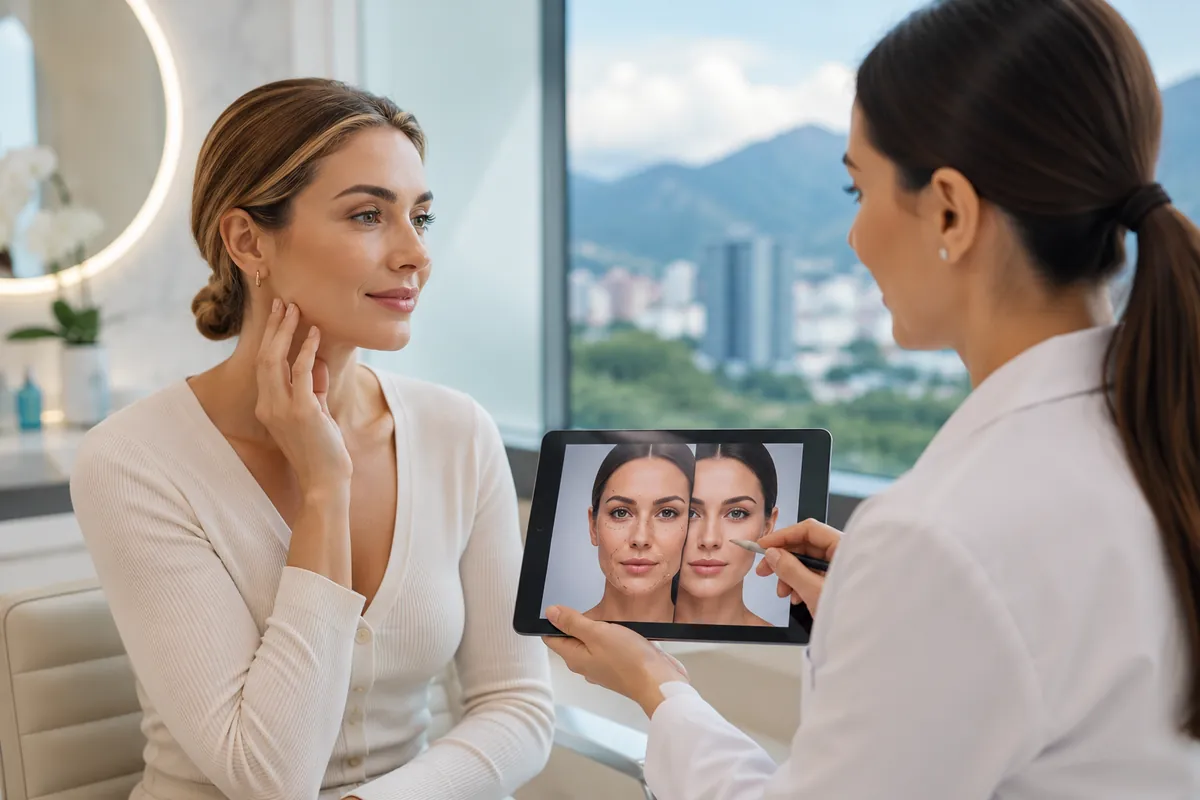
Step 1 — Deciding whether travelling makes sense at all
The first question is not where to go, it is whether to go. Medical travel works well for planned, elective procedures with a predictable course: dental work, bariatric surgery, joint replacement, refractive eye surgery, fertility treatment, aesthetic surgery and injectables, and regenerative protocols. It works badly for anything urgent, anything whose diagnosis is still uncertain, and anything requiring close, frequent monitoring for months afterward.
Two personal factors matter as much as the procedure. Uncontrolled medical conditions — poorly managed diabetes, untreated sleep apnea, uncontrolled hypertension, active smoking before a surgery involving healing — change the risk calculation, and a serious clinic will require they be addressed before scheduling rather than after. And your support at home matters: who collects you from the airport, who is there in the first week back, and whether you can take the time off you actually need rather than the minimum.
Be honest about the saving too. It is genuinely large in bariatric surgery, dental work, orthopaedics, injectables and regenerative medicine. In cosmetic surgery it is narrower than the industry advertises, because the U.S. figures usually quoted are surgeon's fees only while a Colombian quote is an all-inclusive package — a distinction we set out on our about page. If the arithmetic does not work for your case, that is a legitimate outcome of step one.
Step 2 — Getting a quote that is actually a quote
A number in a WhatsApp message is not a quote. A quote you can rely on names, in writing:
- The specific procedure, including technique and, where relevant, implant or product brand and quantity.
- The surgeon or treating physician by name, with their specialty registration, and the facility where it will be performed.
- What is included: surgeon's fee, anaesthesia, operating room, implants or devices, hospital stay, post-op garments or medication, transfers, nights of accommodation, interpreter.
- What is not included — the part most people forget to ask about. Pre-operative labs, imaging, an extra hospital night if needed, medication at home, flights, and the cost of a revision if one is required.
- The conditions: what happens if you are found unfit at the pre-op assessment, what the deposit covers, and the cancellation terms.
Ask for the quote as a document. A provider that will not put its own numbers in writing is telling you something useful. For treatments priced by product — injectables in particular — insist the quote states units and brand, as our units guide explains.
Step 3 — Records, clearance and the medical back-and-forth
Before dates are set, the treating specialist should review your case remotely. Expect to send recent medical records, current medication list, allergies, previous surgeries, relevant imaging and, for aesthetic or dental work, photographs taken to specification. For bariatric and orthopaedic cases, expect questions about weight history, mobility and comorbidities rather than a straight yes.
This stage is a genuine filter and you should want it to be. A programme that accepts you without seeing anything is not screening — it is booking. It is also normal at this point to be told that you need something done first: dental clearance, better blood-sugar control, stopping smoking for a defined period, or a cardiology opinion. Those requirements are a good sign.
Pre-operative laboratory tests and imaging are usually done on arrival, one or two days before surgery, because most are time-limited. Some can be done at home and sent ahead, which shortens the trip. Ask which, because it changes the number of nights you need to book. Our guide to choosing a surgeon covers what credentials to verify while this exchange is happening.
Step 4 — Money: deposits, balances and what not to do
How money moves is where the biggest avoidable mistakes happen.
A deposit to hold a date is normal. It is usually a modest percentage, it should be documented, and the terms — what happens if you cancel, if you are found unfit, if the clinic reschedules — should be written down before you send anything.
Paying the full amount in advance by international wire is not normal, and you should not do it. The standard sequence is a deposit to secure the date and the balance after the in-person consultation confirms the plan, paid at the clinic. That sequence protects the thing that matters most: your ability to walk away if the assessment on arrival changes the plan or your mind.
Other practical points. Ask which currency and which payment methods are accepted, and whether card payment carries a surcharge. Ask whether the quoted price is fixed or an estimate, and what would make it change. Keep every receipt — if you ever claim on travel insurance, or need a second opinion at home, the paperwork is what makes your case legible to another physician.
And treat a price that is dramatically below everyone else's as information rather than an opportunity. In medicine, the components have real costs; a number far under the market usually means something has been removed from it, and the honest question is what.
Step 5 — Dates, flights and how long to stay
Here is the rule that trips up most first-time medical travellers: the length of the trip is set by your flying window, not by your procedure. The surgery may take two hours; when you are cleared to sit on a plane is what determines the return date.
As a rough guide, injectables and most dental work impose no restriction at all. Refractive eye surgery needs a short window. Abdominal and body-contouring surgery, bariatric surgery and joint replacement need a longer one, because of the risk of clots on a long flight and the need for at least one post-operative review before you leave. Our guide to when you can fly after surgery gives the ranges by procedure type.
Book flights that are changeable, and build in a buffer. A single extra night for an unexpected review is far cheaper than rebooking a non-refundable ticket. Where accommodation is concerned, decide early between a hotel and a recovery house — for body surgery, the latter provides nursing support, meals and massages that a hotel does not.
Consider travel insurance carefully, and read what it excludes. Standard travel policies frequently exclude complications of elective procedures performed abroad, which is precisely the risk you would want covered. If a policy does cover it, keep the documentation with you.
Step 6 — Arrival, consultation and the right to change your mind
The typical shape on the ground: arrival and settling, pre-operative labs and imaging, then the in-person consultation with the specialist who will treat you. This is not a formality. It is the moment the plan is confirmed against what the surgeon actually sees and feels, and it is normal for it to be modified — a different technique, a staged approach, or a recommendation to do less than you asked for.
Two things are worth saying clearly. First, you can still say no. Being in another country does not oblige you to proceed, and a clinic that reacts badly to a patient who wants to pause has told you something important. Second, a surgeon who talks you out of something is doing their job. The most common way patients get hurt in medical travel is not by bad technique — it is by having too much done in one session because it was efficient for the trip.
Ask, at this consultation, three practical questions: who will be in the operating room, what the plan is if you need an extra night, and how you contact the treating physician directly after you leave. Write the answers down. Our guide to choosing a facilitator explains why those three answers predict the rest of the experience.
Step 7 — Treatment, recovery and the flight home
Treatment day itself is usually the least eventful part of the process, precisely because everything has been decided in advance. What follows depends entirely on the procedure: same-day discharge for injectables and most dental work, one or more nights for surgery, and a defined number of days of local recovery before you are cleared to fly.
During the recovery window in Medellín, the useful things are unglamorous: walking early and often to reduce clot risk, following compression and wound-care instructions exactly, eating and drinking properly, and attending every scheduled review rather than the ones that feel necessary. Our recovery timeline sets out what is normal week by week for body surgery.
Before you fly, you should leave with a package of documents, and this is worth insisting on: the operative report or treatment record, the implants or products used with their references, medication prescribed, wound-care instructions, the schedule of follow-ups, and direct contact details for the treating physician. That file is what allows any doctor at home to understand what was done. Travelling home without it is the single most common regret patients describe.
Step 8 — Follow-up at home, and if something goes wrong
Follow-up is the stage most programmes describe least well, which is why it deserves to be agreed before you travel. A reasonable standard is scheduled remote reviews with the treating physician — photographs plus a video consultation — at intervals that match the procedure, plus an open channel for questions in between.
Ask explicitly: what happens if there is a complication once I am home? A serious answer covers three things: who you contact first and how fast they respond; who provides local care if you need to be seen physically, and how the treating specialist coordinates with them; and what the policy is on revision — whether a returning patient pays surgeon's fees again, facility costs only, or nothing, and who pays for the flight.
None of those answers has to be generous to be acceptable. What matters is that they exist and are written down before you commit. A programme that has never been asked will improvise, and improvisation at that moment is worth avoiding.
If you want to see what this looks like end to end for your own origin country, our pages on medical tourism from the USA, from Canada and from Central America cover flights, entry rules and the specialties patients most commonly travel for. And for the question underneath all of this, our article on whether medical tourism is safe gives the honest version rather than the reassuring one.
Considering plastic surgery in Colombia?
See the procedure, pricing and the process for international patients on our Plastic Surgery & Aesthetic Medicine.
Procedure guides: BBL in Colombia · Mommy Makeover in Colombia · Liposuction & Liposculpture in Colombia from $3,500
«When choosing where to have surgery, look at who answers if something goes wrong. A low price with no complication plan and no included follow-up is not a saving, it is risk transferred to the patient.»

Dra. Olga González, Medical Director, HealthBridge Medical Tourism, Aesthetic Medicine Physician · Longevity & Regenerative Medicine · Health Coach in Nutrition